🏞️ Tyrannosaurus rex
🌍 What It Was
The Tyrannosaurus rex, often referred to as T. rex, was a colossal dinosaur that roamed the Earth millions of years ago. It was one of the largest land carnivores that ever existed, making it highly distinctive among prehistoric animals.
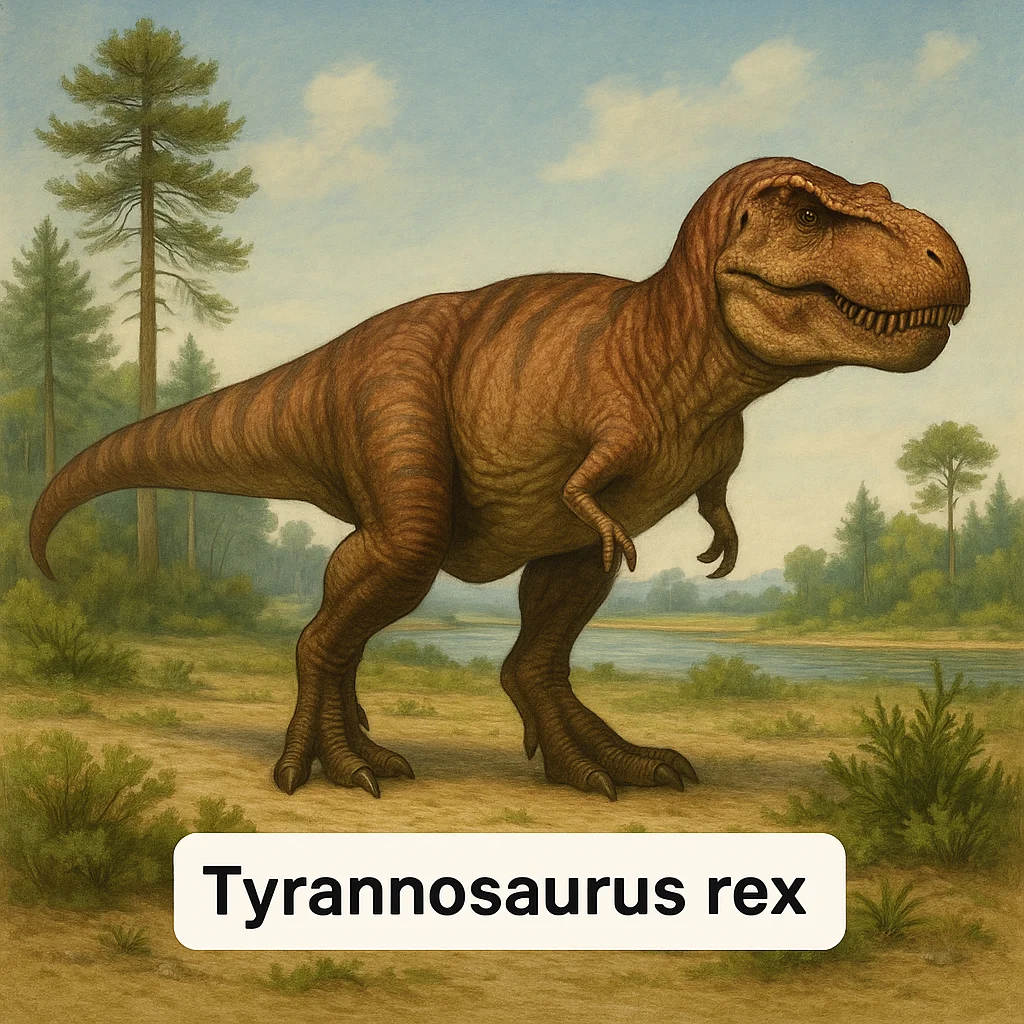
Belonging to the theropod group, T. rex was closely related to modern birds, as well as other dinosaurs like the Allosaurus and Velociraptor. Its massive jaws and powerful legs made it a formidable predator of its time.
This article delves into key aspects of the Tyrannosaurus rex: its habitat and lifestyle, physical characteristics, the circumstances surrounding its disappearance, and how its extinction is understood today.
🧭 Where It Lived
The Tyrannosaurus rex primarily lived in what is now North America. Fossil evidence suggests it inhabited areas that are part of the USA and Canada today, especially in regions that were once covered by lush forests and river valleys.
The habitats T. rex thrived in included a mix of forests and open plains. These ecosystems supported an abundance of diverse plant and animal life, offering T. rex ample hunting opportunities for large herbivores like triceratops.
Due to its widespread presence across the continent, T. rex was not limited to islands or highly localized areas. This extensive range slightly buffered the species from immediate localized extinctions that often threaten island species.
🌿 Habitat and Daily Life
The climate during the time of T. rex was generally warm with a subtropical feel, featuring distinct wet and dry seasons. These conditions supported diverse ecosystems where plant growth was vigorous, sustaining various herbivorous dinosaurs.
T. rex had a primarily carnivorous diet, preying on large dinosaurs and possibly scavenging on carrion. Its powerful bite and keen sense of smell aided its hunting endeavors, positioning it as an apex predator.
Little is confirmed about the Tyrannosaurus rex's social structure, but some evidence hints at possible solitary hunting patterns. The reproduction process likely involved laying eggs, similar to modern reptiles, with young T. rex relying on several survival strategies to reach adulthood.
🧬 What Made It Unique
The Tyrannosaurus rex was massive, often reaching lengths of up to 40 feet and towering at nearly 12 feet tall at the hips. Its most recognizable feature was its immensely powerful jaw, filled with large sharp teeth capable of crushing bone with great force.
Adaptations such as its keen sense of smell allowed T. rex to track prey over long distances. Its stout body and strong legs enabled it to cover substantial ground quickly, although its exact speed remains debated among paleontologists.
As one of the most iconic dinosaurs, T. rex has captured human imagination for centuries, often symbolizing the might and mystery of prehistoric life without any direct cultural significance during its existence.
⏳ When It Disappeared
The Tyrannosaurus rex went extinct approximately 66 million years ago at the end of the Cretaceous Period. Its disappearance coincided with a mass extinction event believed to be caused by a combination of asteroid impact and volcanic activity.
This event marked the end of the Cretaceous and the beginning of the Paleogene, wiping out about three-quarters of Earth's plant and animal species. The last confirmed records of T. rex are fossil evidence dated to this period.
In paleontology, declaring a species extinct typically relies on a thorough absence of evidence in the fossil record beyond a certain geological layer, as is the case for T. rex.
⚠️ Why It Went Extinct
The extinction of the Tyrannosaurus rex was primarily driven by dramatic climate shifts and catastrophic events, like the asteroid impact near present-day Mexico, which likely triggered global wildfires and tsunamis.
This impact also caused prolonged darkness, cooling temperatures, and impeded photosynthesis, leading to a collapse in food chains. The associated shift in climate contributed to habitat loss and fragmentation across the globe.
While T. rex wasn't directly overhunted, the multi-causal extinction event profoundly altered its environment, reducing viable habitats and decimating its prey base, proving too challenging for the species to adapt rapidly enough.
🧩 How We Know (Evidence and Records)
Our understanding of the Tyrannosaurus rex comes from its well-preserved fossils found across various sedimentary rock formations in North America. These fossils have provided insights into its anatomy and have been crucial in reconstructing its ecological role.
Scientists use radiometric dating of these fossils to confirm their age, ensuring they correlate with the late Cretaceous Period. Additionally, comparisons with other fossilized species help validate the timeline of T. rex's existence.
Although no direct human accounts exist, the abundance of fossil evidence allows researchers to make educated conclusions about its life and eventual extinction, illustrating the importance of paleontological studies.
🛡️ Could It Have Been Saved
Given that the main drivers of T. rex's extinction were natural cataclysms, conservation actions like those employed today would not have been applicable. Without modern technological advancements, predicting or mitigating asteroid impacts was impossible.
Conceptual conservation strategies such as habitat protection or controlling climate influence were beyond reach in the prehistoric context. While modern-day conservation has tools to prevent certain extinctions, the conditions that led to the demise of T. rex rendered it unavoidable.
It is important to note that while direct action could not have saved T. rex, understanding past extinction events helps in preparing for and potentially mitigating future biodiversity crises.
🔁 Are There Any Survivors or Close Relatives Today
The closest living relatives of the Tyrannosaurus rex are birds, particularly those that fall under the category of theropods. Birds are direct descendants of certain theropod dinosaurs, sharing common traits like hollow bones.
While no exact ecological replacement for T. rex exists today, apex predator roles are occupied by several large land mammals, such as lions and bears, which similarly shape their environments by controlling prey populations.
There are no reintroduction or captive programs concerning T. rex, as it is a species long extinct with no feasible means of revival, though its legacy continues in scientific research and public fascination.
❓ Common Questions and Misconceptions
Was it hunted to extinction? No, it disappeared due to natural catastrophes that altered the environment drastically.
Why didn’t it adapt or move? The speed and scale of environmental changes were too rapid and widespread for adaptation.
Could it still be alive somewhere? Highly unlikely, as no evidence suggests the existence of T. rex beyond the Cretaceous Period.
What does 'declared extinct' actually mean? It means all members of the species are gone, with no known survivors.
What is the difference between endangered and extinct? Endangered species still exist but face a high risk of extinction, whereas extinct species have no living members.
Why are island species so vulnerable? Island species often have limited ranges and isolated environments, making them more susceptible to changes and threats.
📌 Summary
- It was a large theropod dinosaur, an apex predator.
- Lived across North America during the late Cretaceous.
- Inhabited forests, plains, and river valleys.
- Fed on large herbivores, possibly scavenging as well.
- Had unique adaptations like powerful jaws and keen senses.
- Last known period alive was about 66 million years ago.
- Went extinct due to climate shifts and an asteroid impact.
- Evidence from well-preserved fossils in sedimentary rocks.
- Birds are its closest living relatives.
- Teaches the lesson of ecosystem sensitivity to cataclysmic events.
- A memorable takeaway is its iconic status in both science and popular culture.