🏞️ Triceratops
🌍 What It Was
The Triceratops was a genus of herbivorous dinosaurs that roamed the earth during the late Cretaceous period, around 68 to 66 million years ago. Known for its massive build and three prominent facial horns, the Triceratops is one of the most recognizable dinosaurs.
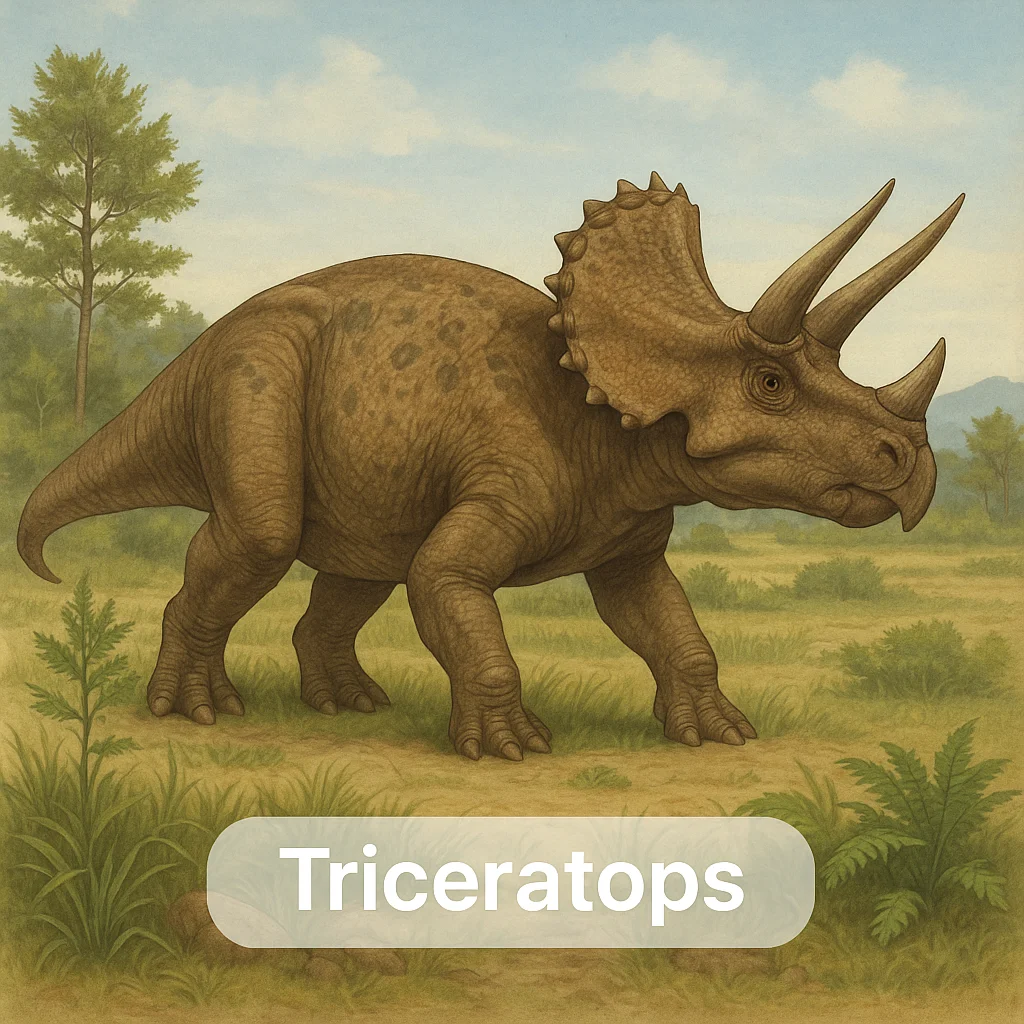
These prehistoric creatures are part of the Ceratopsidae family, characterized by large skulls with frills and horn arrangements. A distant relative of today’s birds, Triceratops shared its habitat with other iconic dinosaurs such as the Tyrannosaurus rex.
Throughout this article, you will learn about where the Triceratops lived, how it survived daily, and theories about how it eventually disappeared from the earth.
🧭 Where It Lived
The Triceratops called what is now North America home. Its fossils have been predominantly found in the Western United States and Canada, from states like Montana to Alberta. This area was known as Laramidia, a landmass that existed due to a shallow sea splitting North America in two.
The environment in which Triceratops thrived was diverse, ranging from subtropical forests to river valleys and floodplains. These regions provided abundant vegetation that was crucial for the dinosaur's survival.
Though not island-confined, Triceratops’ geographical distribution still left it vulnerable to environmental changes and habitat pressures which played a role in its extinction journey.
🌿 Habitat and Daily Life
The climate during the late Cretaceous was warmer and more humid compared to today. Seasons were likely defined by wet and dry periods rather than temperature fluctuations. This climate supported lush plant growth, essential for the herbivore's diet.
Triceratops were herbivores, feeding primarily on low-growing vegetation like ferns and shrubs. Their beaks and strong teeth allowed them to process fibrous plants effectively. Social animals, Triceratops likely lived in herds for protection against predators.
Reproducing much like modern birds, Triceratops would lay eggs, and juvenile dinosaurs would rely on herd protection. This species coexisted with predators such as the Tyrannosaurus rex, providing a constant challenge for survival.
🧬 What Made It Unique
Triceratops is most recognizable for its three facial horns and large bony frill at the back of its skull. These features likely served multiple purposes, including defense against predators, mating displays, and thermoregulation.
As a quadruped, Triceratops' sturdy legs supported its heavy body. It is estimated to have been up to 30 feet long and 10 feet tall, making it one of the larger herbivores of its time. Its horns and frill also contributed to its defensive capabilities.
⏳ When It Disappeared
The Triceratops' extinction coincides with the mass extinction event that ended the Cretaceous period around 66 million years ago. This event wiped out a significant portion of the earth's species, including all non-avian dinosaurs.
While no exact last sighting is documented, the lack of fossil evidence beyond this period supports the timeline for their disappearance. Extinction declarations rely heavily on fossil records, and Triceratops is considered fully extinct.
⚠️ Why It Went Extinct
The most accepted theory for Triceratops' extinction aligns with the mass extinction event, often attributed to a massive asteroid impact. This event would have led to drastic climate shifts, severely affecting food availability.
With its environment rapidly changing, the habitat loss and fragmentation caused by the event would have made survival increasingly difficult for herbivores like Triceratops.
Additionally, the intense competition for resources and increased predation pressure during these challenging times probably contributed to the extinction of this majestic dinosaur.
🧩 How We Know (Evidence and Records)
Our understanding of Triceratops comes from extensive fossil records. Paleontologists have unearthed numerous well-preserved skeletons, providing insights into their physiology and lifestyle.
Careful examination of these fossils allows scientists to date them accurately and place them in the correct historical context. Verification includes comparing fossils with known specimens and using modern techniques like radiometric dating.
Some species are difficult to verify due to sparse records, but Triceratops stands out due to the abundance and quality of its fossil evidence.
🛡️ Could It Have Been Saved
Although modern conservation practices could not have been applied to the ancient past, hypothetical protective measures might have included preserving their vast habitats or managing the ecosystems to reduce predator pressure.
Such actions were not feasible or possible for a dinosaur, demonstrating how significant and abrupt changes in the earth's system can overwhelm even the most well-adapted species.
While there were no conservation attempts in prehistoric times, modern parallels can be drawn for efforts to protect today’s endangered species before they reach a point of no return.
🔁 Are There Any Survivors or Close Relatives Today
Birds are considered the closest living relatives to dinosaurs, including the Triceratops. Though they do not share direct features like horns, their evolutionary lineage connects back to these prehistoric giants.
Modern ecological roles once filled by dinosaurs have been assumed by large herbivores like elephants that maintain vegetation and affect ecosystem structures similarly to how Triceratops might have done in its time.
❓ Common Questions and Misconceptions
Was it hunted to extinction? No, Triceratops were not hunted by humans as they existed millions of years before humans.
Why didn’t it adapt or move? The rapid environmental changes likely outpaced their ability to adapt or migrate to suitable habitats.
Could it still be alive somewhere? No evidence supports that Triceratops survived the mass extinction event that ended the Cretaceous period.
What does 'declared extinct' actually mean? It means there is no reasonable doubt that the species has no surviving individuals in the wild or captivity.
What is the difference between endangered and extinct? Endangered species are at risk of extinction, while extinct species have no surviving members.
Why are island species so vulnerable? Island species often face limited resources and space, making them more susceptible to extinction forces.
📌 Summary
- The Triceratops was a large herbivorous dinosaur known for its distinctive horns and frill.
- It lived in North America, primarily in regions that were once part of the landmass Laramidia.
- The habitat comprised subtropical forests, river valleys, and floodplains.
- Its diet included low-growing vegetation like ferns, processed by strong jaws and teeth.
- Recognizable for its three facial horns, used for defense and mating rituals.
- Lived until the mass extinction event around 66 million years ago.
- Main extinction drivers included habitat loss and a dramatic climate shift from an asteroid impact.
- Fossil records provide a critical understanding and confirmation of its existence.
- Closest living relatives are birds, which evolved from the same dinosaur lineage.
- Triceratops demonstrate the profound impact of sudden environmental changes on species survival.
- Serves as a reminder of the importance of habitat protection and understanding ecological roles.
- A remarkable creature of its time, known for its unique horns and frill features.