🏞️ Plesiosaurus (Plesiosaur)
🌍 What It Was
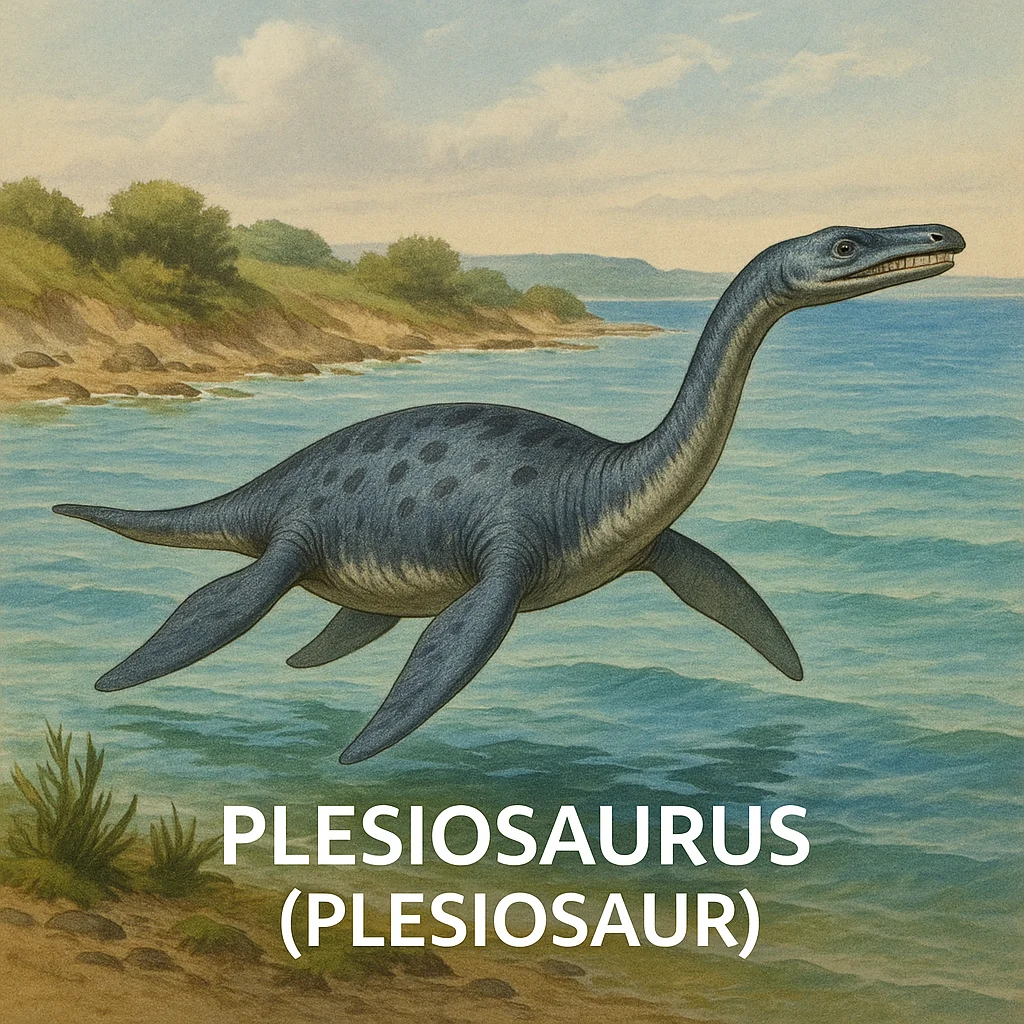
The Plesiosaurus, often simply called plesiosaur, was a marine reptile that thrived during the early Jurassic period. Known for its distinctive long neck and small head, this creature is often depicted in popular culture as resembling the mythical Loch Ness monster. What set it apart from other marine reptiles of its time was its unique body shape, which included a broad body and four powerful flippers.
Unlike dinosaurs, which are land-dwelling, the Plesiosaurus lived in the oceans, making it an entirely different kind of reptile. It shared the seas with other large marine predators and preyed predominantly on fish and other small sea creatures. The closest living relatives of the Plesiosaurus are probably today's modern reptiles, though its exact lineage branched off quite differently.
In this article, you will learn about where the Plesiosaurus lived, its lifestyle, when it became extinct, and the likely reasons behind its disappearance. We'll explore its adaptations for marine life and consider what its extinction can teach us about conservation today.
🧭 Where It Lived
The Plesiosaurus predominantly lived in the shallow seas that covered much of what is now Europe during the Jurassic period. Fossil evidence suggests it likely inhabited marine environments that featured clear, warm waters, which were rich in fish and other small marine organisms.
This creature did not dwell in the deep open ocean but rather stayed close to continental shelves where it could easily find food and suitable conditions for survival. Fossil remains have been discovered in regions that include what are now the United Kingdom, Germany, and parts of France.
These oceanic habitats were crucial for the Plesiosaurus, providing the necessary resources to thrive. However, because it occupied a relatively narrow ecological niche, changes in these environments could have had significant impacts on its survival, putting it at risk of extinction as the seas shifted and climate changes occurred over millennia.
🌿 Habitat and Daily Life
During the Jurassic period, the climate was generally warm with no polar ice caps, which meant higher sea levels and more extensive marine environments for the Plesiosaurus. It likely experienced seasonal changes, though probably less extreme than what we see today.
The Plesiosaurus was a carnivorous predator that used its sharp teeth to catch fish, squid, and other marine life. Its long neck may have allowed it to stealthily approach prey or snatch prey in a swift lateral movement. Paddling with its large flippers, it had the agility needed to hunt effectively in its aquatic surroundings.
Reproductively, the Plesiosaurus gave birth to live young rather than laying eggs, a trait that suggests it did not need to return to land at any stage of its reproductive cycle. This mode of reproduction is similar to some modern marine reptiles like sea snakes. Young plesiosaurs may have been relatively independent, though they likely remained in shallower waters for safety from larger predators.
🧬 What Made It Unique
The most notable feature of the Plesiosaurus was its long neck, which made up nearly half of its total length. This adaptation is believed to have helped it surprise prey from a distance. In addition to its neck, the Plesiosaurus had a compact body with four large flippers, reflecting its adaptation to a completely aquatic lifestyle.
These flippers were excellent for swimming, propelling the reptile through water in a manner similar to how modern penguins swim. Although the Plesiosaurus did not have the size advantage of some of its marine contemporaries, its unique physical traits marked it as an efficient marine predator of its time.
Culturally, the Plesiosaurus has intrigued people since its fossils were first discovered, sparking imaginations with the possibility of sea monsters. This fascination continues to fuel significant interest in paleontology and marine biology.
⏳ When It Disappeared
The Plesiosaurus became extinct around the end of the Cretaceous period, roughly 66 million years ago. This extinction event is noted for being one of the most significant in Earth's history, often attributed to a dramatic change in climate and ecosystems worldwide.
Precise timelines of its extinction are difficult to pinpoint. However, evidence suggests that the Plesiosaurus did not survive the myriad environmental changes that occurred during this time, which also saw the extinction of non-avian dinosaurs.
While the term "extinction" describes the complete loss of a species, "extinct in the wild" refers to species that survive only in captivity. The Plesiosaurus falls into the former category, with no living specimens surviving in captivity or otherwise.
⚠️ Why It Went Extinct
The extinction of the Plesiosaurus, like that of many prehistoric animals, was likely due to multiple factors. Habitat loss and fragmentation played a significant role, as changing sea levels and climates altered the marine environments on which it depended.
Furthermore, shifts in global climates could have led to changes in the distribution and abundance of prey species, making it difficult for the Plesiosaurus to sustain its populations. While over-fishing or hunting by other marine creatures may have contributed to its decline, evidence for specific interactions is harder to come by.
Other external factors, such as increased volcanic activity and the impact of a large asteroid that is believed to have struck Earth, likely caused or aggravated worldwide climatic changes that ultimately spelled the end for Plesiosaurus and many other species.
🧩 How We Know (Evidence and Records)
The primary evidence for the existence and extinction of the Plesiosaurus comes from fossils. These fossils are well-preserved in sedimentary rocks, allowing scientists to study their structure and relate them to modern species.
Paleontologists use various methods, such as radiometric dating, to determine the ages of these fossils and to verify the period during which the Plesiosaurus existed. The size, shape, and location of the fossils help scientists to piece together the lifestyle and habitat of this extinct marine reptile.
Additionally, research into similar marine ecosystems provides context for how the Plesiosaurus might have lived and interacted with its environment. However, some aspects of its life remain speculative due to the limitations of available evidence.
🛡️ Could It Have Been Saved
Given the magnitude and global nature of the extinction event that wiped out the Plesiosaurus, it is unlikely that any specific conservation efforts could have saved it. The drastic environmental changes were beyond the capacity of any one species or group to avert.
However, had the environmental degradation been localized or less severe, protective measures such as habitat preservation might have slowed its decline. Marine reserves to maintain critical habitats could have supported its prey, indirectly benefiting the Plesiosaurus.
Conservation action often comes too late, as the full extent of a species' decline is not recognized until populations have dwindled substantially. In the case of ancient species like the Plesiosaurus, rapid environmental changes likely outpaced many organisms' ability to adapt or move to viable new habitats.
🔁 Are There Any Survivors or Close Relatives Today
The closest living relatives of the Plesiosaurus are other reptiles, although its particular lineage has no direct modern descendant. Modern marine reptiles, such as sea turtles and marine iguanas, share similar aquatic adaptations but are not directly descended from plesiosaurs.
While none of these animals play an identical ecological role to the Plesiosaurus, many adapted to fill various niches in today’s oceans. These replacements illustrate the adaptive nature of life, showing how ecosystems can rebalance over time.
No reintroduction or captive breeding programs exist for the Plesiosaurus, as its extinction precedes human history. Instead, its legacy continues in scientific study and the cultural fascination with prehistoric marine life.
❓ Common Questions and Misconceptions
Was it hunted to extinction? No, hunting by humans was not a factor in its extinction as humans were not present at the time.
Why didn’t it adapt or move? Rapid environmental changes often outpace an organism's ability to adapt or find new habitats.
Could it still be alive somewhere? No evidence suggests that Plesiosaurus survived past the Cretaceous period.
What does "declared extinct" actually mean? It means that there are no known living individuals remaining, either in the wild or captivity.
What is the difference between endangered and extinct? Endangered species still have living individuals but are at high risk of extinction, whereas extinct species have no surviving members.
Why are island species so vulnerable? Limited resources and restricted habitats make island species particularly susceptible to environmental changes.
📌 Summary
- Plesiosaurus was a marine reptile known for its long neck and flippers.
- It lived in shallow seas, primarily around current-day Europe.
- Its habitat consisted of warm, marine environments rich in fish.
- It was a carnivorous predator, feeding on fish and small marine creatures.
- Plesiosaurus had unique adaptations for efficient swimming in aquatic environments.
- It likely went extinct around the end of the Cretaceous period.
- Main extinction drivers included global climate shifts and habitat changes.
- Fossils provide the primary evidence of its existence and extinction.
- Modern reptiles are its closest living relatives, though not direct descendants.
- Conservation teaches the importance of understanding and protecting diverse habitats.
- Plesiosaurus remains an icon of marine prehistoric life, intriguing researchers and the public.