🏞️ Brachiosaurus
🌍 What It Was
Brachiosaurus was a genus of large, herbivorous dinosaurs that lived during the Late Jurassic period, which was about 150 million years ago. It is one of the most iconic dinosaurs due to its enormous size and distinctive long neck, which allowed it to reach high vegetation in trees.
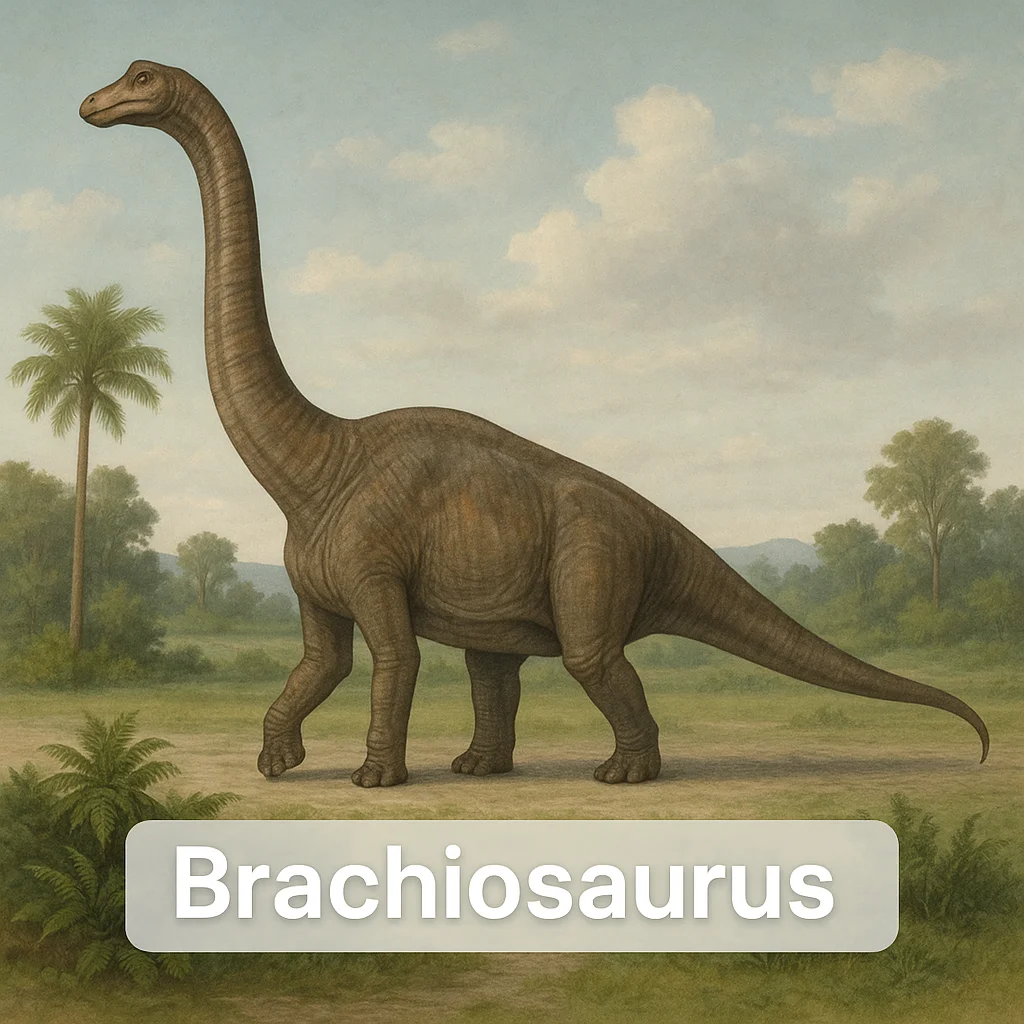
The Brachiosaurus is part of the sauropod family, a group of long-necked dinosaurs. They are distantly related to modern birds and crocodilians, their only surviving relatives. Its ecological role included being a browser of tall trees, which helped shape the prehistoric plant life around it.
In this article, we will explore the Brachiosaurus's habitat and diet, its unique traits and behaviors, when it went extinct, and why. Readers will gain an understanding of this fascinating creature and the factors leading to its disappearance from Earth.
🧭 Where It Lived
Brachiosaurus inhabited regions that are today known as North America and Africa. During its time, these continents had not yet drifted apart and were located much closer to the equator, providing warm and humid climates ideal for thriving forests and floodplains.
The preferred habitat of Brachiosaurus was likely the lush, riverine forests and floodplains where fern-like plants and tall coniferous trees grew abundantly. These environments offered plenty of vegetation for browsing and water sources to sustain its massive size.
While Brachiosaurus was not an island-limited species, its large size and need for vast quantities of food likely restricted its range to areas capable of supporting such a giant herbivore, reducing its adaptability and increasing vulnerability to environmental changes.
🌿 Habitat and Daily Life
The Late Jurassic period was marked by warm temperatures, high humidity, and distinct wet and dry seasons. These climatic conditions supported diverse ecosystems, allowing Brachiosaurus to flourish in environments where vegetation was plentiful year-round.
Brachiosaurus subsisted on a diet primarily composed of foliage from tall trees and other high-growing plants. Its long neck allowed it to access plant material that other herbivores could not reach, reducing competition for food resources.
The reproductive behavior of Brachiosaurus, like other sauropods, likely involved laying eggs in nests. These dinosaurs were presumed to be social creatures, possibly moving in herds for protection and communal care of their young.
Interactions with other species included competing with other herbivores for resources and avoiding predators. Predators, if any, would have likely targeted only the young or weak due to the sheer size of adult Brachiosaurus.
🧬 What Made It Unique
Brachiosaurus was distinguished by its extraordinary length, measuring up to 85 feet, with a notable giraffe-like stance due to its longer front legs compared to its hind legs. This adaptation enabled it to reach even higher vegetation than other sauropods.
The size and structure of Brachiosaurus suggest it may have been warm-blooded, an adaptation that would allow it to maintain a stable internal temperature despite environmental fluctuations. This theory is still under scientific debate.
Culturally, the fascination with Brachiosaurus has grown since its discovery, largely due to its impressive stature and depiction in popular media. It remains an important icon in paleontology museums worldwide, symbolizing ancient biological marvels.
⏳ When It Disappeared
The Brachiosaurus went extinct around the end of the Jurassic period, approximately 145 million years ago. The timeline of its extinction is based on fossil evidence found in sediment layers, with no definitive cause pinpointed due to the passage of time.
Extinction is declared based on the lack of Brachiosaurus fossils found in younger geological strata, indicating that they did not survive past a certain period. The precise details of its extinction remain speculative due to the incomplete fossil record.
The concept of being "Extinct in the Wild" does not apply here, as Brachiosaurus, like all dinosaurs, is declared totally extinct with no surviving individuals or direct descendants.
⚠️ Why It Went Extinct
The extinction of Brachiosaurus is thought to be the result of multiple factors, typical of mass extinctions. The main drivers are believed to include habitat loss and fragmentation due to shifting continental plates and climatic changes.
As the Jurassic period ended, dramatic environmental changes such as volcanic activity and altering sea levels could have diminished the Brachiosaurus's habitat, making it difficult to find sufficient food and suitable living conditions.
Predation pressure may have also played a role, as evolutionary changes in predators could lead to increased threats, although Brachiosaurus's large size would have provided some protection against most contemporary predators.
🧩 How We Know (Evidence and Records)
The primary evidence for Brachiosaurus comes from fossils, including well-preserved skeletons that allow paleontologists to study its anatomy and infer its lifestyle. Fossils found in stratified layers help date their existence and trace their evolutionary journey.
Fossil identification is confirmed through comparative anatomy with existing specimens, and date estimates are established using radiometric dating techniques on rock layers where fossils are found.
The challenges in confirming Brachiosaurus existence include incomplete fossil records and potential misidentifications with similar species. Remote dig sites and the logistical difficulties of fossil retrieval add to these challenges.
🛡️ Could It Have Been Saved
The concept of conserving Brachiosaurus is purely hypothetical, as it lived millions of years before humans appeared. In hindsight, we can speculate that preserving its natural habitat and maintaining a stable climate could have helped its survival.
Today's conservation methods, such as habitat protection and addressing climate change, are designed to preclude similar patterns of extinction that may have affected past species like Brachiosaurus.
No late attempts to conserve the Brachiosaurus exist, as it became extinct far before any possible intervention. Lessons learned from understanding its extinction contribute to modern conservation strategies, emphasizing the importance of proactive measures.
🔁 Are There Any Survivors or Close Relatives Today
The closest living relatives of Brachiosaurus are birds, which together with crocodiles share a common ancestor with dinosaurs. Although vastly different in size and appearance, birds still retain certain dinosaurian traits in their bones and reproductive behaviors.
There is no direct ecological replacement for Brachiosaurus, given its unique feeding adaptations and massive size. However, other herbivores in modern ecosystems may fill similar broad roles in plant community dynamics.
No reintroduction or captive programs exist for Brachiosaurus, as it is impossible to revive a species extinct for millions of years. Instead, efforts focus on conserving the biodiversity we have today.
❓ Common Questions and Misconceptions
Was it hunted to extinction? No, Brachiosaurus lived millions of years before humans.
Why didn’t it adapt or move? Its large size and specific habitat needs limited its ability to adapt quickly to climate changes.
Could it still be alive somewhere? No evidence supports the survival of Brachiosaurus beyond the end of the Jurassic period.
What does 'declared extinct' actually mean? It means there are no surviving individuals of the species, confirmed through evidence like fossils.
What is the difference between endangered and extinct? Endangered means a species still exists but is at high risk of extinction, while extinct means none are left.
Why are island species so vulnerable? Island species often have limited ranges and resources, making them more susceptible to changes and introduced species.
📌 Summary
- Brachiosaurus was a large herbivorous dinosaur from the Late Jurassic period.
- It lived in regions that are now North America and Africa.
- Its habitat included lush, riverine forests and floodplains.
- Brachiosaurus was a high-browsing herbivore, feeding on tall vegetation.
- It had long necks and legs, adaptations for reaching high foliage.
- Last known to exist around 145 million years ago.
- Key extinction drivers included habitat loss and climatic shifts.
- Evidenced by fossils, studied through radiometric dating and comparative anatomy.
- Closest living relatives include birds and crocodilians.
- A key conservation lesson is the importance of stable habitats.
- Its towering neck and impressive size continue to capture imaginations today.