🏞️ Market Hunting and the Passenger Pigeon
🌍 What It Was
The Passenger Pigeon was a bird species once abundant in North America. Known for its remarkable flock sizes, it was a bird of medium build with a long tail and pointed wings. Its coloring was predominantly gray on the back and wings, with a pinkish hue on its body.
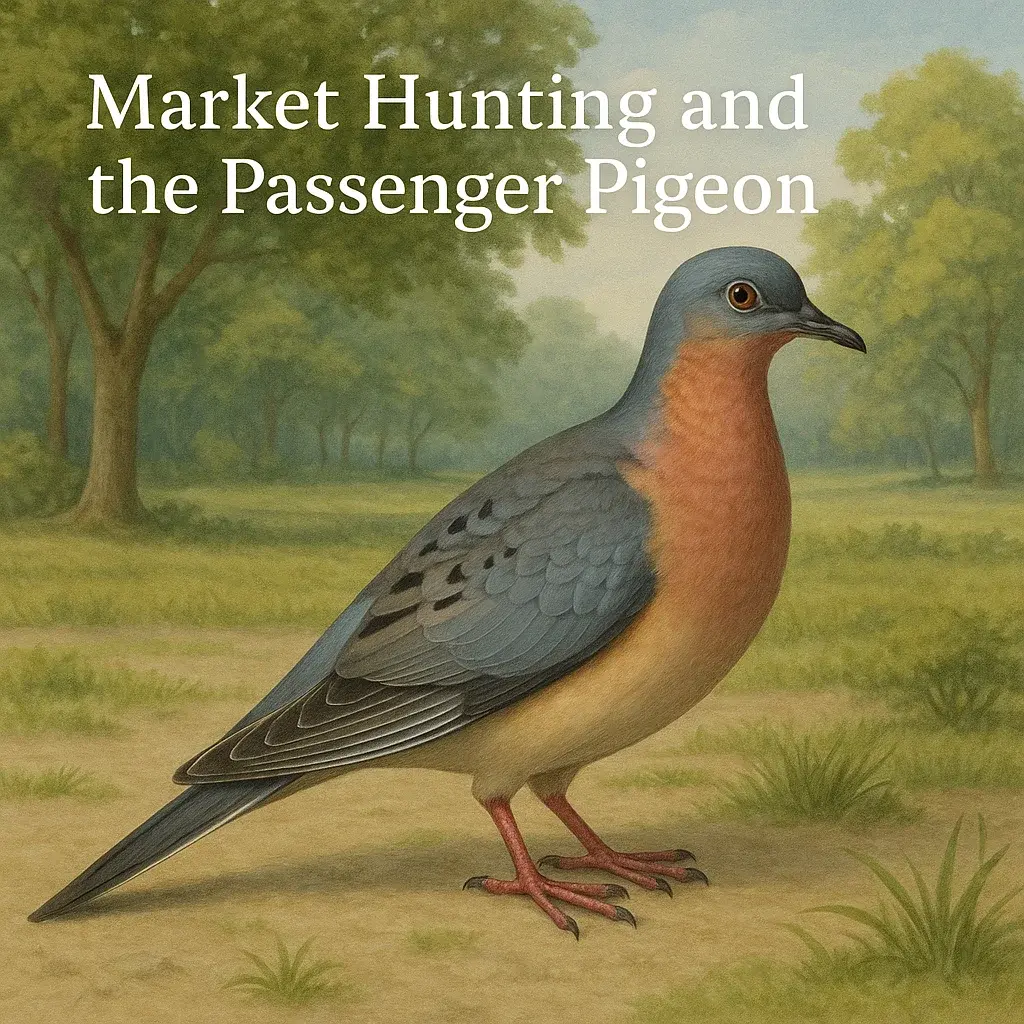
Closely related to modern-day pigeons and doves, the Passenger Pigeon played a significant role in its ecosystem by influencing vegetation and providing food for predators.
In this article, you will learn about its habitat, daily life, and eventual extinction, providing insight into the factors that led to its demise.
🧭 Where It Lived
The Passenger Pigeon inhabited the vast woodlands of eastern and central North America. Its range extended from southern Canada to the southeastern United States, with flocks migrating according to season and food availability.
Passenger Pigeons depended on deciduous forests rich in mast: a term for tree fruits like acorns and beech nuts that were their main food source. These forests provided breeding grounds and shelter necessary for their survival.
Because the birds were highly mobile and relied on large forests, habitat fragmentation—a process where large habitats are broken into smaller, isolated patches—posed a significant risk. The reduction of large continuous forests made it difficult for Passenger Pigeons to find adequate resources and breeding sites.
🌿 Habitat and Daily Life
The Passenger Pigeon's habitat was characterized by a temperate climate with distinct seasons. These birds thrived in areas with sufficient rainfall to support lush forests, ensuring ample food supply.
Their diet comprised mainly seeds, fruits, and nuts, which they foraged from the forest floor. The bird's ability to migrate enabled it to exploit seasonal food sources effectively.
Breeding occurred in enormous colonies which sometimes stretched over several miles. The pigeon would build simple stick nests on branches where they laid one or two eggs. Both parents participated in feeding and caring for the young.
Passenger Pigeons engaged in a highly social lifestyle, often forming massive flocks. They interacted with several other species by influencing seed dispersal and serving as prey for various predators.
🧬 What Made It Unique
In terms of physical traits, Passenger Pigeons were distinguished by their streamlined bodies and long wings, adaptations allowing for swift flight over long distances. This speed and agility enabled them to travel great distances in search of food.
These pigeons also played a vital ecological role as seed dispersers. By consuming seeds and nuts, they helped to maintain healthy forest ecosystems, which balanced plant species and benefited other forest inhabitants.
Historically, the Passenger Pigeon was significant to indigenous peoples and early settlers, both as a food source and as part of cultural traditions. However, this also contributed to its vulnerability as human exploitation grew.
⏳ When It Disappeared
The decline of the Passenger Pigeon was shockingly rapid. The last wild specimen was shot in 1900, and the last captive pigeon, named Martha, died in 1914 at the Cincinnati Zoo. This marked the extinction of the species.
While extinction dates are clear, the speed of their disappearance left many questions. Researchers point out that missing records in remote areas could mean populations existed slightly longer than documented.
With confirmed extinction, no individuals were identified in their natural habitat, signifying the species was not just "Extinct in the Wild" but completely extinct.
⚠️ Why It Went Extinct
The extinction of the Passenger Pigeon is often attributed to multiple factors, chiefly overhunting and habitat loss. Market hunting became a major threat as their meat was in high demand, leading to massive slaughters for commercial sale.
Habitat fragmentation played a critical role as well, with deforestation significantly reducing the availability of suitable nesting and foraging grounds.
While other factors such as disease and introduced species were considered, the primary drivers were undeniably human-induced overexploitation and habitat destruction.
These interconnected causes diminished their ability to survive and reproduce, ultimately leading to their extinction.
🧩 How We Know (Evidence and Records)
Knowledge about the Passenger Pigeon is derived from a mix of historical records, fossil findings, and museum specimens. Specimens kept in museums provide insights into their size and physical adaptations.
Historical accounts, coupled with paintings and photographs, help establish timelines and verify the identity of the species. Oral histories contribute narratives of their presence and behaviors.
Identifying extinct species can be challenging, especially when records are sparse or species were widespread and mobile. However, the abundant documentation of the Passenger Pigeon simplifies positive identification.
🛡️ Could It Have Been Saved
Efforts to save the Passenger Pigeon, had they occurred earlier, might have included regulated hunting and habitat preservation. Establishing protected areas could have maintained adequate breeding and feeding grounds.
Captive breeding programs could have been another measure, potentially allowing for population stabilization had they been initiated when numbers were still sufficient.
Unfortunately, conservation action came too late, as the realization of their impending extinction coincided too closely with their rapid decline.
🔁 Are There Any Survivors or Close Relatives Today
The closest living relatives to the Passenger Pigeon are other pigeons and doves, such as the Mourning Dove. These species share similar dietary habits and ecological roles.
While no current species completely fills the ecological niche left by the Passenger Pigeon, other birds contribute to seed dispersal and maintain similar symbiotic relationships within the ecosystem.
To date, there are no efforts to reintroduce or revive the Passenger Pigeon using genetic technologies, keeping its close relatives as its only biological legacy.
❓ Common Questions and Misconceptions
Was it hunted to extinction? Yes, extensive hunting for their meat was a crucial factor in their extinction.
Why didn’t it adapt or move? Their large population sizes and reliance on specific forests made adaptation difficult under rapidly changing conditions.
Could it still be alive somewhere? Given the comprehensive records and observations, it's highly unlikely that any Passenger Pigeons exist today.
What does 'declared extinct' actually mean? It means that extensive searches have failed to find any living individuals in the wild or captivity.
What is the difference between endangered and extinct? Endangered species are at high risk of extinction, whereas extinct species have no surviving individuals.
Why are island species so vulnerable? Island species often face elevated risks due to limited ranges, fewer defensive behaviors against introduced predators, and drastic environmental impacts.
📌 Summary
- The Passenger Pigeon was once an abundant bird species in North America.
- It lived in eastern and central North America's forests.
- Relied on deciduous forests with plentiful mast.
- Ate seeds, fruits, and nuts, often while migrating to find food.
- Adaptations included swift flight for migration and seed dispersal roles.
- Last confirmed wild pigeon was shot in 1900 and last captive died in 1914.
- Main extinction causes were overhunting and habitat loss from deforestation.
- Evidence includes museum specimens, historical records, and oral histories.
- Mourning Dove and other pigeons are its closest living relatives.
- The key lesson is the importance of early intervention in conservation efforts.
- A memorable takeaway: It highlights the impact human activities can have on even large and once-common species.