🏞️ Toolache Wallaby
🌍 What It Was
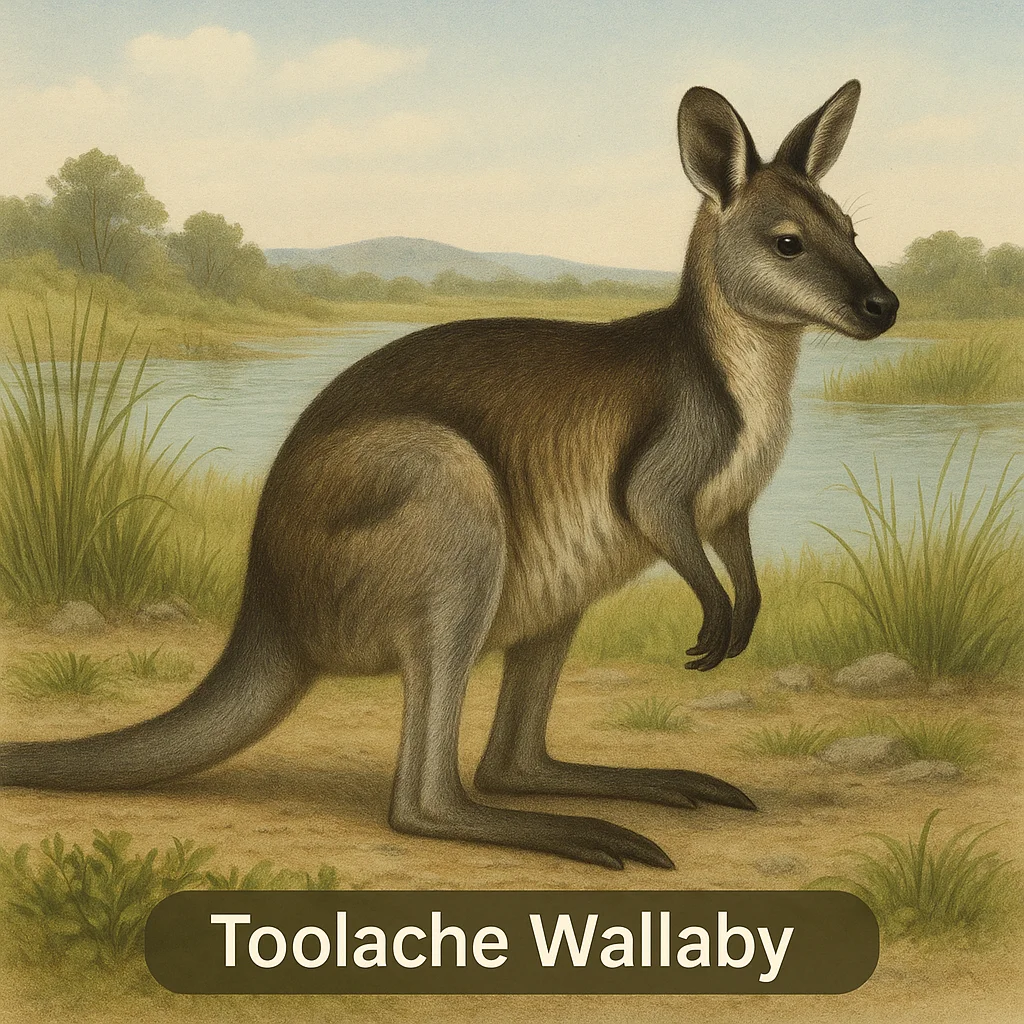
The Toolache Wallaby, also known scientifically as Macropus greyi, was a type of marsupial that belonged to the macropod family, which includes kangaroos, wallabies, and tree-kangaroos. This particular wallaby was distinctive for its graceful build and light brown-grey fur, which made it visually distinct from other species in its family.
Its closest living relatives today include various other wallabies and kangaroos that share similar ecological roles, such as grazing on grasses and living in complex social structures. The Toolache Wallaby played a significant role in its ecosystem, impacting the vegetation and serving as prey for natural predators.
In this article, we will explore the Toolache Wallaby's habitat, daily life, and distinctive characteristics. We will also delve into when and why this species disappeared, the available evidence of its existence, and what lessons can be learned for conservation.
🧭 Where It Lived
The Toolache Wallaby was endemic to Australia, meaning it was native to this region and found nowhere else in the world. Specifically, it lived in the southeastern parts of South Australia and southwestern Victoria. It thrived in areas that provided ample grasslands and low shrub coverage, which were its primary sources of food and shelter.
This wallaby depended on open grassy areas interspersed with patches of bushes and trees. Such habitats provided not only food but also protection from predators. Being an animal tied to a specific type of environment made it vulnerable to changes in its habitat, and its highly localized range contributed to its risk of extinction.
The habitat fragmentation it experienced arose from human activities such as agriculture and urbanization, which further limited its living space and resources. This fragmentation reduced its ability to find sufficient food and mates, an essential aspect of survival and reproduction.
🌿 Habitat and Daily Life
The climate in the Toolache Wallaby's range was generally temperate, with moderate temperatures and regular seasonal variation, including distinct wet and dry seasons. These conditions allowed for diverse plant growth, providing the wallaby with a year-round supply of fresh grasses, which constituted its primary diet.
Toolache Wallabies were known for their foraging behavior, often feeding in groups during the night to avoid daytime predators. Their social behavior included living in large mobs, which provided them with better protection and social interaction. Reproduction involved a breeding season, after which females would care for the young, known as joeys, in their pouches until they were mature enough to survive independently.
These wallabies played a part in their ecosystem by stimulating plant regrowth through their grazing habits, and they themselves were an integral part of the food chain. Predators included both native species, such as eagles, and introduced species, like foxes, which added distress to their populations over time.
🧬 What Made It Unique
The Toolache Wallaby was noted for its elegant physical traits. It was relatively small, with a slender build that enabled quick and agile movements, which were vital for escaping predators. Its coat was notably smooth and a mix of browns and greys, which provided excellent camouflage in its natural habitat.
This wallaby's long tail was used for balance, and its powerful hind legs were adapted for hopping at high speeds. These adaptations were crucial for interacting with its environment, from escaping danger to covering large distances while foraging.
Although not known for any specific cultural significance, the Toolache Wallaby was a part of the natural heritage of the regions it inhabited, representing a segment of the diverse Australian wildlife heritage that once thrived before European settlement brought drastic changes.
⏳ When It Disappeared
The decline of the Toolache Wallaby began in the late 1800s and continued into the early 1900s. The last confirmed sighting was reported in the 1920s, though unconfirmed sightings and anecdotal reports suggest they might have survived a bit longer in more remote areas.
Extinction is a process often declared after exhaustive searches fail to find the species or reliable evidence of its existence. The declaration for the Toolache Wallaby highlighted the absence of populations in areas where it was once an integral part of the ecosystem.
The possibility of "extinct in the wild" status was bypassed as no captive populations existed and all natural populations had disappeared, marking a total extinction under both scientific and lay definitions.
⚠️ Why It Went Extinct
The extinction of the Toolache Wallaby is attributed to several interlinked factors, highlighting the complexity of species loss. Habitat loss and fragmentation played a major role, as agricultural expansion and deforestation transformed its living environment into farmland and settlements.
Overhunting also contributed significantly, as the wallaby was hunted for its fur by settlers and affected by sport hunting. The introduction of invasive species like foxes and cats brought new predators that the Toolache Wallaby was not adapted to evade, leading to substantial declines in its population.
Climate shifts and periodic extreme weather events changed the availability of its food resources, further stressing an already declining population. These factors, in combination, were instrumental in driving the Toolache Wallaby to extinction.
🧩 How We Know (Evidence and Records)
Evidence of the Toolache Wallaby's existence comes from several sources, including museum specimens, historical photographs, and detailed field notes from the time when the species was still present. These records help scientists piece together the life and decline of the species.
Museum collections hold preserved skins and bones, which play a critical role in understanding the physical characteristics and validating the species' identity. Such specimens also assist in confirming the geographic range through the sites they were collected from.
The reliability of these records allows current conservationists and researchers to study the factors that led to its extinction and apply these learnings to prevent future losses of other species.
🛡️ Could It Have Been Saved
Realistically, the Toolache Wallaby might have been saved if conservation efforts were implemented earlier. Protecting its natural habitat and enforcing hunting restrictions could have maintained a more stable population size.
Efforts to control invasive species that preyed on the wallaby could have also helped in stabilizing its numbers. However, many of these efforts came too late when population numbers had already decreased beyond recovery levels.
While captive breeding programs have saved other species, no such initiatives seemed to have been attempted or successful for the Toolache Wallaby, partly due to limited awareness and prioritization at the time of its decline.
🔁 Are There Any Survivors or Close Relatives Today
Today, the closest living relatives to the Toolache Wallaby are other wallaby species within the macropod family, such as the Eastern Grey Kangaroo. These relatives share similar ecological roles but differ in specific adaptations and habitats.
While there are no known ecological replacements that perfectly fit the niche the Toolache Wallaby once occupied, other marsupials and grazers continue to contribute to grassland ecology in Australia.
No reintroduction or captive breeding programs are in place for the Toolache Wallaby since the species is confirmed extinct, leaving it an unfortunate reminder of the importance of timely conservation action.
❓ Common Questions and Misconceptions
Was it hunted to extinction? Hunting contributed significantly, but habitat loss and invasive species also played major roles.
Why didn’t it adapt or move? Its specialized habitat and rapid environmental changes limited its ability to adapt quickly.
Could it still be alive somewhere? It is highly unlikely due to extensive searches and lack of credible sightings.
What does 'declared extinct' actually mean? It means exhaustive searches have shown no evidence of its existence in the wild or captivity.
What is the difference between endangered and extinct? Endangered means facing a high risk of extinction in the wild, while extinct means no known individuals remain.
Why are island species so vulnerable? Limited range and resources make them more susceptible to changes and threats.
📌 Summary
- The Toolache Wallaby was a marsupial native to Australia.
- It was found in southeastern South Australia and southwestern Victoria.
- Preferred open grasslands with interspersed bushland and trees.
- Diet consisted primarily of grasses, and it was nocturnal and social.
- Notable for its elegant build, smooth fur, and agile movements.
- Became extinct in the early 20th century, last seen in the 1920s.
- Driven by habitat loss, hunting, invasive species, and climate factors.
- Evidence includes museum specimens and historical records.
- Closest relatives are other wallaby species like the Eastern Grey Kangaroo.
- Highlights the importance of proactive conservation to prevent future extinctions.
- Its extinction serves as a poignant reminder of the impact of human activity on biodiversity.