🏞️ Quagga
🌍 What It Was
The Quagga was a unique subspecies of the plains zebra, known for its distinct coat pattern. Sporting stripes only on the front part of its body, the Quagga's rump was a solid brown, making it stand out among its striped relatives.
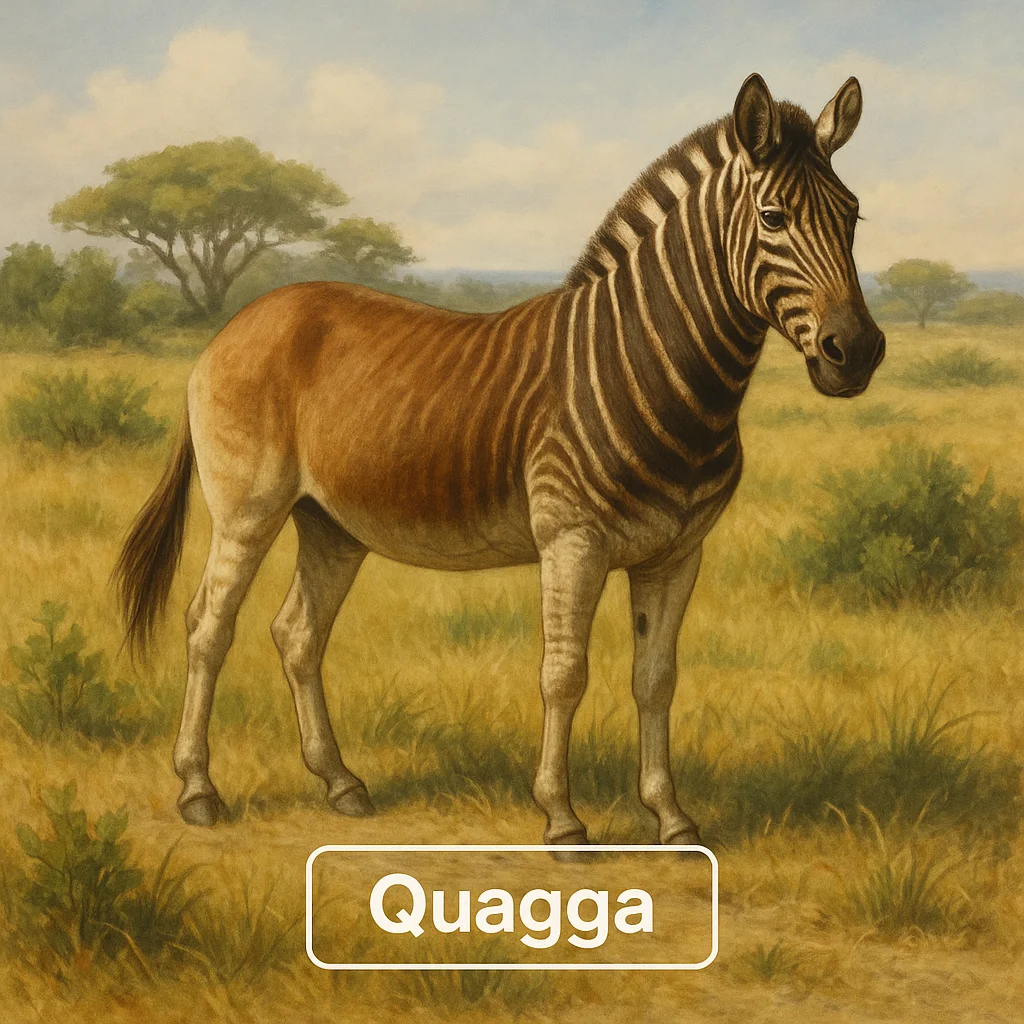
Closely related to other zebras and horses, the Quagga shared a common habitat and played a significant role in its ecosystem by grazing and helping maintain the grasslands.
In this article, you'll learn about where the Quagga lived, how it thrived in its environment, the factors that led to its extinction, and how we study this extinct subspecies today.
🧭 Where It Lived
The Quagga was native to South Africa, with a range that mainly included the southern grasslands of the Cape Province and the southern part of the Orange Free State. These areas provided the open plains that were essential to its lifestyle.
The habitat of the Quagga consisted of grassland plains, which offered abundant grasses essential for their survival. These regions typically have a subtropical climate with seasonal rainfall, supporting vast landscapes of grass that were perfect for grazing animals.
Being restricted to these specific regions increased the Quagga's risks, as habitat destruction or alterations could significantly impact their population. Such specialization in habitat is a common vulnerability for many species.
🌿 Habitat and Daily Life
The climate in the regions the Quagga inhabited featured warm temperatures and periodic rains. Temporary water sources were crucial during dry seasons, supporting the thriving grasslands that defined their habitat.
As herbivores, Quaggas primarily fed on grasses. They were social animals, likely forming groups known as herds, which is common among zebras and helped them escape predators and efficiently navigate their environment.
The Quagga's breeding habits were similar to other zebras, with a gestational period that lasted about a year. Foals were cared for by the mother until they were independent, learning to forage and socialize within the herd.
🧬 What Made It Unique
The most distinctive physical trait of the Quagga was its coat: stripes on the front half of the body that faded into a plain brown rear, unlike other zebras with stripes covering their entire bodies. This unique pattern may have provided camouflage in its specific environment.
The Quagga played an essential role in the ecosystems it inhabited by promoting grassland health through grazing. This grazing helped sustain the biodiversity of the plains by preventing overgrowth of certain plant species.
Historically, Quaggas were notable to early settlers in South Africa, often mentioned in writings and illustrations that help us understand their appearance and importance at the time.
⏳ When It Disappeared
The Quagga was declared extinct in the late 19th century, with the last known individual dying in an Amsterdam zoo in 1883. Prior reports of sightings dwindled, and without verified field records in the wild, this led to its official extinction status.
There were uncertainties about sightings in the wild, compounded by the similar appearance of other zebras and loss of clear records as their numbers dwindled due to hunting and habitat changes.
Once declared extinct, it became a cultural symbol and a cautionary tale of how human activities can lead to the rapid decline of animal populations.
⚠️ Why It Went Extinct
The extinction of the Quagga was driven by multiple factors. Overhunting by European settlers for meat and hides significantly reduced their numbers. Unrestricted hunting led to their rapid decline.
Another contributing factor was habitat loss, as settlers converted grasslands into farmlands and introduced livestock, which competed with Quaggas for food resources, further degrading their habitat.
Though disease and climate shifts were not primary drivers, they may have added pressures as the Quagga populations were already low and vulnerable due to the aforementioned human activities.
🧩 How We Know (Evidence and Records)
The study of Quaggas is largely based on historical records, museum specimens, and field notes. These sources have provided valuable information on their physical appearance and habitat.
Museum specimens, including skins and bones, have allowed scientists to conduct genetic analyses, confirming the Quagga was a distinct subspecies of zebra.
Verifying the Quagga's extinction status involved compiling historical sightings, interviews, and comparing them with physical evidence to rule out other zebras.
🛡️ Could It Have Been Saved
Conservation efforts, such as habitat protection and hunting regulations, might have helped preserve Quagga populations if implemented earlier. However, during the 1800s, awareness and resources for wildlife conservation were limited.
The concept of captive breeding or genetic diversity methods like those used today was not established, meaning efforts to preserve or restore populations were minimal and ineffective.
Late attempts to save similar species highlighted the importance of timely intervention, though for the Quagga specifically, these efforts came too late.
🔁 Are There Any Survivors or Close Relatives Today
The closest living relatives of the Quagga are other plains zebras, which still inhabit African grasslands today and exhibit similar grazing habits and social structures.
The Quagga Project is an attempt to selectively breed zebras to resemble the Quagga's distinct appearance. While not directly bringing the Quagga back, it aims to preserve its phenotypical characteristics.
Ecologically, other zebras continue the role once played by the Quagga, maintaining grassland ecosystems through similar grazing behaviors.
❓ Common Questions and Misconceptions
Was it hunted to extinction? Yes, overhunting significantly contributed to the Quagga's extinction.
Why didn’t it adapt or move? The Quagga was highly specialized to its environment, limiting its ability to adapt quickly or relocate.
Could it still be alive somewhere? It is highly unlikely, given thorough research and lack of verified sightings since the 19th century.
What does 'declared extinct' actually mean? It means no members of the species are alive after exhaustive surveys failed to identify any individuals.
What is the difference between endangered and extinct? Endangered species are at high risk of extinction but still have living individuals; extinct species have none.
Why are island species so vulnerable? Island species often have limited ranges and specific adaptations, making them susceptible to changes in their environment.
📌 Summary
- The Quagga was a subspecies of the plains zebra.
- It lived in the grasslands of South Africa.
- Its habitat was comprised of open plains suitable for grazing.
- Quaggas were herbivores with a social structure.
- They had unique partially striped coats.
- The last known Quagga died in the 1880s.
- Main extinction drivers were overhunting and habitat loss.
- Evidence comes from museum specimens and historical records.
- The plains zebra is its closest living relative.
- Conservation highlights the need for timely action.
- The Quagga remains a symbol of how quickly species can vanish.