🏞️ Crescent Nail-tail Wallaby
🌍 What It Was
The Crescent Nail-tail Wallaby was a small marsupial native to Australia. As a member of the macropod family, which includes kangaroos and wallabies, it was characterized by a unique feature—a crescent-shaped nail on the tip of its tail. This small wallaby lived a solitary life, foraging primarily at night.
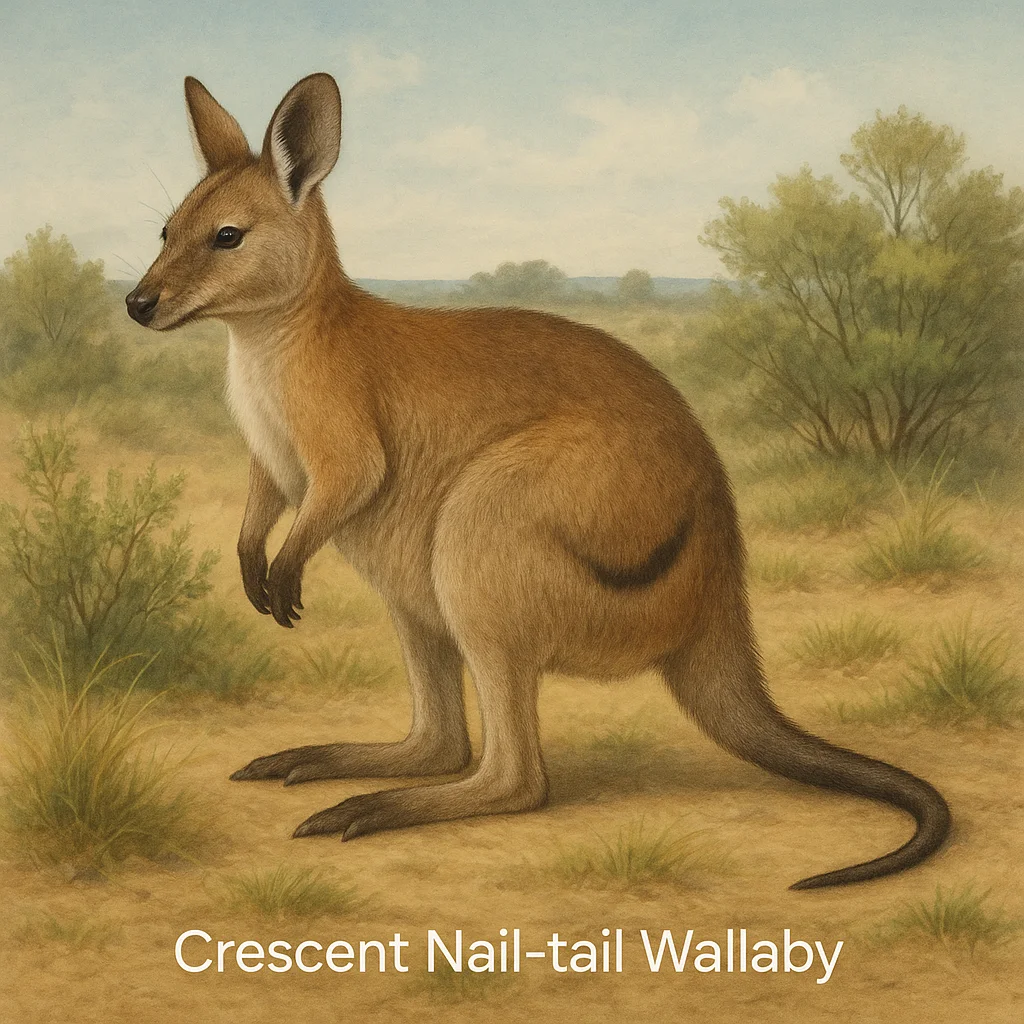
Its closest living relatives are other wallabies and kangaroos, sharing similar characteristics such as strong hind legs and long tails for balance. Within its ecosystem, it played a critical role in grazing and seed dispersal, which helped maintain the health of its native habitats.
Throughout this article, you will learn about the Crescent Nail-tail Wallaby's historical range, the environment it thrived in, its eventual extinction, and the factors leading to its disappearance. We will also explore what makes this species unique and discuss broader implications for conservation.
🧭 Where It Lived
The Crescent Nail-tail Wallaby was primarily found in arid and semi-arid regions of central Australia. Its geographic range included parts of the Australian states of South Australia, New South Wales, and Queensland. These regions are characterized by sparse vegetation and a hot, dry climate.
These wallabies depended on habitats such as open woodlands, grasslands, and scrublands. These areas provided the necessary cover and food resources to support their way of life. Unfortunately, these habitats are also highly susceptible to human impact and environmental changes, which can pose a threat to local wildlife.
Being limited to such a specific and narrow range increased the Crescent Nail-tail Wallaby's vulnerability to extinction. Island species and those with restricted ranges often face higher extinction risks due to a lack of alternative habitats and inability to migrate to safer areas when faced with ecological disturbances.
🌿 Habitat and Daily Life
The habitats of the Crescent Nail-tail Wallaby were characterized by hot and dry conditions, with minimal rainfall and extreme temperature variations between day and night. These environmental factors shaped the wallaby's daily life and behavior.
Its diet consisted primarily of grasses and leaves, which it foraged at night. As a nocturnal animal, this wallaby was adapted to avoid the harsh daytime heat, which helped conserve water and reduce the risk of dehydration in its arid environment.
Reproduction occurred with seasonal variation, with females giving birth to underdeveloped joeys the size of a bean. The young would then crawl into the mother's pouch to continue development, which is typical of marsupial life cycles. Crescent Nail-tail Wallabies had few known predators, but they may have competed with other small herbivores for food resources.
🧬 What Made It Unique
The Crescent Nail-tail Wallaby had several distinctive physical features. Most notably, the crescent-shaped nail on its tail, which served no known functional purpose today, remains a unique characteristic. Its coat was a mix of gray and brown shades, providing a natural camouflage against the arid landscape.
In terms of ecological roles, this wallaby helped disperse seeds through its grazing activities, indirectly supporting plant growth and ecosystem health. While there is limited cultural or historical significance directly tied to this species, its extinction underscores broader concerns about the loss of Australia's unique biodiversity.
⏳ When It Disappeared
Records indicate that the Crescent Nail-tail Wallaby disappeared during the early to mid-20th century. The last confirmed records date back to the 1950s, although there have been unverified sightings since then. Declaring a species extinct involves thorough surveys and research, with careful consideration of the completeness and reliability of available information.
Uncertainty regarding the exact timeline of its extinction is partly due to its remote habitats and the challenges of documenting nocturnal animals. Many species like the Crescent Nail-tail Wallaby get classified as "extinct" only after exhaustive searches yield no evidence of their continual existence.
⚠️ Why It Went Extinct
The extinction of the Crescent Nail-tail Wallaby was driven by a combination of factors. Habitat loss and fragmentation significantly reduced the wallaby's living spaces. Land clearing for agriculture and urban development destroyed large swathes of its natural habitat.
Introduced species, such as foxes and domestic cats, further threatened their survival by preying on the wallabies. These predators exploited the wallabies' lack of defensive adaptations against non-native threats.
Additionally, climate shifts, including prolonged droughts and unpredictable weather patterns, increased stress on the species. These factors, coupled with overhunting for food and sport during earlier years, contributed to their decline.
🧩 How We Know (Evidence and Records)
Evidence of the Crescent Nail-tail Wallaby's existence comes from natural history museum specimens, field notes by early European settlers, and Aboriginal oral histories. These records provide valuable insights into the wallaby's life and habitats.
Scientific techniques, such as radiocarbon dating of fossils, help verify the presence and estimated time frames of existence. The difficulty in confirming the presence of rare species in remote locations often complicates the timely detection of population declines.
🛡️ Could It Have Been Saved
Several conservation measures might have made a difference, such as protecting essential habitats, implementing hunting restrictions, and controlling predators. However, such actions were often pursued too late to be effective.
In some cases, captive breeding programs have been used to try and conserve critically endangered species. While this was not attempted for the Crescent Nail-tail Wallaby, it can offer a lifeline for similarly threatened species before populations reach a critical threshold of decline.
🔁 Are There Any Survivors or Close Relatives Today
The closest living relatives of the Crescent Nail-tail Wallaby are other wallaby species that still inhabit Australia. While they share some physical traits, they occupy different ecological niches and face varying degrees of conservation challenges.
Ecological replacements might include other small herbivores that fulfill similar roles in grazing and seed dispersal, though each species' unique contributions to biodiversity cannot be entirely replicated.
❓ Common Questions and Misconceptions
Was it hunted to extinction? Hunting contributed to their decline, but it was a combination of factors that led to extinction.
Why didn’t it adapt or move? Limited ability to migrate or adapt to rapid environmental changes increased vulnerability.
Could it still be alive somewhere? Though unlikely, some remote areas could potentially harbor undiscovered populations.
What does 'declared extinct' actually mean? It means exhaustive searches have found no evidence of their existence over a substantial period.
What is the difference between endangered and extinct? Endangered species are at risk of extinction, while extinct species have no surviving individuals.
Why are island species so vulnerable? They have smaller populations and limited escape routes from environmental changes and threats.
📌 Summary
- The Crescent Nail-tail Wallaby was a small marsupial with a unique nail on its tail.
- It lived in central Australia, in arid and semi-arid regions.
- Its habitats included open woodlands, grasslands, and scrublands.
- Diet consisted mainly of grasses and leaves, foraging at night.
- Notable for its distinct crescent-shaped tail feature.
- Last recorded sightings occurred around the 1950s.
- Main drivers of extinction included habitat loss, invasive species, and climate change.
- Evidenced by museum specimens, field notes, and oral histories.
- Closest relatives include other wallaby species.
- A key conservation lesson is the importance of timely action to prevent loss.
- Its extinction highlights the fragility of specialized species in changing environments.