🏞️ Deforestation and Species Collapse
🌍 What It Was
Deforestation has been a critical factor contributing to the collapse of countless species. This phenomenon refers to the large-scale removal of forests, which are vital as habitats for many animals. Deforestation has played a pivotal role in extinction events by stripping animals of their homes, food sources, and migratory routes.
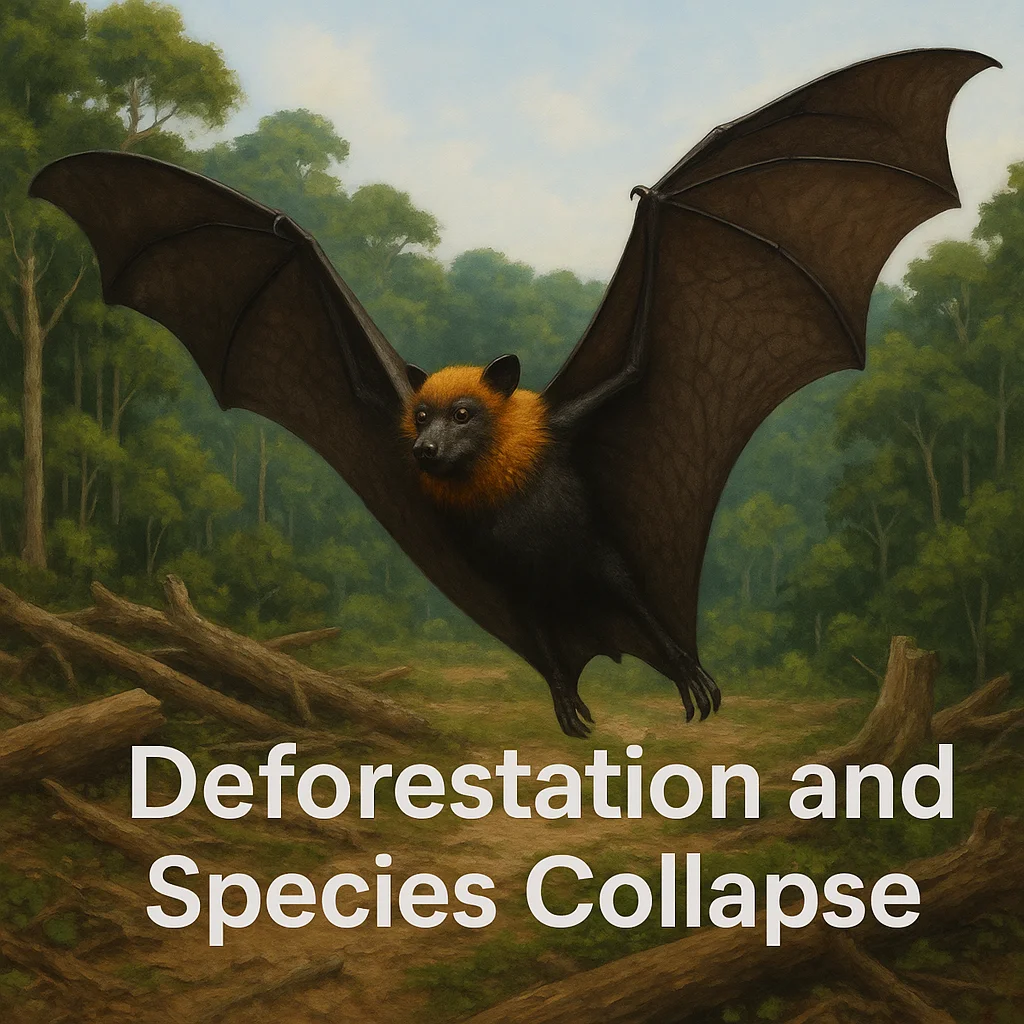
Many of the affected species include distinctive animals like the giant golden-crowned flying fox, a large bat native to the Philippines, known for its impressive wingspan. This bat is one of many creatures whose survival is closely linked to dense forest habitats.
In this article, we will explore where these animals lived, how deforestation impacted their daily lives, and what made some of them unique. By understanding these elements, we can gain insights into why so many species have disappeared and the broader implications for conservation.
🧭 Where It Lived
The species most affected by deforestation are those dependent on forest ecosystems. These habitats are extensive and varied, ranging from the tropical rainforests of the Amazon Basin to the temperate forests of North America. Each forest type hosts its own unique community of plants and animals.
Many deforested species were highly localized, often confined to specific regions or islands. For instance, island species like the dodo of Mauritius were especially vulnerable due to their restricted range and inability to migrate to new areas when their habitat was destroyed.
This dependence on specific forest habitats placed these species at a heightened risk of extinction. The removal of forests led to habitat fragmentation, drastically reducing available living space and isolating populations, which decreased their ability to survive.
🌿 Habitat and Daily Life
The climates within these forests vary widely. Tropical forests are known for high rainfall and warm temperatures year-round, while temperate forests experience distinct seasonal changes. These environmental conditions supported diverse ecosystems.
The daily lives of forest-dependent species revolved around the abundance of resources the forests provided. Diets varied significantly; herbivores relied on abundant plant life, while predators hunted the rich supply of animals. Some species, like rodents, foraged on the forest floor, while others, like birds, sought food in the canopy.
Reproductive strategies also differed; many forest species had specific breeding seasons to align with resource availability. Social structures could be complex, with some animals living in groups to enhance survival. Predators, prey, and other species often interacted through symbiotic relationships.
🧬 What Made It Unique
The physical traits of forest-dwelling species were as varied as their environments. Some animals, like the now-extinct passenger pigeon, were built for speed and long-distance travel, facilitating seasonal migrations. Others developed camouflage adaptations to evade predators.
Ecologically, many forest species played critical roles. Seed dispersers like bats and birds contributed to forest regeneration, while predators maintained population balance among prey animals. The ecological roles of these species often went beyond simple survival, enhancing entire ecosystems.
Some extinct species, like the ivory-billed woodpecker, also had cultural significance. This bird's striking appearance made it the subject of folklore and hunting, contributing indirectly to its decline as its habitat shrunk.
⏳ When It Disappeared
The timeline of a species' disappearance often involves complex factors. Many species declined gradually, with the last confirmed sightings occurring decades ago. For example, the dodo was last sighted in the late 1600s, shortly after humans arrived on Mauritius.
Extinction is considered confirmed when exhaustive searches and studies fail to locate remaining individuals. However, in some cases, a species may be declared "Extinct in the Wild," meaning it only survives in captivity, as with some turtles and plants.
Uncertainty often surrounds extinction dates due to sparse records, remote habitats, or misidentifications. As a result, some species are reassessed when new evidence arises, but confirmed returns from extinction are exceedingly rare.
⚠️ Why It Went Extinct
The reasons for extinction are manifold and interconnected. Habitat loss and fragmentation due to deforestation are primary drivers. As forests disappear, so do the resources necessary for survival, leading to population decline.
Overhunting and overfishing have direct impacts on species, reducing numbers to unsustainable levels. Introduced species may outcompete, prey on, or bring diseases to native species not adapted to these threats.
Climate change and extreme weather events can further stress vulnerable populations, while pollution from human activities poisons water and air, affecting health and reproduction.
These causes often act together, complicating conservation efforts. Understanding each factor's role is essential for effective intervention and supporting surviving species.
🧩 How We Know (Evidence and Records)
Evidence of past species and their extinction comes from multiple sources. Fossils and subfossils provide physical proof of existence, often offering insights into physical characteristics and habitats.
Museum specimens are invaluable for studying extinct species, providing material for genetic analysis and helping reconstruct historical populations. Field notes, photographs, and oral histories supplement the physical evidence, offering context and timelines.
Scientists use these varied sources to verify identities and establish extinction dates, but challenges remain, especially for rare, nocturnal, or deep-sea species whose remains are harder to find and analyze.
🛡️ Could It Have Been Saved
Several conservation actions might have helped forestall extinctions. Establishing protected areas could have preserved critical habitats, while regulations on hunting and logging might have limited human impact.
Controlling invasive species is crucial in maintaining ecosystem balance, though difficult in practice. Captive breeding programs can bolster populations, but are often constrained by funding and biological factors.
Despite some late conservation attempts, action frequently came too late to save endangered species. The trade-offs and complexities of ecological interventions highlight the need for proactive measures.
🔁 Are There Any Survivors or Close Relatives Today
While extinct species are lost, their nearest living relatives often continue as reminders of what once was. For example, the rodent relatives of the extinct Christmas Island rat persist on surrounding islands.
In some cases, ecological replacements can fulfill similar roles, such as different grazing animals filling niches left by extinct grazers. These replacements help maintain ecosystem functions.
Occasionally, species are reintroduced into their former habitats through captive breeding and release programs, aiming to reestablish populations and restore ecosystem balance.
❓ Common Questions and Misconceptions
Was it hunted to extinction? Hunting played a role in many extinctions, but habitat loss and other factors were often more significant.
Why didn’t it adapt or move? Rapid environmental changes and island limitations hindered these adaptations.
Could it still be alive somewhere? Most likely not; thorough searches typically precede an extinction declaration.
What does 'declared extinct' actually mean? It indicates there are no known living individuals after extensive searching.
What is the difference between endangered and extinct? Endangered species have critically low populations, while extinct species have none remaining.
Why are island species so vulnerable? Small ranges, isolated populations, and lack of predators make them less adaptable to changes.
📌 Summary
- Deforestation leads to habitat loss, a major extinction cause.
- Species impacted lived in diverse global forests.
- Habitats ranged from tropical zones to temperate woodlands.
- Diet and behavior varied widely across species.
- Unique adaptations helped survival in specific niches.
- Most extinctions occurred from the 1600s onward.
- Main drivers include habitat loss, hunting, invasive species.
- Evidence from fossils, specimens, and historical records.
- Closest relatives offer insights into extinct life.
- Conservation teaches the importance of timely action.
- Understanding past extinctions highlights present conservation needs.