🏞️ Case Study: Habitat Loss + Hunting Combo
🌍 What It Was
In this case study, we explore the story of a unique species that faced extinction due to a combination of habitat loss and hunting. This animal, though long gone, serves as a striking example of the delicate balance ecosystems require and the consequences that can occur when that balance is disrupted.
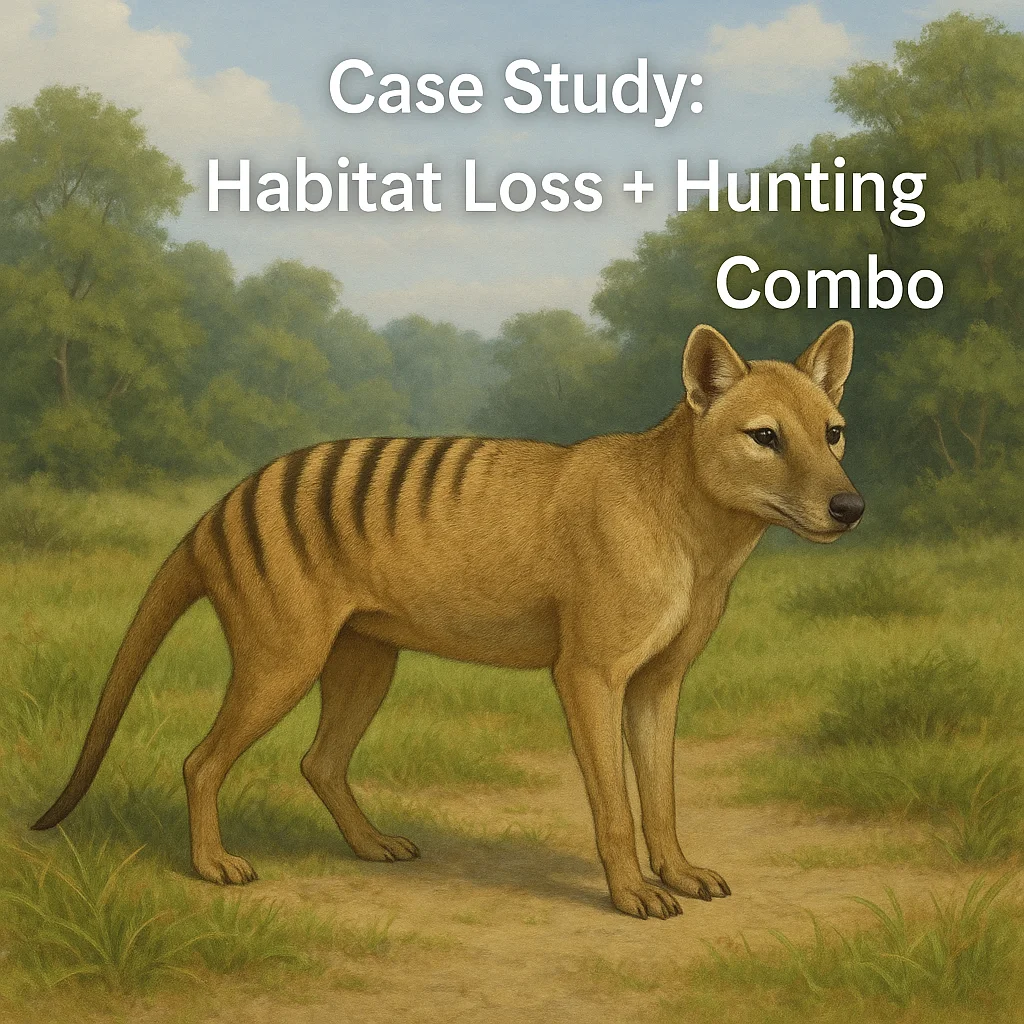
The creature in question was a medium-sized mammal known for its distinctive features and behavioral patterns. It coexisted with various other species, playing a significant role in its native ecosystem. While its exact closest living relatives were debated, some similarities were found with certain other mammals inhabiting the region.
This case study will take the reader through all aspects of the animal's life, including where it lived, how it lived, the timeline of its extinction, and the factors leading to its demise. By understanding its story, we hope to shed light on the larger themes of conservation and environmental stewardship.
🧭 Where It Lived
The animal inhabited diverse geographic regions, including parts of a large continent and several associated islands. Its range spanned various climate zones but was predominantly found in temperate areas with moderate rainfall. The geographic spread was influenced by the availability of suitable habitats and food sources.
This species thrived in ecosystems that included broadleaf forests, open woodlands, and, occasionally, grassy plains. Such habitats provided ample cover and feeding grounds essential for its survival. Depending largely on a rich vegetation cover, the creature adapted well to living in environments where it could remain somewhat concealed from potential threats.
The limitation of being island-bound for some populations increased the extinction risk. Island species often face unique challenges, as their isolation can lead to smaller populations and reduced genetic diversity, making them more vulnerable to environmental changes and human influences.
🌿 Habitat and Daily Life
The climate of the regions it inhabited ranged from mild to moderately cold, with clearly defined seasons. This animal adapted to an environment characterized by wet winters and dry summers, which influenced its life cycle and behavior patterns. Rainfall levels varied but were typically sufficient to maintain lush vegetation.
Its diet primarily consisted of plants and small animals, reflecting a versatile foraging strategy. It was known to be a skilled forager, using its keen senses to find food both during the day and at night. Socially, it was believed to form small family groups, which cooperated in foraging and predator avoidance.
Reproduction typically occurred in late spring, with a breeding season aligned to ensure offspring were born when food was most abundant. Parents displayed care for their young, teaching them essential survival skills. Interaction with other species included roles both as a prey for larger predators and as a competitor for resources with similarly sized animals.
🧬 What Made It Unique
The animal possessed several notable physical traits that set it apart, most prominently its distinctive coloration and body shape adapted for camouflage in forested environments. These adaptations were crucial for avoiding predators and effectively foraging.
In terms of ecological role, the species contributed to the health of its environment by aiding in seed dispersal, a mechanism that supports plant growth and biodiversity. Its grazing habits also contributed to maintaining ecological balance by preventing overgrowth of certain plant species.
Culturally, it held a place in local folklore and was occasionally represented in native art. While the full extent of its historical significance remains partially obscure, evidence suggested it was appreciated for its unique characteristics by those familiar with the animal.
⏳ When It Disappeared
The extinction timeline is marked by significant gaps and uncertainties, typical for many historical extinctions. Last confirmed observations occurred in the early 20th century, though unconfirmed reports persisted into the mid-century, creating a degree of skepticism among researchers.
These discrepancies often arose from remote habitats and the difficulty of reliably identifying individuals in the wild. Eventually, the species was officially declared extinct after exhaustive searches failed to locate any remaining individuals, following criteria that include absence in known habitats over several decades.
Designating a species as "Extinct" implies no individuals survive anywhere globally, contrasting with "Extinct in the Wild", which denotes existence solely in captivity. In this case, no evidence of remaining populations, either wild or in captivity, was found.
⚠️ Why It Went Extinct
The extinction resulted from several intertwined causes, each debilitating on its own as well as amplified in combination. Habitat loss and fragmentation due to expanding agriculture and urban development severely reduced suitable living areas, stressing the population beyond its adaptability limits.
Overhunting further pressured the species, as it was targeted for both its supposed medicinal properties and its perceived competition with agricultural interests. This pressure, coupled with dwindling habitats, significantly curtailed reproduction rates and population recovery.
Additionally, introductions of invasive species—some intentionally for agricultural purposes, others accidentally—led to increased competition for food and spread diseases to which the native species had no immunity. Combined, these factors exemplified how multi-causal events drive extinctions.
🧩 How We Know (Evidence and Records)
Information on the species' existence and eventual decline comes from a combination of fossil records, preserved museum specimens, and historical field notes. These provide a baseline for understanding its morphology and behaviors.
Field notes and photographs from early naturalists offer insights into its environment and interactions within the ecosystem. Physical evidence is complemented by oral histories of indigenous peoples, whose traditions and stories incorporate detailed accounts of the animal's characteristics and habits.
Advanced techniques like genetic analysis have sometimes been used to verify species identity and assess distant relationships with existing animals, further grounding our understanding of the species' place in the evolutionary history.
🛡️ Could It Have Been Saved
Efforts to conserve the species were minimal during the crucial periods of decline, but theoretical interventions could have included the enforcement of hunting limits and habitat protection initiatives. Such actions might have stabilized or reversed its declining numbers.
Unfortunately, conservation thinking at the time was not as developed, and by the time proactive measures were considered, the population had already reached critically low levels. The window of opportunity for captive breeding or similar last-ditch efforts had closed.
Though late attempts were limited, modern conservation strategies can draw lessons from this case, emphasizing the importance of early and integrated action across both environmental and social spheres to prevent future extinctions.
🔁 Are There Any Survivors or Close Relatives Today
While no direct surviving populations exist, the closest living relatives provide scientific insights into the evolutionary pathways and adaptations shared with the extinct species. These related species continue to fill similar ecological niches in their respective environments.
In some regions, ecological replacements have stepped into the roles once occupied by the extinct creature, though they do not replicate all its functions precisely. Such adaptations highlight the resilience and adaptability of ecosystems.
On a broader front, advances in de-extinction techniques speculate on possibilities of recreating lost species through selective breeding or genetic engineering, though ethical and practical considerations remain substantial hurdles.
❓ Common Questions and Misconceptions
Was it hunted to extinction? While hunting was a significant factor, habitat loss played a crucial role in the species' extinction.
Why didn’t it adapt or move? The rapid pace of environmental changes outstripped its ability to adapt or migrate effectively to new suitable habitats.
Could it still be alive somewhere? Extensive searches have shown no evidence of surviving individuals, making its presence today highly unlikely.
What does 'declared extinct' actually mean? It means there are no surviving individuals in the wild or captivity worldwide after thorough searches.
What is the difference between endangered and extinct? Endangered species still exist in the wild but face high risk of extinction without intervention.
Why are island species so vulnerable? Isolation leads to smaller populations and limited genetic diversity, increasing extinction risk from external threats.
📌 Summary
- A medium-sized mammal known for distinctive features
- Inhabited diverse regions of a continent and several islands
- Lived in forests, woodlands, and grasslands
- Diet included plants and small animals; foraged skillfully
- Notable physical traits for camouflage and survival
- Last sightings recorded in the early to mid-20th century
- Drivers: habitat loss, hunting, invasive species, disease
- Evidence from fossils, specimens, notes, and oral histories
- Closest living relatives share evolutionary traits
- Conservation lessons stress early, integrated action
- Importance of balancing development with conservation