🏞️ San Marcos Gambusia
🌍 What It Was
The San Marcos Gambusia was a small freshwater fish species native to the United States. As a member of the Poeciliidae family, the San Marcos Gambusia was closely related to other small fishes like guppies and mollies. What set it apart was its unique adaptation to the specialized spring environment it inhabited.
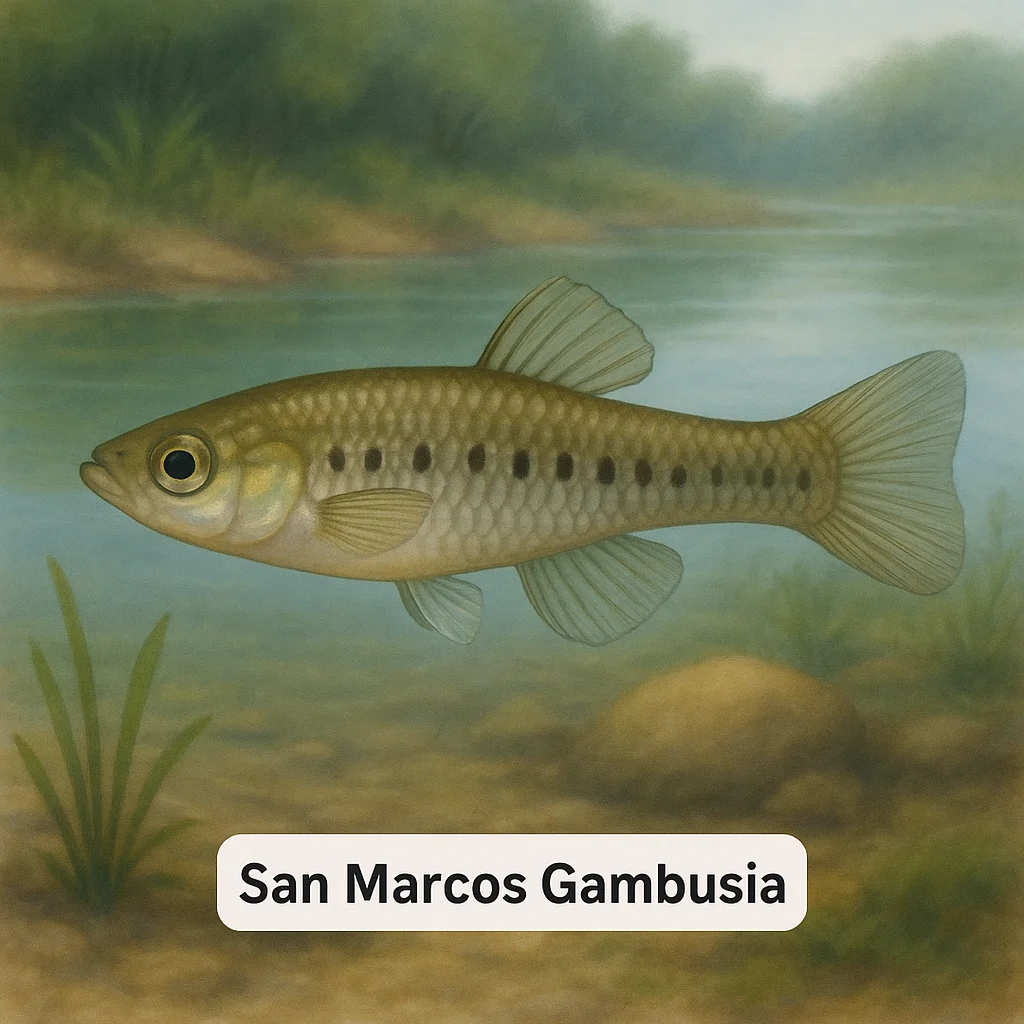
As an endemic species, meaning it was found nowhere else, it played a specific role in its local ecosystem. This isolated fish managed to survive within the delicate balance of its native environment, living alongside similar aquatic life.
Throughout this article, you'll learn about the San Marcos Gambusia's natural habitat, lifestyle, reasons for its disappearance, and the key lessons for conservation. We will delve into where it lived, its behavior patterns, and the factors leading to its extinction.
🧭 Where It Lived
The San Marcos Gambusia was found exclusively in a small region of Texas, specifically the San Marcos River. This river, fed by natural springs, provided a unique habitat for various aquatic species. Such highly localized distribution made the species particularly vulnerable to environmental changes.
The San Marcos River is characterized by its constant flow and stable temperatures due to the spring water, creating a supportive environment for its endemic species. The river's clarity and moderated conditions were crucial for the survival of the San Marcos Gambusia, allowing it to thrive amidst lush aquatic vegetation.
Being geographically restricted to this single location posed a significant risk, as any alterations in their environment or illegal activities could have immediate consequences on their survival. This isolation underpins their extinction story, highlighting how localized species often face greater risks.
🌿 Habitat and Daily Life
The climate surrounding the San Marcos River is generally mild, with warm temperatures throughout most of the year. This allowed for a stable ecosystem where the San Marcos Gambusia could sustain itself. The river provided all the necessities for its sustenance, including food and breeding grounds.
The diet of the San Marcos Gambusia primarily consisted of small insects and algae. As an opportunistic feeder, it played a part in controlling insect populations while also contributing to the aquatic food web as prey for larger fish and birds.
Breeding was an important aspect of daily life for the San Marcos Gambusia. With a life cycle tied to the consistent conditions of the river, they reproduced by giving live birth, a trait shared with many of their close relatives. This live-bearing feature allowed them to quickly repopulate when conditions were favorable.
🧬 What Made It Unique
Physically, the San Marcos Gambusia was a small, slender fish with a somewhat drab coloration to blend with its surroundings. This coloration helped avoid predators and allowed it to effectively forage within its habitat.
One of its remarkable adaptations was its ability to thrive in the particular water chemistry of the San Marcos River, a feature not easily replicated elsewhere. This ecological specialization is part of what made the fish so distinct but also contributed to its vulnerability.
The San Marcos Gambusia held no notable cultural or historical significance to people outside of scientific circles, but it stood as a symbol of the unique biodiversity found in localized ecosystems.
⏳ When It Disappeared
The San Marcos Gambusia was last confirmed in the wild in the late 1980s. Nature and scientific records worked together to paint a picture of its existence until its numbers dwindled beyond sustainability. By the time it was declared extinct, surveys had shown that the fish had not been seen in its natural habitat for some time.
The process of declaring a species extinct includes extensive surveys and research, but uncertainties can and often do exist, especially with small and secluded populations. Despite hopes for sightings, evidence and scientific consensus led to its official extinction declaration.
Once declared extinct, it means there are no known individuals left in the wild or captivity. In the case of the San Marcos Gambusia, it indeed reached this unfortunate conclusion.
⚠️ Why It Went Extinct
The extinction of the San Marcos Gambusia was due to multiple factors working in concert. Habitat loss and fragmentation played a significant role as development altered the river environment, affecting water flow and quality.
Additionally, the introduction of non-native species, such as certain types of fish and plants, created competition for resources and introduced disease. This invasive species dynamic can alter ecosystems dramatically, outcompeting native species.
During its decline, pollution, mainly due to increased human activity, also disrupted the fragile ecosystem balance. These factors together made it increasingly difficult for the San Marcos Gambusia to survive and reproduce successfully.
🧩 How We Know (Evidence and Records)
Scientists relied on various forms of evidence to confirm the San Marcos Gambusia's extinction, such as field surveys, photographs, and historical accounts. Museum specimens provided key insights into its physical characteristics and genetic makeup.
Research into past records and new field explorations has helped create a timeline of existence and decline, verifying the species' identity and confirming its disappearance. Despite their efforts, gaps in early records mean complete precision is often unattainable in extinction studies.
These records highlight the importance of museum collections and consistent field observations in understanding biodiversity and the evolution of species over time.
🛡️ Could It Have Been Saved
Several conservation efforts could have potentially saved the San Marcos Gambusia, such as habitat protection and the control of invasive species. Protecting their spring-fed habitat would have been the most effective measure.
Unfortunately, awareness of the species' decline came too late for impactful conservation. While initiatives to protect the river's natural conditions have since improved, they arrived after the species had already dwindled beyond recovery.
These lost opportunities stress the necessity for early intervention and proactive strategies in conservation, emphasizing the role of monitoring small and largely localized species.
🔁 Are There Any Survivors or Close Relatives Today
While the San Marcos Gambusia is no longer with us, it has relatives like the Western Mosquitofish that continue to thrive in similar habitats across North America.
The Western Mosquitofish shares certain traits, such as reproductive strategies and ecological niche, but lacks the specialized adaptations of the San Marcos Gambusia.
There are currently no captive programs or successful attempts at resurrection through breeding or genetic research. Emphasis remains on protecting related species to prevent similar outcomes.
❓ Common Questions and Misconceptions
Was it hunted to extinction? The San Marcos Gambusia was not hunted to extinction; its decline was primarily due to habitat changes and competition from invasive species.
Why didn’t it adapt or move? As a highly specialized and localized species, it didn't have the capacity to adapt or migrate beyond its specific environment.
Could it still be alive somewhere? Despite hopes, extensive searches have not found surviving populations, and it is deemed extinct.
What does 'declared extinct' actually mean? It means there are no known surviving individuals in the wild or in captivity.
What is the difference between endangered and extinct? Endangered species are at risk of extinction, whereas extinct species have no living individuals remaining.
Why are island species so vulnerable? Island and highly localized species like the San Marcos Gambusia have limited ranges and can be disrupted easily by environmental changes.
📌 Summary
- The San Marcos Gambusia was a small freshwater fish.
- It lived exclusively in the San Marcos River, Texas.
- It thrived in spring-fed, stable aquatic environments.
- The fish fed on insects and algae.
- Unique adaptations were suited to a specific river habitat.
- Last known records come from the late 1980s.
- Extinction drivers included habitat loss and invasive species.
- Evidence from field notes and specimens confirmed its extinction.
- Closest living relatives include the Western Mosquitofish.
- It emphasizes the importance of early conservation action.
- Remember the interconnectedness of ecosystems and the role of specialized species.