🏞️ Climate + Disease: A Dangerous Pair
🌍 What It Was
In this article, we explore the interaction between climate change and disease as a perilous combination that has driven certain species to extinction. Though our focus includes many different species, individual animals like the golden toad come to mind. This small, brightly colored amphibian was once common in a high-altitude forest in Costa Rica.
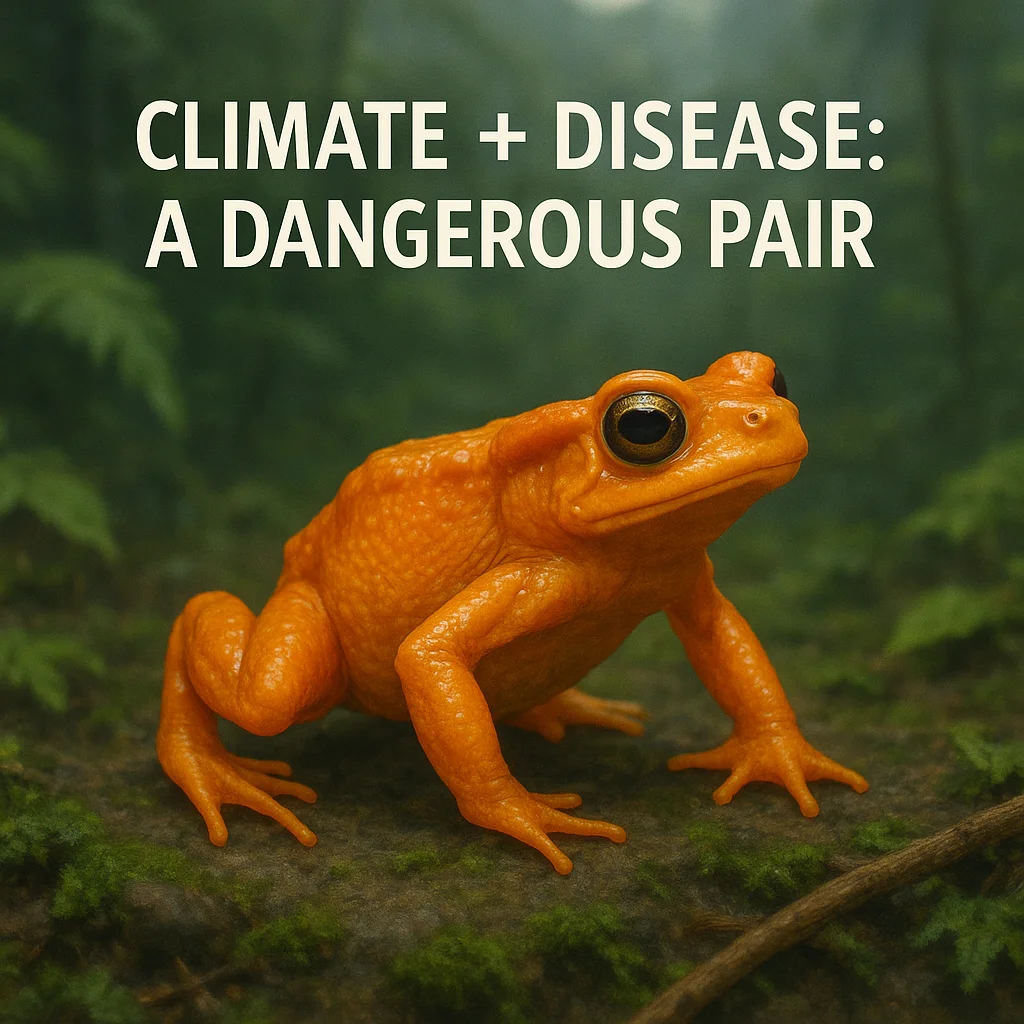
The golden toad was part of the toad family, with living relatives still found around the world. It played a crucial role in its ecosystem, primarily controlling insect populations. In this article, you will learn about where it lived, its distinctive lifestyle, and the factors that contributed to its eventual disappearance, including the dangerous pairing of climate shifts and disease.
The causes behind the extinction of species are complex, often involving multiple interrelated factors. This article will investigate how the changes in climate, combined with the spread of disease, create an environment where survival becomes increasingly difficult. Understanding these mechanisms can offer insights into preventing future losses.
🧭 Where It Lived
The golden toad inhabited a very specific environment in the cloud forests of the Monteverde region in Costa Rica. These are high-altitude tropical forests characterized by persistent, low-level cloud cover at the canopy level. The dense, humid environment was ideal for amphibians, providing ample resources and habitat.
Because it was restricted to such a limited area, the golden toad's range made it particularly susceptible to changes within that ecosystem. Any alteration in climate or the introduction of disease could have significant impacts on its survival. Generally, animals confined to isolated or specialized habitats face higher extinction risks due to their limited ability to relocate or adapt.
The particular conditions of these cloud forests, with their unique moisture levels and temperature ranges, create a delicate balance that the golden toad depended on. Any disruptions to these parameters could have severe consequences, affecting everything from breeding success to food availability.
🌿 Habitat and Daily Life
The climate of the cloud forests is characterized by high humidity and stable temperatures, with abundant rainfall throughout the year. This environment supports a rich biodiversity and complex food webs, with amphibians like the golden toad relying on insects and small creatures for sustenance.
The golden toad engaged in seasonal breeding, congregating in pools formed by the frequent rains. Unlike many other animals, the species did not undertake long migrations, instead remaining within this climatically unique area for its entire life cycle. Social structures were simple, with much of the interaction focused around breeding activities.
Interactions with other species included serving as prey for local birds and small mammals. At the same time, the golden toad played a functional role in controlling insect populations, proving essential for maintaining ecological balance. Their disappearance would disrupt this balance and affect other species.
🧬 What Made It Unique
The diminutive golden toad, with its vivid, almost neon coloration, was well-camouflaged in the vibrant green of its forest home. This distinctive color not only set it apart but also served as a warning to potential predators of its potential toxicity.
Besides its striking appearance, the golden toad was known for its ability to thrive in the moist, cool climate of its limited range. The species' adaptation to this specific environment made it highly specialized, with few other animals inhabiting the same niche.
Though not widely recognized outside of scientific circles during its time, the golden toad became a symbol of the vulnerability of amphibians—creatures frequently considered indicators of environmental health—underscoring the need for greater conservation efforts.
⏳ When It Disappeared
The decline of the golden toad was rapid and alarming, with the last confirmed sighting occurring in 1989. Prior to this, the species had been observed in large numbers, making its sudden disappearance more shocking. Attempts to locate individuals after this date proved unsuccessful.
Declaring a species extinct requires careful proof, a process involving extensive field surveys often hindered by the difficulty of accessing remote areas. For species like the golden toad, residing in a compact, isolated region, the absence of sightings over several years is usually a strong indication of extinction.
For the golden toad, its extinction in the wild is now accepted by the scientific community. However, the factors that led to its decline illustrate how such events can occur swiftly, highlighting the precariousness of highly localized species.
⚠️ Why It Went Extinct
Several interconnected factors contributed to the extinction of the golden toad, with climate change and disease being the primary causes. As global temperatures shifted, even small changes in the microclimate of the cloud forests resulted in drier conditions, affecting breeding and increasing mortality.
The introduction of fungal diseases, particularly chytridiomycosis—caused by the chytrid fungus—exacerbated these issues. This invasive pathogen spreads quickly among amphibian populations, reducing their numbers drastically. The stress from environmental changes likely made the toads more susceptible to this deadly disease.
Overall habitat loss and fragmentation played a significant part in the species' decline. The increasing rarity of suitable breeding conditions, combined with disease and climate impacts, created a multi-causal scenario where survival became nearly impossible.
🧩 How We Know (Evidence and Records)
The primary sources of evidence regarding the golden toad's extinction come from field observations, both historical and modern. Local scientists documented substantial population declines, and subsequent searches yielded no sighting results, gradually leading to its classification as extinct.
Museum specimens and field researchers' notes provide insights into the biology and behavior of the golden toad, helping scientists understand the conditions it required. The fungus responsible for chytridiomycosis has been detected in specimens, linking it to the broader pattern of amphibian declines globally.
The difficulty in confirming the extinction of amphibians arises from their elusive nature; many live in remote or dense habitats. For the golden toad, however, its conspicuous breeding behavior meant its absence from regularly monitored breeding sites was a reliable indicator of its extinction.
🛡️ Could It Have Been Saved
Efforts to save the golden toad might have included habitat protection and disease management. Regulating tourism and development in the Monteverde region could have preserved critical habitat integrity. Meanwhile, international collaboration in disease prevention might have mitigated the spread of chytridiomycosis.
Unfortunately, the golden toad's decline was swift and initially underestimated. Conservation actions tend to lag behind immediate pressures when rapid environmental changes occur. The absence of specific disease management strategies further limited available options.
Late-stage conservation attempts often face trade-offs, such as resource allocation and competing ecological priorities, and the fate of the golden toad reflects these complexities. Proactive measures for future species might break this pattern.
🔁 Are There Any Survivors or Close Relatives Today
Today, the golden toad has no known survivors in the wild or captivity. However, other toad species with similar characteristics continue to inhabit the region, including those with shared dietary habits and ecological roles.
These surviving relatives remind us of the diversity within the toad family and the important function these creatures perform in ecosystems. While they do not replicate the exact role of the golden toad, they carry on parallel ecological interactions.
The importance of amphibian conservation is demonstrated by ongoing efforts to protect related species from similar fates. Projects focused on habitat restoration and disease management reflect lessons learned from the golden toad's extinction.
❓ Common Questions and Misconceptions
Was it hunted to extinction? The golden toad was not hunted to extinction; its decline was primarily due to climate shifts and disease.
Why didn’t it adapt or move? Specialized habitat needs and rapid environmental changes left little opportunity for adaptation or relocation.
Could it still be alive somewhere? While it's always possible that undiscovered populations exist, extensive searches have found no evidence of survivors.
What does 'declared extinct' actually mean? It means that the species is considered no longer extant after thorough search efforts confirm its absence.
What is the difference between endangered and extinct? Endangered species still exist but face high risk of extinction, while extinct species are believed to have none remaining.
Why are island species so vulnerable? Isolated locations limit genetic diversity and adaptive options, making island species susceptible to changes.
📌 Summary
- The golden toad was a small amphibian formerly found in Costa Rica.
- It lived in the Monteverde cloud forests, a highly specific and isolated environment.
- This habitat was marked by high humidity and stable temperatures.
- The golden toad's diet mainly consisted of insects.
- Its vivid coloring helped it thrive in its moisture-rich environment.
- Last confirmed sightings occurred in 1989, during a significant decline period.
- Main extinction drivers include climate change and disease.
- Evidence comes from field observations and museum specimens.
- Toads similar to the golden toad still exist within the same region.
- Conservation must address multi-causal pressures on isolated species.
- The golden toad's decline underscores the urgent need for proactive environmental protection.