🏞️ Rodrigues Solitaire
🌍 What It Was
The Rodrigues Solitaire was a flightless bird species that once inhabited the island of Rodrigues in the Indian Ocean. It was part of the Raphinae family, which also included the renowned Dodo. Flightlessness and a robust build characterized this unique bird, making it an intriguing figure in discussions about extinct animals.
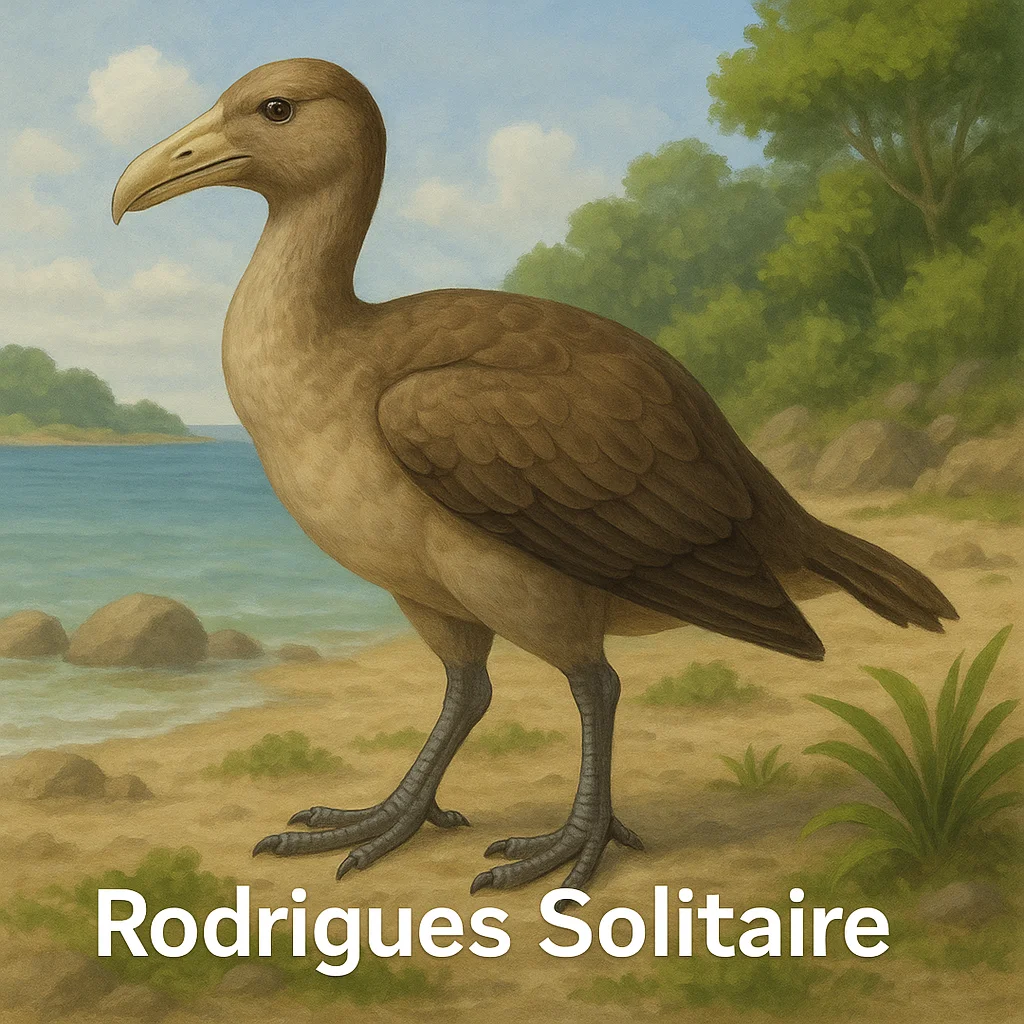
The solitaire's closest living relatives are pigeons and doves, and it shared the flightless trait with its relative, the Dodo. Both species were part of the ecosystem of the Mascarene Islands, where they played critical roles in seed dispersal and vegetation management.
This article will explore where the Rodrigues Solitaire lived, its habits and interactions in its environment, the reasons behind its extinction, and the insights we can gather from its history.
🧭 Where It Lived
The Rodrigues Solitaire inhabited the island of Rodrigues, a small landmass in the Mascarene archipelago located in the Indian Ocean. The island, being relatively remote and isolated, was home to a unique set of flora and fauna, including several species not found anywhere else.
Rodrigues is characterized by its tropical climate and varied landscapes, which include forests, grasslands, and coastal areas. These diverse habitats provided the solitaire with ample resources for feeding and nesting, though its restricted range made it more vulnerable to external threats.
Being limited to a single island, the species faced an increased risk of extinction due to its inability to migrate to other areas. This dependency on a specific geographic location made it highly susceptible to any changes within its environment, such as habitat modification or the introduction of predators and competitors by humans.
🌿 Habitat and Daily Life
The climate on Rodrigues is characterized by warm temperatures and seasonal rainfall, which supported lush forests and grasslands. The Rodrigues Solitaire adapted to this environment, relying on the abundant plant life for its diet.
The solitaire was primarily herbivorous, consuming fruits, nuts, and leaves. Its foraging behavior involved browsing through undergrowth and using its strong beak to access food sources. This dietary habit played a significant role in seed dispersal across the island.
Nesting on the ground, the Rodrigues Solitaire is believed to have had a simple life cycle, with breeding likely aligned with the island's seasonal climate. Parental care would have been crucial for the survival of offspring, especially in an environment with limited food sources and potential predators introduced by humans.
Interactions with other species on the island were likely minimal given the solitaire's size. However, the introduction of non-native animals by humans would have presented new competitors and predators, impacting its ability to thrive.
🧬 What Made It Unique
The Rodrigues Solitaire was notable for its size and build, akin to a turkey but with a heavier body, long neck, and stout legs. Its inability to fly was offset by strong legs adapted for walking within the island's varied terrain.
The bird's plumage was believed to be grey or brown, offering camouflage in its natural habitat, while its beak was adapted for cracking nuts and manipulating food. These physical traits were well-suited to the solitaire's niche on Rodrigues.
Culturally, the solitaire became a part of local lore and was briefly noted by early explorers. Its status as a flightless bird, related to the Dodo, draws fascination for its evolutionary path on isolated islands.
⏳ When It Disappeared
Records indicate the Rodrigues Solitaire went extinct by the late 1700s. The bird's disappearance was gradual, with sporadic sightings and reports becoming rarer until none were documented.
Uncertainties in sighting records and the remoteness of its habitat contributed to challenges in determining the exact timeline of extinction. However, the bird is declared extinct due to the sustained absence in the wild and inability to survive under new environmental conditions.
Unlike species classified as "Extinct in the Wild," where some individuals may survive in captivity, no efforts were made to preserve the Rodrigues Solitaire outside its natural habitat, leading to its complete extinction.
⚠️ Why It Went Extinct
Several factors contributed to the extinction of the Rodrigues Solitaire, often acting in combination rather than isolation. The island faced significant habitat loss and fragmentation due to human settlement, leading to reduced areas for feeding and breeding.
Overhunting is believed to have played a considerable role, with sailors and settlers viewing the flightless bird as an easy source of meat. This relentless hunting depleted populations rapidly.
The introduction of invasive species, such as cats and rats, introduced new elements of predation and competition for food. These non-native animals disturbed the ecological balance, making survival more challenging for the solitaire.
Though climate change is not considered a direct factor, occasional extreme weather events, such as cyclones, could have temporarily reduced food availability, impacting reproduction and survival rates.
🧩 How We Know (Evidence and Records)
Our understanding of the Rodrigues Solitaire comes from a combination of subfossil remains, sketches and writings by early explorers, and later scientific examinations of the island's environment. These findings have painted a clearer picture of the bird's existence.
Researchers rely on these artifacts to verify the solitaire's characteristics and ecological role, using comparative analysis with related species and studying changes in Rodrigues' habitat to understand its historical context.
While direct photographic evidence does not exist, the detailed accounts and illustrations by those who encountered the bird provide valuable insights into its appearance and behavior.
🛡️ Could It Have Been Saved
With today's conservation knowledge, several actions might have helped preserve the Rodrigues Solitaire. Establishing protected areas, limiting hunting, and controlling invasive species might have mitigated some extinction causes.
However, such measures were not considered or implemented during the time when these pressures began to mount. The lack of immediate action led to the slow but inevitable decline of the population.
No late conservation attempts were recorded, as the understanding of extinction and species preservation was still in its infancy, lacking the institutional support we see today.
🔁 Are There Any Survivors or Close Relatives Today
The closest living relatives of the Rodrigues Solitaire are pigeons and doves, sharing genetic traits and evolutionary lineage. These birds continue to occupy ecosystems around the world, illustrating a successful adaptation process.
Although no reintroduction or captive breeding programs exist for the solitaire, other island species serve similar ecological roles, such as seed dispersal and habitat engineering, filling the void left by the bird's extinction.
❓ Common Questions and Misconceptions
- Was it hunted to extinction? Yes, overhunting was a significant factor, compounded by other pressures.
- Why didn’t it adapt or move? Its evolutionary path on Rodrigues left it well-suited to its specific environment, but vulnerable to rapid changes and pressures.
- Could it still be alive somewhere? No credible evidence supports this; it is considered extinct due to lack of sightings or evidence.
- What does 'declared extinct' actually mean? It indicates no living individuals have been observed for a considerable time period, and species survival is highly unlikely.
- What is the difference between endangered and extinct? Endangered species face a high risk of extinction but still have surviving members, whereas extinct species do not.
- Why are island species so vulnerable? Limited ranges and resources make them more susceptible to environmental changes and human impact.
📌 Summary
- The Rodrigues Solitaire was a flightless bird from Rodrigues Island.
- It lived in the Mascarene archipelago in the Indian Ocean.
- Its habitat consisted of tropical forests and grasslands.
- The species was herbivorous, feeding on fruits and leaves.
- It had a robust body and specific adaptations for its environment.
- The bird went extinct by the late 1700s due to multiple factors.
- Main extinction drivers included habitat loss, hunting, and invasive species.
- Evidence includes subfossils, explorer records, and scientific studies.
- Its closest living relatives are pigeons and doves.
- Island biogeography highlights the importance of conservation.
- The solitaire's extinction teaches the critical balance of ecosystems.