🏞️ Oʻahu ʻŌʻō
🌍 What It Was
The Oʻahu ʻŌʻō was an intriguing bird species that once thrived in the Hawaiian Islands. It belonged to the family of birds known as honeyeaters, which are famous for their specialized feeding on nectar. This species stood out due to its striking color combination and unmistakable song.
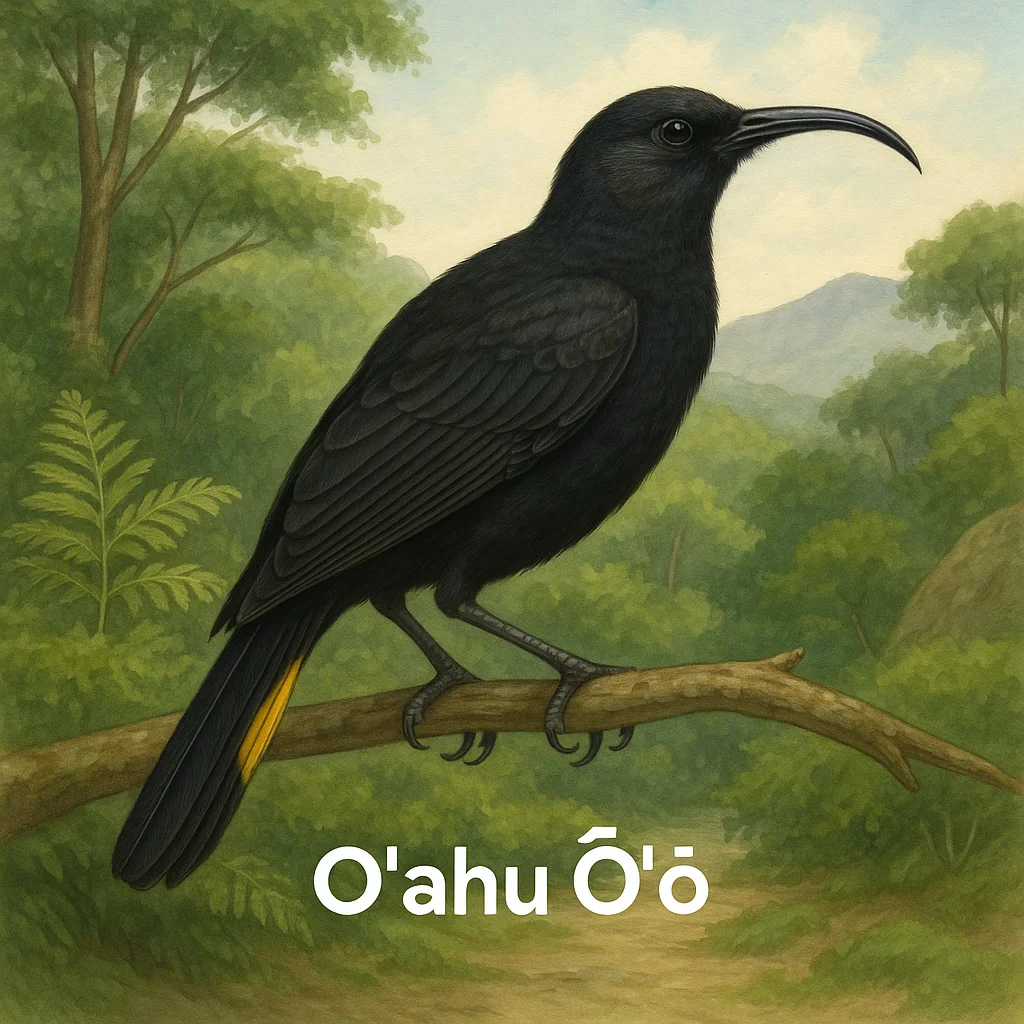
The bird was part of a small group endemic to Hawaii, meaning it was found nowhere else in the world. It is closely related to other ʻŌʻō species that lived on nearby islands. Researchers believe it played a vital role in its ecosystem, likely contributing to pollination as it moved from flower to flower.
In this article, we will explore where the Oʻahu ʻŌʻō lived, how it survived, when it vanished from existence, and the reasons behind its disappearance.
🧭 Where It Lived
The Oʻahu ʻŌʻō was native to the island of Oʻahu, one of the Hawaiian Islands. It was a place teeming with diverse ecosystems, each presenting its unique challenges and benefits for survival.
Specifically, the Oʻahu ʻŌʻō inhabited dense mountain forests, preferring areas abundant in flowering plants. These forests, known as montane rainforests, offered a rich supply of nectar and insects.
Being restricted to a single island made the Oʻahu ʻŌʻō highly vulnerable to environmental changes. When species lack the ability to relocate beyond their bounded territory, any threat can have a significant impact, ultimately increasing their risk of extinction.
🌿 Habitat and Daily Life
The environment of Oʻahu was characterized by its tropical climate, boasting warm temperatures and high annual rainfall. These conditions created a lush environment where the Oʻahu ʻŌʻō thrived.
The diet of the Oʻahu ʻŌʻō primarily consisted of nectar, complemented by insects and other small invertebrates. The bird's feeding behavior was linked to its role in pollinating the island's flora.
The life cycle of the Oʻahu ʻŌʻō involved breeding primarily during the months when food availability was high. Little is known about its social behavior, but like many birds, it likely had a structured formation when it came to nesting and raising its young.
🧬 What Made It Unique
The Oʻahu ʻŌʻō's physical traits included a mix of bright yellow and dark colors, a combination that made it quite distinctive. Its bill was curved, a specific adaptation for reaching deep into flowers to access nectar.
Its unique song was another distinguishing feature. Accounts from the past describe it as melodious and clear, contributing to the bird's cultural significance in Hawaiian folklore.
The Oʻahu ʻŌʻō played an essential ecological role. As a pollinator, it contributed to the reproduction of various plant species in its environment, playing a part in maintaining the island's biodiversity.
⏳ When It Disappeared
The Oʻahu ʻŌʻō was last confirmed in the year 1837. The species was then declared extinct after continued searches into the 1900s yielded no further sightings.
The absence of more recent records suggests a timeline fraught with challenges in verifying the exact date of its disappearance. The notoriously dense habitats of Oʻahu may have delayed the confirmation for some time.
Being declared extinct meant that no individuals were found in the wild, and extensive searches by researchers could not locate any surviving populations, confirming its unfortunate loss.
⚠️ Why It Went Extinct
The extinction of the Oʻahu ʻŌʻō was driven by multiple factors, with habitat loss being a significant contributor. As humans settled on Oʻahu, they cleared forests for agriculture and development, resulting in habitat fragmentation.
Introduced species, such as rats and mongooses, played a critical role by preying on the bird's eggs and young. The introduction of non-native diseases further exacerbated the decline, as the local birds had no immunity.
Climate fluctuations may also have altered the delicate balance of their environment, affecting food availability and nesting sites. The interaction of these factors often compels species decline, ultimately leading to functional extinction.
🧩 How We Know (Evidence and Records)
Our understanding of the Oʻahu ʻŌʻō comes from a variety of sources, including early field notes, preserved specimens, and oral histories. These records provide a snapshot of the bird's characteristics and behaviors.
Museum specimens give scientists physical evidence to analyze, confirming details like plumage and size. However, the actual timing of extinction often relies on last confirmed sightings and continuous monitoring.
Verifying the existence of elusive species can be difficult, particularly for island-dwelling or nocturnal animals, where dense habitats and limited samples make confirmation challenging.
🛡️ Could It Have Been Saved
Hypothetically, conservation actions such as protected reserves or habitat restoration might have provided the Oʻahu ʻŌʻō a lifeline. Controlling invasive species could have mitigated some predation threats, giving the bird an opportunity to rebuild population numbers.
Regrettably, conservation efforts of the time were limited, and any attempts came too late to halt the progression towards extinction.
Although some actions, such as controlling introduced predators, might have made a difference, they generally lagged behind the escalating impacts of development and disease.
🔁 Are There Any Survivors or Close Relatives Today
Relatives in the same family as the Oʻahu ʻŌʻō include other honeyeaters found in the Australasian region, although none are precisely similar in habits or habitat.
No direct descendant lines remain, but some species occupy analogous roles in terms of diet and ecological contribution to pollination in Hawaii and other tropical regions.
❓ Common Questions and Misconceptions
Was it hunted to extinction? There is no strong evidence that hunting directly led to its extinction.
Why didn’t it adapt or move? Endemic species often have niche adaptations, making it challenging to survive in new environments.
Could it still be alive somewhere? Experts believe it's unlikely, given the thorough search efforts over the years.
What does "declared extinct" actually mean? It means exhaustive surveys failed to find any individuals in the wild.
What is the difference between endangered and extinct? Endangered indicates imminent risk of extinction, while extinct means none remain alive.
Why are island species so vulnerable? Isolation and specialization make them sensitive to change and threats like invasive species.
📌 Summary
- The Oʻahu ʻŌʻō was a unique honeyeater bird endemic to Oʻahu in Hawaii.
- It lived exclusively in montane rainforests, reliant on nectar and insects.
- Its critical habitat was diminished, contributing to its extinction.
- The bird relied on nectar for food and contributed to pollination.
- Unique adaptations like its curved bill assisted in nectar feeding.
- Last confirmed in the 1830s, extinction was confirmed by the 20th century.
- Main drivers included habitat destruction and invasive species.
- Knowledge comes from preserved specimens and historical records.
- Closest living relatives are other honeyeaters, none are identical.
- Conservation emphasizes the need for early intervention on small islands.
- A key takeaway is how specialized island life can heighten extinction risk.