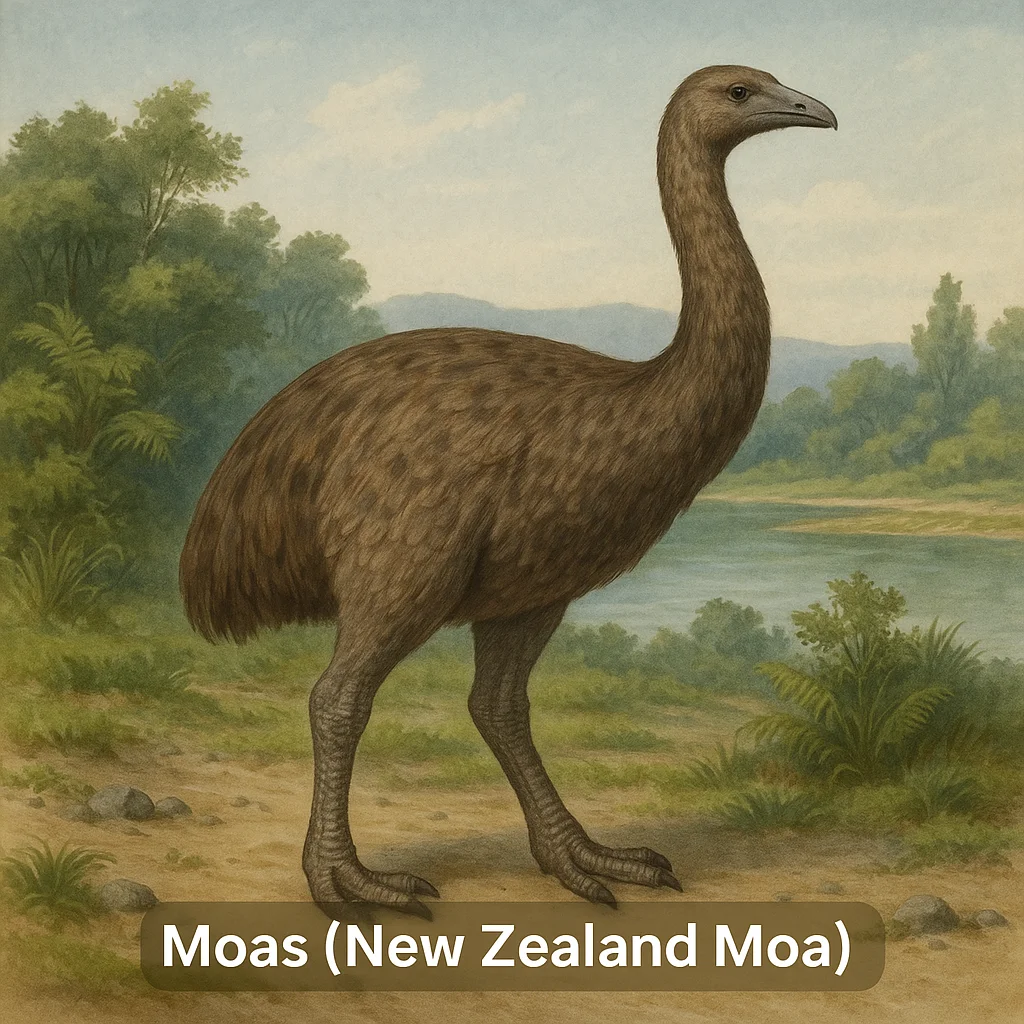
🏞️ Moas (New Zealand Moa)
🌍 What It Was
The Moas were a group of flightless birds native to New Zealand. They were part of the order Dinornithiformes and were among the largest birds known, with some species reaching up to 3.6 meters in height. These distinctive birds were characterized by their massive bodies, long necks, and absence of wings, which habitually grounded them.
Moas had no living relatives, but they were distantly related to other flightless birds worldwide, such as ostriches and emus. These birds occupied a variety of ecological niches in New Zealand, playing vital roles in seed dispersal and serving as prey for the now-extinct Haast's eagle.
This article will explore where the Moas lived, their daily life, what made them unique, their extinction, and more. Understanding the story of the Moa can offer important insights into extinction science and conservation efforts for birds and other wildlife.
🧭 Where It Lived
Moas were endemic to New Zealand, meaning they were found nowhere else in the world. Their geographic range spanned across the two main islands, North Island and South Island, and even some of the smaller surrounding islands. This limited distribution to an island setting increased their vulnerability to extinction.
Various species of Moas thrived in different habitat types, including dense forests, shrublands, and grasslands. These habitats provided ample food resources and offered protection from the rare, yet extant, predators.
The specialization to island life meant that Moas were particularly sensitive to environmental changes. Isolation on islands often leads to unique evolutionary paths but can make species more susceptible to rapid changes, whether from natural events or human activities.
🌿 Habitat and Daily Life
New Zealand's climate is temperate, with moderate temperature and rainfall variations. These conditions allowed for a diverse range of plant life, which Moas relied heavily on for their diet. As herbivores, Moas primarily consumed leaves, twigs, and fruits, typically foraging at ground level and sometimes reaching up to higher vegetation with their long necks.
Moas were believed to be primarily solitary creatures, but evidence suggests some species may have lived in groups during certain times of the year. There is little evidence of migratory behavior; however, they may have moved in response to the availability of food and breeding opportunities.
Regarding reproduction, Moas laid eggs, with the females likely responsible for nesting and caring for the young. The eggs were large, consistent with their size, and were laid in simple ground nests.
🧬 What Made It Unique
The Moa's most defining physical traits included its large size and notable lack of wings. This absence of wings is a result of evolution in an environment devoid of mammalian predators, decreasing the necessity for flight. Their size varied significantly among species, with some as small as a turkey and others towering over a person.
In ecological terms, Moas played important roles in their ecosystems, notably in the process of seed dispersal. Their grazing habits also influenced vegetation structures in the regions they inhabited, contributing to the ecological balance.
Moas also held cultural significance for the indigenous Māori people of New Zealand. They were a source of food, and their bones and feathers were utilized in tools and ornaments. The presence of Moas is reflected in Māori stories and rock art.
⏳ When It Disappeared
The extinction timeline of Moas is a subject of scientific study, with evidence suggesting that they became extinct approximately 600 years ago. The last confirmed records are based on Māori archaeological sites that indicate Moa hunting was prevalent until around the 14th century.
There is some uncertainty due to the lack of detailed records from the era, with final extinction possibly occurring a few decades later. Extinction confirmation involves the disappearance of physical evidence like bones and eggshells in the archaeological record.
In broader terms, Moas are classified as "Extinct" rather than "Extinct in the Wild," indicating that they do not exist anywhere in captivity or wild populations.
⚠️ Why It Went Extinct
Various factors contributed to the extinction of Moas, and like many extinctions, it was likely multi-causal. One major driver was overhunting by humans. When the Māori arrived in New Zealand, Moas were a readily available food source, leading to overexploitation of the population.
Habitat loss and fragmentation due to deforestation for agriculture and settlements used for Māori farming also contributed significantly. The destruction of their natural habitats further reduced the viable living spaces for Moas, making it difficult for them to survive and reproduce.
Introduction of new species, including mammals such as rats and dogs brought by Polynesians, likely disrupted the ecosystems Moas were a part of, adding another layer of pressure. While disease and climate shifts may have played minor roles, these were not the primary drivers of their extinction.
🧩 How We Know (Evidence and Records)
Our knowledge about Moas primarily stems from subfossil remains, including bones and eggshells that have been meticulously dated and analyzed by scientists. These remnants provide insights into their physical features, diet, and some aspects of their behavior.
Oral histories from the Māori have also contributed to our understanding of the Moas and their interactions with humans. While not as empirically grounded as physical evidence, they offer contextual knowledge of the Moas' extinction timeline and its impact on early human settlers.
Scientific verification of the Moas’ disappearance involves rigorous analysis of these remains alongside advanced techniques like radiocarbon dating and DNA analysis, which help to confirm species identity and their extinction timeline.
🛡️ Could It Have Been Saved
In hindsight, several conservation strategies could have potentially helped save the Moas. Implementing protected areas where hunting was restricted or banned might have slowed their rate of decline. Similarly, control of invasive species could have minimized the ecosystem disruptions Moas faced.
Introducing sustainable harvest limits could have allowed Moa populations to recover, although the social and technological context of the time posed challenges to such management strategies. Efforts may have come too late, as Moas were already significantly diminished in number by the time such measures could have been formulated.
Unfortunately, the lack of coordinated conservation action during their time meant these opportunities were missed, and there are no records of any organized conservation attempts for Moas before their extinction.
🔁 Are There Any Survivors or Close Relatives Today
Moas have no direct descendants and are, therefore, extinct with no living relatives. However, the closest living group of birds are the ratites, which include ostriches, emus, and kiwis. These flightless birds share a common ancestry and show some similar ecological roles in their respective environments.
There are no known reintroduction or captive breeding programs for Moas simply because they have been extinct for several hundred years, and their ecological niches in New Zealand have changed significantly. Other species now occupy some of these roles, but none fully replicate the unique ecological functions of the Moa.
❓ Common Questions and Misconceptions
Was it hunted to extinction?
Yes, overhunting by humans was a significant factor in the Moas' extinction.
Why didn’t it adapt or move?
The Moas were adapted to a stable island environment and had limited ability to adapt quickly to human-induced changes.
Could it still be alive somewhere?
No credible evidence supports the existence of any surviving Moa populations today.
What does 'declared extinct' actually mean?
A species is declared extinct when there is no reasonable doubt that the last individual has died.
What is the difference between endangered and extinct?
Endangered species are at a high risk of extinction, while extinct species have no living individuals left.
Why are island species so vulnerable?
Island species often evolve in isolation, making them less adaptable to changes and threats introduced by humans or invasive species.
📌 Summary
- Moas were large, flightless birds native to New Zealand.
- They lived primarily on the North and South Islands.
- Habitat types included forests and grasslands.
- Moas were herbivores, feeding on vegetation and fruits.
- They lacked wings, were large, and inhabited ecological niches with no mammalian predators.
- Last known periods were around the 14th century.
- Main extinction drivers were overhunting and habitat fragmentation.
- Evidence includes subfossils, oral histories, and archaeological findings.
- Closest living relatives are the ratites, including ostriches and emus.
- The Moas' story highlights the importance of timely conservation measures.
- Their extinction serves as a stark reminder of human impact on isolated ecosystems.