🏞️ Labrador Duck
The Labrador Duck was a small, sea duck that captured the curiosity of ornithologists and bird enthusiasts alike due to its ultimate extinction. Known for its unique appearance and presumed specialized diet, it stood out among the waterfowl of North America. The bird was part of the family that includes other sea ducks, such as eiders and scoters.
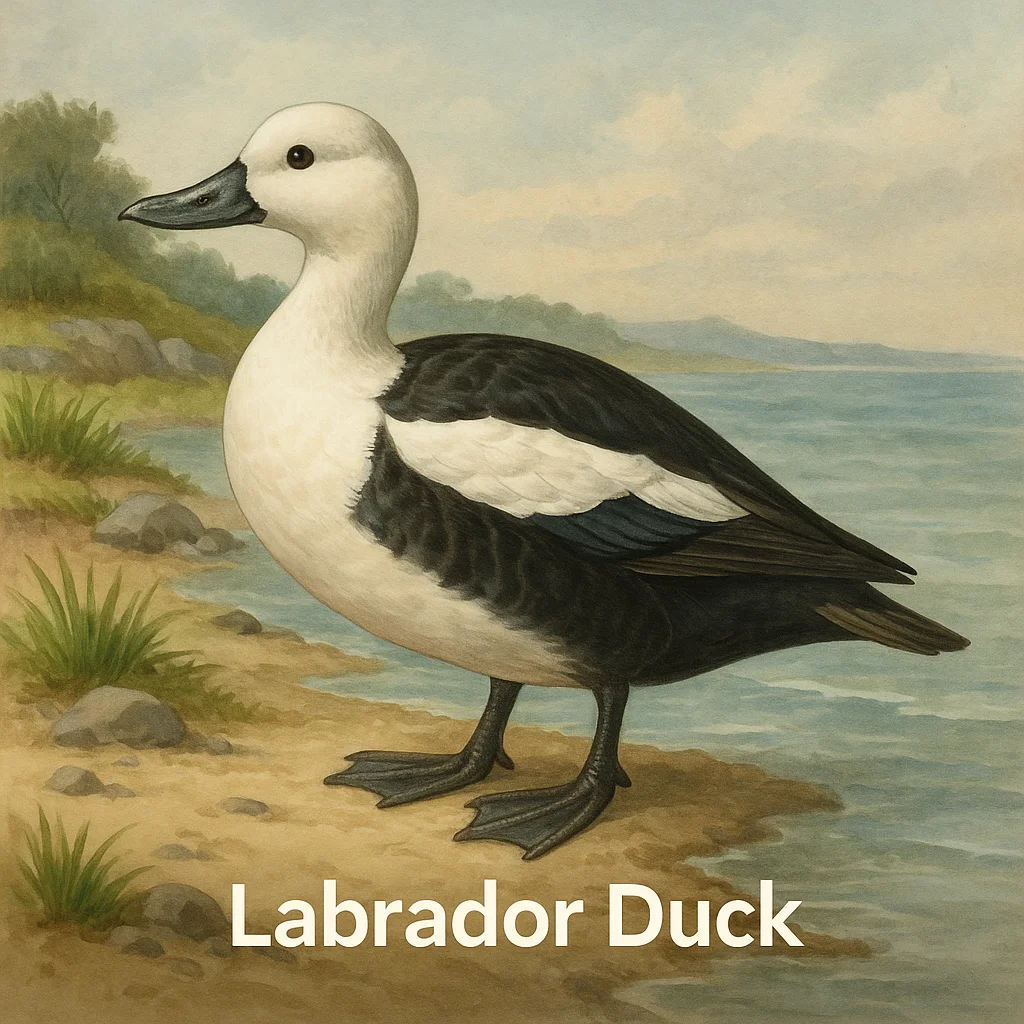
As a member of the waterfowl community, the Labrador Duck played a role in its ecosystem likely similar to that of its surviving relatives, feeding along the coastal waters and engaging in migratory behaviors. The information we possess today helps us piece together the habitat, diet, and eventual disappearance of this distinctive bird species.
This article will explore where the Labrador Duck lived, its behaviors, how it became extinct, and what evidence remains to help us understand this lost species. Through understanding the past, we can gain insights into conservation challenges and strategies relevant today.
🌍 What It Was
The Labrador Duck was a medium-sized water bird with a striking contrasting plumage. The males usually had a white body with a dark head and neck, making them easily recognizable. Females, like many duck species, had more subdued coloring to blend into their surroundings.
The closest living relatives of the Labrador Duck are the other sea duck species. These birds were known for their diving capabilities to catch mollusks, which were a substantial part of their diet. They played a part in coastal marine ecosystems, likely helping to control mollusk populations.
Throughout this section, we’ll delve into their distribution, behavior, and eventual disappearance, centering on factors such as geography, lifestyle, and the broader ecological roles they might have had.
🧭 Where It Lived
The Labrador Duck's geographic range was primarily along the northeastern coast of North America. Historical records suggest that it was found from the maritime provinces of Canada down through the coastlines of New England, with some reaching further south during migration periods.
The habitats the Labrador Duck depended on included coastal waters, bays, and estuaries, where they would forage along the shorelines. These areas often feature a mixture of sandy, rocky, and muddy terrains that support various mollusks and other small marine organisms.
Being limited to these coastal habitats may have increased the risk of extinction for the Labrador Duck. As specialized habitats tend to do, these areas left the species vulnerable to environmental changes and human impacts like habitat degradation.
🌿 Habitat and Daily Life
The Labrador Duck thrived in coastal environments where temperatures could range significantly from the cool, humid climate of the north during summer to milder conditions further south in winter. Seasonal changes would influence their migratory patterns and food availability.
These ducks are thought to have fed primarily on mollusks and shellfish, diving into the water to retrieve their meals. This specialized feeding method highlights their role in controlling local populations of these organisms, making them a key part of the coastal food web.
Reproduction likely followed a similar pattern to other ducks, with the breeding season commencing in the spring. Females may have nested along the coastline, laying eggs and caring for their hatchlings until they were ready to join flocks on migrations.
🧬 What Made It Unique
The physical appearance of the Labrador Duck was distinguished by its stark black-and-white plumage in males and its uniquely shaped bill, which is believed to aid in the extraction of shellfish from the seabed. These adaptations might have allowed it to specialize in feeding strategies different from other ducks.
Little is known about the cultural significance of the Labrador Duck. However, it was occasionally mentioned by early settlers and indigenous people, perhaps more noted for its odd appearance and behavior than for any economic or symbolic value.
⏳ When It Disappeared
The exact timeline of the Labrador Duck's extinction is not entirely clear, but it was last reliably sighted in the late 1800s. By the time it was declared extinct, no verified sightings could confirm any remaining populations.
One challenge in pinpointing its disappearance is that remote coastal locations and the bird's migratory nature could have obscured the last of its populations until no more were observed. Historical records often suffer from these gaps, leaving room for speculation.
⚠️ Why It Went Extinct
The extinction of the Labrador Duck was likely due to a combination of factors. Habitat loss and fragmentation played a role as coastal areas were developed and altered. Changes in their environment could have impacted the availability of shellfish, their primary food source.
Overhunting might have contributed to their decline. Although not considered a prime target for hunters due to the reported poor taste, incidental captures and commercial egg collecting could have reduced their numbers.
No evidence strongly suggests that introduced or invasive species were a direct cause, but competition for food resources may have pushed the species toward extinction. Climate shifts, though not well-documented for their impact during that period, might still have altered their habitats.
🧩 How We Know (Evidence and Records)
The evidence surrounding the Labrador Duck’s existence comes from museum specimens, field notes, and historical records. Specimens are held in numerous natural history collections, providing DNA insights and anatomical study opportunities.
Scientists use these records to verify the identity and confirm the timeline associated with their extinction. Such analyses are crucial for understanding the species’ biology and causes of its disappearance.
🛡️ Could It Have Been Saved
Realistically, saving the Labrador Duck might have required habitat protection and stricter hunting regulations, especially regarding eggs and nesting sites. Conservation efforts in the late 19th century, though sparse, might have included the establishment of protected coastal areas.
The late recognition of the species' decline limited conservation actions. A lack of understanding about the importance of biodiversity and the role of each species also contributed to the challenges in taking timely action.
🔁 Are There Any Survivors or Close Relatives Today
Today, the Labrador Duck's closest living relatives are other sea ducks, like eiders and scoters, which share similar ecological roles as diver feeders in marine environments. These species help continue the ecological dynamics once influenced by the Labrador Duck.
No reintroduction or captive programs exist for the Labrador Duck, primarily due to its complete extinction, meaning no living individuals remain to work with. Instead, conservation focuses on ensuring the survival of its relatives.
❓ Common Questions and Misconceptions
Was it hunted to extinction? While hunting may have contributed, it was not the sole cause due to their non-preferred taste.
Why didn’t it adapt or move? Specialized feeding habits tied them closely to regions with specific resources, limiting adaptability.
Could it still be alive somewhere? No confirmed sightings exist, and it is declared officially extinct.
What does "declared extinct" actually mean? An extensive lack of evidence of survival over a timeframe justifies extinction status.
What is the difference between endangered and extinct? Endangered species are at risk of extinction but are not yet extinct.
Why are island species so vulnerable? Limited habitat and resources make island species particularly susceptible to changes and threats.
📌 Summary
- The Labrador Duck was a small sea duck with unique feeding adaptations.
- It lived along the northeastern coast of North America.
- Habitats included coastal waters and estuaries.
- The diet consisted mainly of mollusks and shellfish.
- It had a distinctive black-and-white male plumage.
- Last reliably seen in the late 1800s.
- Main extinction drivers include habitat loss and possible overhunting.
- Evidence includes museum specimens and historical records.
- Closest relatives are other sea ducks like eiders.
- The lesson is the importance of timely conservation actions.
- The Labrador Duck's story highlights the vulnerability of specialized species.