🏞️ Kauaʻi ʻŌʻō
🌍 What It Was
The Kauaʻi ʻŌʻō was a small forest bird native to the Hawaiian island of Kauaʻi. Renowned for its enchanting song, this bird was a member of the Mohoidae family, commonly known as the Hawaiian honeyeaters. Unfortunately, the Kauaʻi ʻŌʻō, like its relatives, is now extinct.
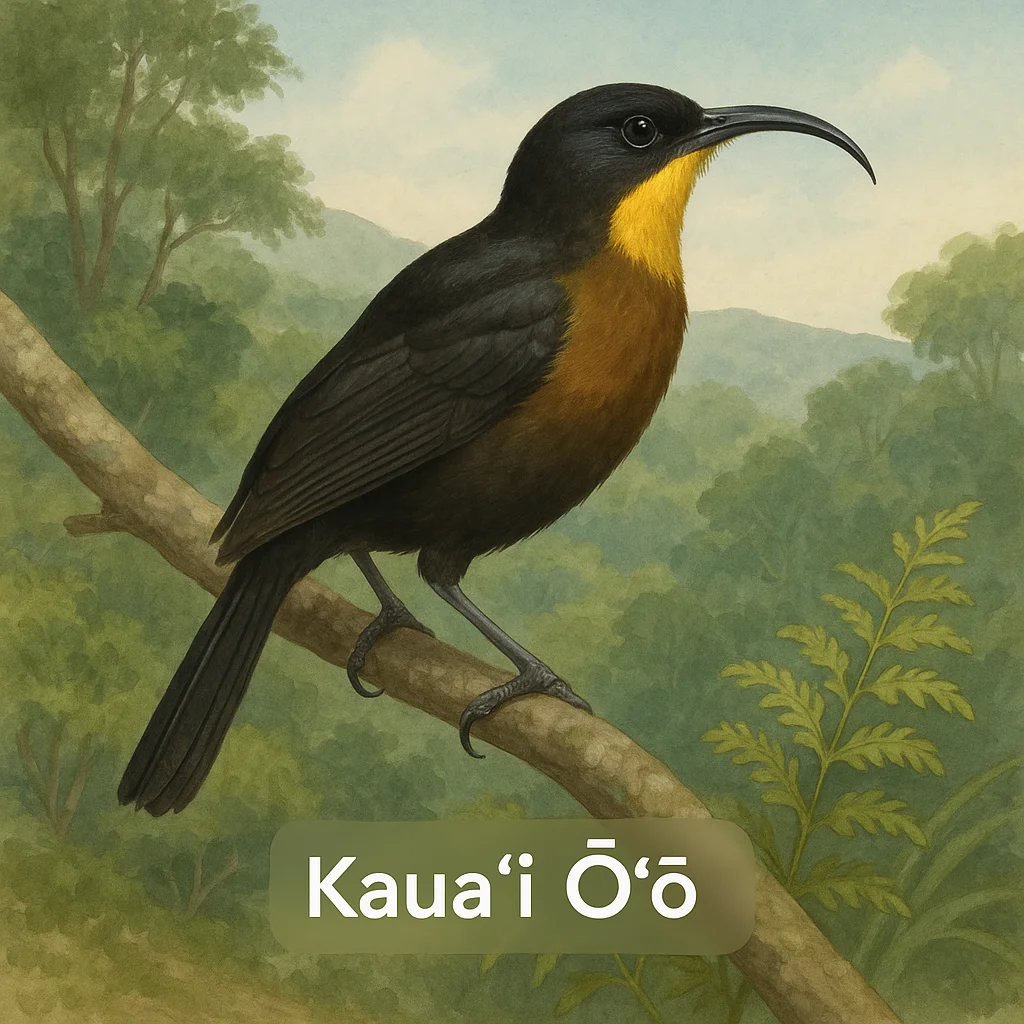
In terms of relatives, the Kauaʻi ʻŌʻō was closely related to other Hawaiian honeyeaters. However, these have also vanished, leaving no direct descendants. The Kauaʻi ʻŌʻō played a vital role in its ecosystem as a pollinator and seed disperser, contributing to the maintenance of forest integrity.
This article aims to guide readers through the life of the Kauaʻi ʻŌʻō, its habitat, why it disappeared, and the broader implications regarding extinction and biodiversity loss.
🧭 Where It Lived
The Kauaʻi ʻŌʻō was endemic to the island of Kauaʻi in the Hawaiian archipelago. This means it lived nowhere else on Earth. Its range was limited to the lush forests of Kauaʻi, particularly the highland and lowland rainforests which provided a rich diversity of flora.
Kauaʻi is known for its dense tropical rainforests, characterized by high rainfall and a warm climate. These forests offered an abundant supply of nectar and native fruits, essential for the diet of the Kauaʻi ʻŌʻō. The island's ecological isolation allowed unique species like the Kauaʻi ʻŌʻō to evolve.
However, being island-limited increased its risk of extinction. With no ability to expand its range beyond Kauaʻi, any threats to its habitat directly impacted its survival. This geographical confinement made it highly vulnerable to environmental changes and human activities.
🌿 Habitat and Daily Life
The Kauaʻi ʻŌʻō thrived in humid tropical rainforests, where temperatures remained relatively constant year-round and rainfall provided a steady ecosystem. This stable climate fostered the growth of flowering plants, whose nectar formed a critical part of the bird's diet.
The bird primarily fed on nectar from native flowers, using its curved bill to access the sweet liquid deep within blossoms. This diet was supplemented by fruits and insects, which were abundant in the lush environment.
Breeding occurred during specific seasons when food resources were plentiful. The Kauaʻi ʻŌʻō was believed to be a monogamous bird, with pairs raising a small number of offspring each year. Both parents participated in nurturing and feeding the young.
Interaction with other species included its role as a pollinator, vital for the propagation of many native plant species. The Kauaʻi ʻŌʻō helped maintain the balance of its ecosystem through these interactions.
🧬 What Made It Unique
The Kauaʻi ʻŌʻō had a striking appearance with glossy, black plumage and golden yellow leg feathers. Its song, a series of clear, flute-like notes, was a distinctive feature that filled the forests of Kauaʻi with melodious tunes. Its sounds were often described as haunting and beautiful.
The bird's specialized feeding adaptations, such as its curved bill, allowed it to access nectar, playing a crucial role in plant pollination. This ecological function made the Kauaʻi ʻŌʻō an indispensable part of its habitat's biodiversity.
Culturally, the Kauaʻi ʻŌʻō held significance for native Hawaiians, who viewed these birds as symbols of their rich natural heritage. The bird's song was often featured in traditional stories and chants, highlighting its importance in Hawaiian culture.
⏳ When It Disappeared
The last confirmed sighting of the Kauaʻi ʻŌʻō was in the late 1980s. The absence of recordings or reports since then has led to its classification as extinct. Announcing a species as extinct typically follows rigorous survey efforts; however, the remote and dense nature of Kauaʻi's forests made absolute confirmation challenging.
Extinction was declared following years of declining populations and failed attempts to observe any remaining individuals. Despite this, some uncertainty persists due to the bird's elusive nature, sparking occasional hope of rediscovery.
⚠️ Why It Went Extinct
The extinction of the Kauaʻi ʻŌʻō was likely due to a combination of factors. Habitat loss and fragmentation from deforestation and land development reduced the available living space essential for its survival.
Introduced species, such as rats and mosquitoes, posed considerable threats. Rats preyed on eggs and hatchlings, while mosquitoes spread avian malaria, to which native birds had no immunity. This disease was a significant factor in population decline.
Climate shifts could have also impacted the availability of key resources, adding stress to an already vulnerable species. As with many extinctions, a combination of human-induced changes and natural factors intertwined, making it difficult for the Kauaʻi ʻŌʻō to sustain viable populations.
🧩 How We Know (Evidence and Records)
Evidence of the Kauaʻi ʻŌʻō exists in various forms, including museum specimens, audio recordings of its song, and field notes from early ornithologists. These records provide crucial insights into its appearance and behavior.
Ornithologists and researchers verified the existence of the bird through these records and taxonomic studies. The overwhelming decline in sightings and the absence of any verifiable evidence for decades led to its extinction status.
The challenges in confirming its extinction include the difficult terrain and dense forest cover of its habitat, which may have shielded any remaining individuals from detection until it was too late.
🛡️ Could It Have Been Saved
The Kauaʻi ʻŌʻō might have been saved with timely conservation efforts, such as protecting its remaining habitat, controlling invasive species, and managing disease. Initiatives to preserve its ecosystem and reduce deforestation could have provided a critical buffer against extinction pressures.
However, conservation actions were limited and often delayed. The bird's decline was rapid after major threats were identified, highlighting the constant struggle between ecological preservation and development interests.
🔁 Are There Any Survivors or Close Relatives Today
Unfortunately, no direct relatives of the Kauaʻi ʻŌʻō survive today. The entire family of Hawaiian honeyeaters is believed to be extinct. However, other native Hawaiian bird species play similar ecological roles, although they face their own conservation challenges.
No known reintroduction or captive breeding programs exist for the Kauaʻi ʻŌʻō, partly because the species was declared extinct before such efforts became widespread.
❓ Common Questions and Misconceptions
Was it hunted to extinction? No, hunting was not a significant factor in the Kauaʻi ʻŌʻō's extinction.
Why didn’t it adapt or move? Being highly specialized and island-limited, the Kauaʻi ʻŌʻō had limited options for adaptation or movement.
Could it still be alive somewhere? While unlikely, the remote and dense forests of Kauaʻi leave a slim possibility.
What does 'declared extinct' actually mean? It means no individuals have been observed for a substantial period, leading scientists to conclude it no longer exists.
What is the difference between endangered and extinct? Endangered means a species is at risk of extinction, while extinct means it no longer exists.
Why are island species so vulnerable? Island species often evolve in isolation, making them particularly susceptible to environmental changes and invasive species.
📌 Summary
- The Kauaʻi ʻŌʻō was a forest bird native to Kauaʻi, Hawaii.
- It inhabited tropical rainforests on the island.
- Its habitat consisted of dense, humid forests crucial for foraging.
- The bird primarily fed on nectar, playing a pollinator's role.
- Its notable characteristic was a haunting song and unique appearance.
- The last known period alive was the late 1980s.
- Extinction drivers included habitat loss and invasive species.
- Museum specimens and recordings provide evidence of its existence.
- No close living relatives remain today.
- Conservation lessons highlight the need for proactive habitat protection.
- A memorable takeaway is its critical ecological role, lost with its extinction.