🏞️ Huia
🌍 What It Was
The Huia was a remarkable bird native to New Zealand, noted for its striking appearance and unique beak shapes between males and females. Belonging to the passerine bird family, it was a part of the New Zealand wattlebirds, a group now mostly extinct.
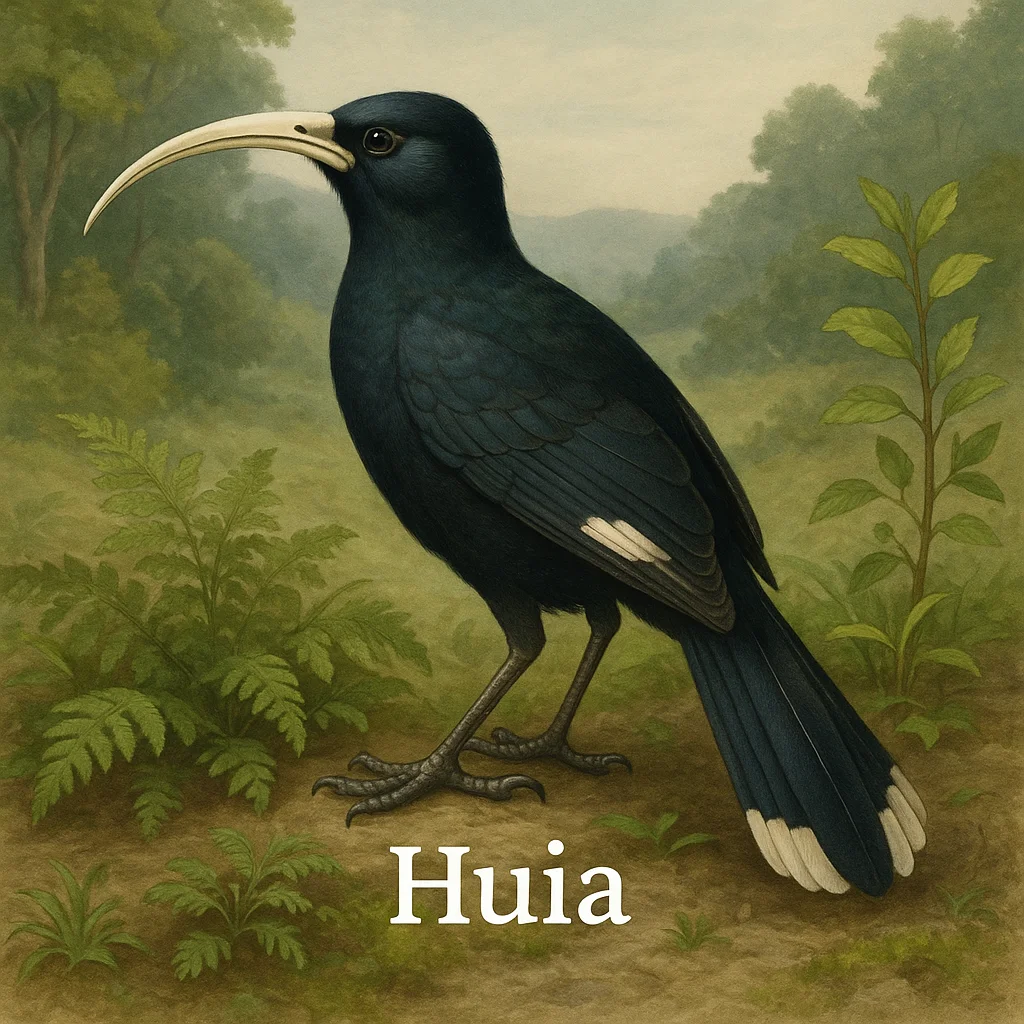
The male and female Huia had distinctly different beak shapes, with males possessing short, straight beaks and females having long, curved ones. This characteristic allowed them to exploit different food sources, which minimized competition. Its closest living relatives, though not direct, are other birds within the New Zealand forest ecosystems.
This article will guide you through where the Huia lived, its daily life, distinctive traits, circumstances around its disappearance, and the broader extinction science concepts associated with it.
🧭 Where It Lived
The Huia was endemic to New Zealand, specifically within the North Island. Endemic species are those found only in a specific geographic location. The Huia largely inhabited temperate forests in the central and southern regions of the island.
It thrived in dense, lush forests where ancient trees provided both food and shelter. These habitats were characterized by a mix of tall trees and a vibrant understory, supporting a diverse range of flora and fauna.
Being limited to island ecosystems meant that the Huia faced higher extinction risks due to its restricted range and specialization. Isolation often prevents the movement to new habitats, which can be problematic when environmental changes occur.
🌿 Habitat and Daily Life
The climate within the Huia's forest home was relatively mild, with plenty of rainfall and a stable temperature range. These conditions ensured a steady supply of food resources throughout the year.
The Huia's diet primarily consisted of insects and larvae found beneath tree bark. The different beak shapes of males and females enabled them to access various food sources; males could drill into wood, while females could probe deeper crevices.
The breeding season generally aligned with plentiful food availability, allowing both parents to care for their young. Their social structure is less clearly understood, but they likely formed small groups or pairs while foraging.
🧬 What Made It Unique
The Huia's most notable feature was the sexual dimorphism in beak shape—a rare trait among birds. This adaptation facilitated niche differentiation, meaning males and females could exploit different resources.
Their plumage was predominantly black with a distinctive wattle at the corner of the beak, which likely served a role in social signaling among individuals.
Beyond its ecological role, the Huia held cultural significance for the Māori people of New Zealand, symbolizing leadership and status. Huia feathers were highly prized, often worn by chiefs.
⏳ When It Disappeared
The last confirmed sightings of the Huia were in the early 1900s, with the bird officially declared extinct in the 1920s. A combination of habitat loss and intensive hunting hastened their decline.
While unconfirmed reports persisted for a while, a lack of credible sightings eventually led to the acknowledgment of their extinction.
The Huia is considered extinct rather than extinct in the wild. "Extinct in the wild" refers to species that survive only in captivity or controlled environments.
⚠️ Why It Went Extinct
Several factors contributed to the Huia's extinction, one of the most significant being habitat loss and fragmentation due to land clearance for agriculture.
Overhunting played a critical role as Huia skins and feathers became collector's items. The demand led to overexploitation of this unique bird.
Introduced species, such as rats and stoats, also impacted the Huia populations by preying on eggs and competing for similar food resources.
🧩 How We Know (Evidence and Records)
The evidence for the Huia's existence and extinction includes museum specimens, field notes from early naturalists, and photographs from the period preceding their extinction.
These records, in addition to oral histories from the Māori people, provide a composite picture of the bird's past abundance and cultural importance.
Genetic studies, while limited due to the age of samples, have corroborated much of the morphological and behavioral knowledge gathered from historical accounts.
🛡️ Could It Have Been Saved
In hindsight, several conservation actions might have altered the Huia's fate, such as habitat protection, regulated hunting practices, and control over invasive species.
The trade-offs involved in these steps included economic impacts and challenges in implementing protective measures in time. However, the global understanding of conservation was still developing at that time.
Regrettably, conservation efforts were minimal and largely ineffective by the time awareness of their plight was heightened.
🔁 Are There Any Survivors or Close Relatives Today
The Huia's closest living relatives are other New Zealand wattlebirds, though these are also under threat. Species like the Kōkako share similar vocalizations and ecological roles.
While no direct ecological replacements match the Huia's unique traits, other birds have assumed some roles in the ecosystem, like insect control through foraging.
No reintroduction or captive programs were established for the Huia, as its extinction was recognized before such conservation methods were widely employed.
❓ Common Questions and Misconceptions
Was it hunted to extinction? Hunting for feathers and museum specimens greatly contributed but was not the sole factor.
Why didn’t it adapt or move? Island species often have fewer options to relocate or adapt quickly enough to rapid changes.
Could it still be alive somewhere? While a romantic notion, lack of credible sightings suggests extinction.
What does 'declared extinct' actually mean? It means there is sufficient evidence that no surviving members exist in the wild.
What is the difference between endangered and extinct? Endangered species are at high risk of extinction, whereas extinct species have no surviving individuals.
Why are island species so vulnerable? Isolation, limited range, and unique ecological roles make them especially susceptible to disturbances.
📌 Summary
- The Huia was a unique bird endemic to New Zealand.
- It inhabited the North Island's temperate forests.
- Its diet primarily consisted of insects and was notably adapted to different feeding niches between genders.
- The Huia had distinctive beak shapes that minimized competition between males and females.
- The last confirmed sightings were in the early 1900s.
- Main extinction drivers included habitat loss and overhunting.
- Museum specimens and historical accounts provide evidence of its existence.
- Closest living relatives are other New Zealand wattlebirds.
- Conservation awareness highlights the need for timely action to prevent such losses.
- The Huia teaches us the importance of preserving biodiversity before it's too late.