🏞️ Dusky Seaside Sparrow
🌍 What It Was
The Dusky Seaside Sparrow was a small bird adapted to life in coastal wetlands. Known for its dark plumage, it stood out among its relatives with its unique coloring and song. As a part of the sparrow family, it shared similarities with other seaside sparrows, but with distinct characteristics that set it apart.
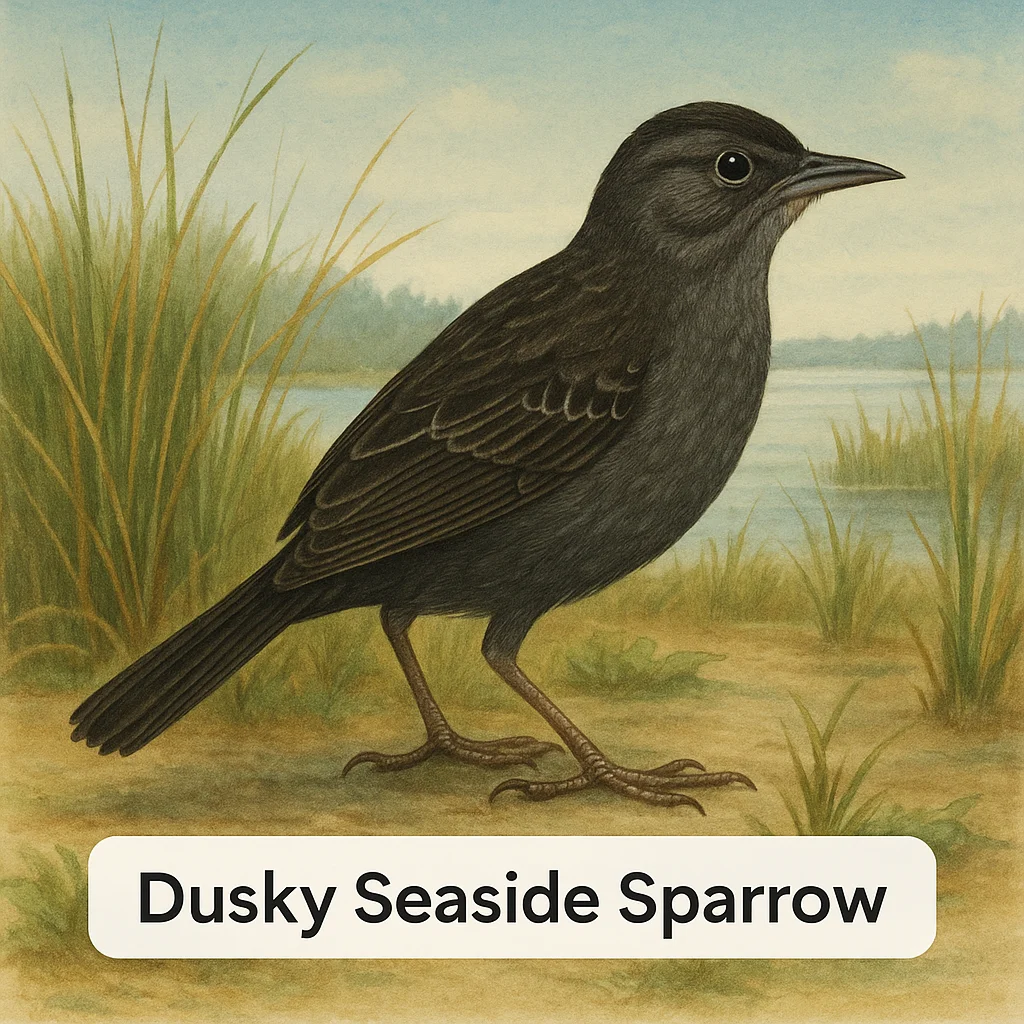
This sparrow was one of the several subspecies of the seaside sparrow, all indigenous to North America's coasts. The closest living relatives are other subspecies that continue to survive in regions less affected by human activity and environmental changes.
In this article, readers will learn about the Dusky Seaside Sparrow's natural habitat, lifestyle, the circumstances leading to its extinction, and what we can learn from its disappearance. By understanding these factors, we gain insights into extinction science and the importance of conservation.
🧭 Where It Lived
The Dusky Seaside Sparrow was endemic to the marshes along Florida's Atlantic coast, especially the St. Johns River and the region surrounding Merritt Island. This means it was found nowhere else in the world, making its small geographic range a critical vulnerability.
The sparrow relied heavily on salt marsh environments, which are wetlands flooded and drained by salt water brought in by tides. These habitats provided ample food and nesting grounds. Unfortunately, being restricted to a narrow ecological niche meant that any changes in these wetlands directly impacted the sparrow's survival.
Endemic species like the Dusky Seaside Sparrow are particularly susceptible to extinction due to their limited distribution. When their habitat is altered or destroyed, there is no alternate location where they can relocate and maintain their population.
🌿 Habitat and Daily Life
The Florida coastal climate was well-suited for the Dusky Seaside Sparrow, characterized by warm temperatures and high humidity. These conditions were critical for maintaining the dense vegetation and insect populations that formed the basis of the sparrow's diet.
The sparrow primarily fed on insects and small invertebrates found in the marsh. Its foraging behavior involved hopping among grasses and using its beak to access food sources hidden from view. This method was effective in sustaining its dietary needs.
Nesting took place in the tall marsh grasses, where the sparrow constructed its cup-shaped nests. Breeding season was aligned with the warmer months, allowing the sparrows to rear their young when food was plentiful. The sparrow’s life cycle revolved heavily around the conditions provided by its marsh habitat.
🧬 What Made It Unique
The Dusky Seaside Sparrow was distinguished by its darker feathers compared to other seaside sparrows, giving it a 'dusky' appearance that influenced its name. This plumage likely played a role in camouflage within the shadowy marsh environment.
Despite its small size, this sparrow was known for a robust song that it used to communicate within its territory. Such vocalizations not only served in mating rituals but also in warding off potential competitors within its habitat.
While the sparrow may not have had a direct cultural or historical significance to humans, its existence highlighted the biodiversity of Florida's wetland ecosystems and underscored the importance of preserving such unique habitats.
⏳ When It Disappeared
The last confirmed sighting of the Dusky Seaside Sparrow was in 1987. By this time, the population had dwindled to a few individuals, largely in captivity or under conservation watch. Declaring a species "extinct" involves significant evidence and consensus, following exhaustive searches that convince researchers no individuals remain.
The exact timeline of the Dusky Seaside Sparrow's decline is marked by habitat loss and fragmentation, as well as other human-induced changes in its environment. Extinction was officially declared in 1990, marking the end of a once-thriving population.
Due to its highly restricted habitat and the pace of environmental change, the sparrow couldn't adapt quickly enough to avoid extinction. It serves as a cautionary tale of how vulnerable species are to rapid environmental shifts.
⚠️ Why It Went Extinct
Habitat loss was the primary driver of the Dusky Seaside Sparrow's extinction. The draining of wetlands for development and mosquito control significantly reduced the available habitat necessary for the sparrow's survival.
Habitat fragmentation further compounded the problem, as isolated patches of suitable environment were insufficient to sustain a healthy breeding population. This separation of habitat fragments reduced genetic diversity and weakened the population's resilience.
Other factors included pollution and the introduction of invasive species, such as predatory birds and plants that altered the marsh ecosystem. These compound issues reveal that extinction is almost always multifaceted, involving several interacting causes.
🧩 How We Know (Evidence and Records)
Researchers relied on a mix of museum specimens, field observations, and historical records to document the Dusky Seaside Sparrow. Past surveys and biological collections provide a detailed chronicle of its existence and the changes in its habitat over time.
Such records help confirm species identification and provide insights into population dynamics. Accurate record-keeping and museum collections are invaluable for studying extinct species and understanding environmental history.
The sparrow's restricted range further complicated conservation efforts, as detecting remaining individuals became increasingly challenging. Unfortunately, the delayed recognition of its dwindling numbers contributed to the challenges in its preservation.
🛡️ Could It Have Been Saved
Efforts to protect the Dusky Seaside Sparrow involved habitat management and breeding programs, but they came too late and faced many challenges. Restoration of wetland habitats could have provided some relief, but large-scale changes were required.
Captive breeding initiatives started as the population declined, yet success was limited because few individuals remained, reducing genetic diversity. Protecting its habitat earlier might have offered a better chance for survival.
The sparrow's case underscores the need for timely conservation action to protect species before they reach critically low population numbers, highlighting the importance of proactive measures over reactive approaches.
🔁 Are There Any Survivors or Close Relatives Today
No Dusky Seaside Sparrows remain today; however, other seaside sparrow subspecies survive and share similar ecological roles within their respective habitats. These birds inhabit a range of coastal marshes along the eastern United States.
These living relatives provide a connection to the extinct sparrow's ecological niche and serve as a reminder of the fragility of species that depend on specialized habitats. Protecting these remaining subspecies can prevent history from repeating itself.
While no reintroduction programs exist for the Dusky Seaside Sparrow itself, learning from its extinction can inform conservation strategies for preserving other similar species along coastal ecosystems.
❓ Common Questions and Misconceptions
Was it hunted to extinction? No, hunting was not a primary factor, although habitat destruction played a significant role.
Why didn’t it adapt or move? The sparrow's adaptation to a specific habitat made relocation impractical, and rapid environmental change outpaced its ability to adapt.
Could it still be alive somewhere? Unlikely, given exhaustive searches and decades without confirmed sightings.
What does 'declared extinct' actually mean? It signifies that there is enough evidence to conclude no living individuals are left after exhaustive searches.
What is the difference between endangered and extinct? Endangered species are at great risk of extinction, whereas extinct species have no living individuals remaining.
Why are island species so vulnerable? Island species often have small populations and limited habitats, making them highly sensitive to environmental changes.
📌 Summary
- Once native to Florida's coastal marshes
- Exclusively relied on salt marsh habitat
- Mainly fed on insects and small invertebrates
- Distinguished by its dark plumage
- Last reliably seen in the late 1980s
- Primarily went extinct due to habitat loss
- Evidence includes museum specimens and field records
- Related to other surviving seaside sparrow subspecies
- Highlights the vulnerability of narrowly localized species
- A reminder of how crucial early conservation action is
- Reflects the broader concern for wetland preservation