🏞️ Sharp-snouted Day Frog
🌍 What It Was
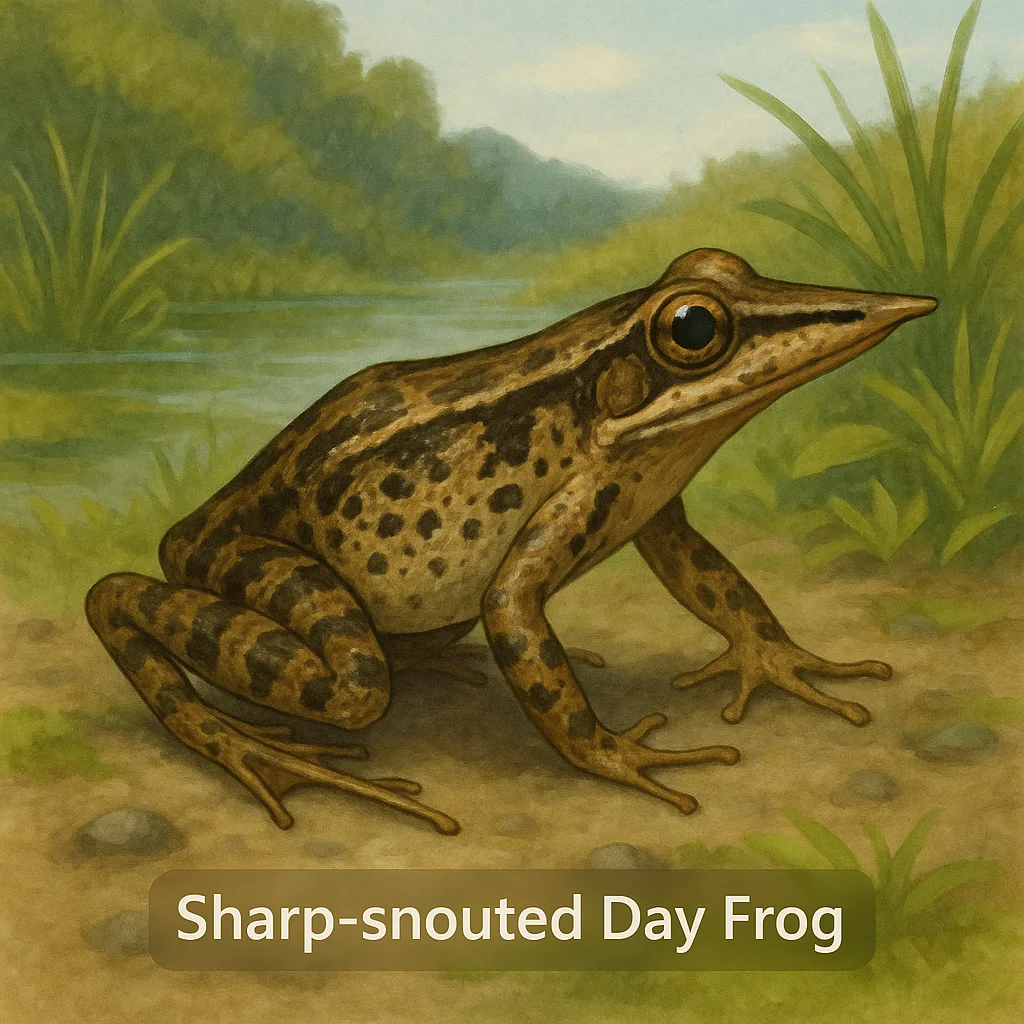
The Sharp-snouted Day Frog was a unique amphibian species known for its distinctively pointed snout. As a part of the tropical rainforest ecosystem, this frog played a significant role within its environment, contributing to the nutrient-rich leaf litter and serving as both predator and prey within its food web.
Closely related to other species in the genus Taudactylus, the Sharp-snouted Day Frog was part of a family of frogs known for their adaptation to diverse and specific ecological niches. While this particular species is no longer with us, its relatives offer insight into the behaviors and characteristics that were once shared.
In this article, we will explore various aspects of the Sharp-snouted Day Frog, including its habitat, lifestyle, and the factors that contributed to its extinction. By examining these elements, we can gain a better understanding of the delicate balance that ecosystems and their inhabitants maintain, and the consequences that arise when this balance is disturbed.
🧭 Where It Lived
The Sharp-snouted Day Frog was endemic to Australia, meaning it was found nowhere else in the world. Within Australia, its range was quite limited, restricted predominantly to the tropical rainforests of Queensland. These frogs inhabited areas characterized by dense canopy cover and high humidity.
This limited geographic range inherently increased the frog's vulnerability to environmental changes and human impacts. Being highly localized, any significant alteration in its habitat could dramatically affect the population's survival. The rainforest provided not only shelter but also the necessary resources for the frog's diet and reproductive activities.
The frog's dependence on a specific habitat type—the wet and lush rainforests—further underscored the importance of maintaining these ecosystems. Unfortunately, as we will discuss later, various factors led to the degradation of these crucial environments, thereby affecting the species that depended on them.
🌿 Habitat and Daily Life
The tropical rainforests of Queensland, where the Sharp-snouted Day Frog lived, were characterized by warm temperatures and heavy rainfall, creating a humid environment. Such conditions are ideal for many amphibians, providing both the moisture and foliage necessary for their survival.
The frog's diet primarily consisted of small insects and invertebrates. As a daytime forager, it relied on its keen eyesight and agility to capture prey. This diurnal activity is somewhat unusual among frogs, many of which are nocturnal, highlighting the frog's unique adaptations to its environment.
Reproduction for the Sharp-snouted Day Frog occurred during the rainy season when resources were abundant. Females laid eggs in moist areas, often in crevices or under leaf litter, where the humidity would aid in keeping the eggs viable until hatching. The frogs' interaction with other species in its environment was complex; they were both predators of smaller insects and prey to larger animals.
🧬 What Made It Unique
The Sharp-snouted Day Frog was easily distinguished by its slender body and pointed snout, which gave it an aerodynamic advantage, perfect for darting through underbrush and capturing quick-moving prey. Its coloring was typically a mix of greens and browns, offering camouflage amongst the rainforest leaves and branches.
Beyond physical adaptations, the Sharp-snouted Day Frog had a role in seed dispersal within its habitat. By consuming fruits and passing seeds in different locations, it helped to maintain the diversity and health of the rainforest plant life. This symbiotic relationship highlights the interconnectedness of animal and plant species within an ecosystem.
While there is no well-documented cultural or historical significance of the frog to humans, its presence in the ecosystem was nonetheless a testament to the rich biodiversity of Australia's rainforests and the evolutionary ingenuity required to survive in such a specialized niche.
⏳ When It Disappeared
The Sharp-snouted Day Frog was last observed in the early 1990s. After an initial decline in sightings, it was eventually declared extinct by researchers when dedicated surveys failed to locate any individuals. Declarations of extinction are made carefully, typically after exhaustive surveys and consideration of all available data.
However, there is always a degree of uncertainty in declaring a species extinct, especially in regions with dense and difficult-to-navigate terrain. The frog's natural habitat's remoteness may contribute to challenges in confirming such extinctions with absolute certainty, leaving a small possibility that undiscovered individuals might exist.
"Extinct in the Wild" is a classification used when species only survive in captivity. Unfortunately, for the Sharp-snouted Day Frog, no such captive populations existed, marking its complete disappearance from our planet.
⚠️ Why It Went Extinct
The extinction of the Sharp-snouted Day Frog was likely due to a combination of factors, highlighting the multifaceted nature of many extinction events.
Habitat Loss/Fragmentation: As land development increased in Queensland, many parts of the rainforest were cleared for agriculture and urban expansion. This habitat loss not only reduced the available living space for the frog but also fragmented the populations, making it harder for them to find mates and exchange genetic material.
Introduced/Invasive Species: Non-native species introduced into the frog's habitat may have competed for the same resources or directly preyed upon it. Such competition or predation can rapidly diminish populations not adapted to cope with these new threats.
Disease: The chytrid fungus, known for devastating amphibian populations worldwide, is thought to have been a significant factor in the decline of the Sharp-snouted Day Frog. The disease affects the skin, which is crucial for amphibians' respiration and hydration, leading to fatal outcomes.
Climate Shifts/Extreme Events: Changes in regional climates, whether from natural variability or human-induced shifts, can alter rainfall patterns and temperatures. Such changes can disrupt breeding cycles and food availability, creating additional stress on already vulnerable populations.
🧩 How We Know (Evidence and Records)
Evidence of the Sharp-snouted Day Frog's existence and its eventual extinction predominantly comes from field studies, museum specimens, and disease diagnostics. Researchers performing fieldwork documented the sightings and behaviors of the frog, providing crucial data on its population numbers over time.
Museum specimens preserve a genetic record of the frog, allowing scientists to further understand its characteristics and how it may have differed from its closest relatives. Such specimens can also be analyzed to detect pathogens, providing insights into any diseases the frog may have been susceptible to.
The verification of extinction typically involves thorough surveying and cross-referencing current conditions with historical records to assess occupation consistency. In some cases, genetic studies may be used to confirm a lack of recent activity when environmental factors alone aren't conclusively illustrative.
🛡️ Could It Have Been Saved
Hypothetically, several conservation measures might have helped preserve the Sharp-snouted Day Frog. Protecting large areas of its rainforest habitat would have been crucial to maintaining healthy population dynamics and genetic diversity.
Controlling invasive species could have relieved competitive and predatory pressures that the frog was not equipped to handle. With chytrid fungus identified as a factor in declines, efforts to study and mitigate the disease in natural habitats could have provided a significant survival boost.
Unfortunately, most conservation efforts were either not implemented or too delayed to effectively address the issues at hand. As a result, while potential strategies existed, they were not enough to save the species in time.
🔁 Are There Any Survivors or Close Relatives Today
The Sharp-snouted Day Frog, as a species, is extinct, but it had several close relatives within the Taudactylus genus. These continue to occupy similar ecological niches in Australian rainforests, although they too face similar environmental pressures.
While there are no direct "ecological replacements" that fill the exact role of the Sharp-snouted Day Frog, various other amphibian species contribute similarly to nutrient cycles and food webs within their habitats.
No structured reintroduction or captive breeding programs were successfully established for the Sharp-snouted Day Frog, making recovery efforts focused more on understanding and protecting its surviving relatives.
❓ Common Questions and Misconceptions
Was it hunted to extinction? No evidence suggests that hunting or collection was a significant factor in its extinction.
Why didn’t it adapt or move? Given its specialized adaptations for a specific habitat, rapid environmental changes likely outpaced its ability to adapt or find new viable habitats.
Could it still be alive somewhere? While it's always a possibility, extensive surveys have shown no reliable evidence of surviving populations.
What does "declared extinct" actually mean? "Declared extinct" means after thorough surveys, no individuals have been observed for a considerable time, and the likelihood of cryptic existence is minimal.
What is the difference between endangered and extinct? "Endangered" indicates a high risk of extinction in the near future, whereas "extinct" means no known individuals are left alive.
Why are island species so vulnerable? Island species often evolve in isolation with limited competition and predators, making them particularly susceptible to disturbances.
📌 Summary
- The Sharp-snouted Day Frog was a distinctive amphibian species with a pointed snout.
- It was endemic to Queensland, Australia, specifically within tropical rainforests.
- These frogs depended on moist, humid rainforest habitats.
- Their diet included small insects and invertebrates.
- They had unique diurnal foraging habits and played roles in seed dispersal.
- Last confirmed sightings were in the early 1990s.
- Extinction resulted from multiple factors: habitat loss, disease, invasive species.
- Scientific knowledge comes from specimens, field notes, and disease diagnostics.
- Closest living relatives belong to the Taudactylus genus.
- A key conservation lesson is the importance of timely protective actions.
- Species extinctions remind us of the intricate balance in ecosystems.