🏞️ Atelopus longirostris (Longnose Harlequin Frog)
🌍 What It Was
Atelopus longirostris, commonly known as the Longnose Harlequin Frog, was an extraordinary amphibian characterized by its vibrant coloration and distinctive long nose. This species was a true frog under the family Bufonidae, known for its bright skin patterns that served as a warning to potential predators about its toxic capabilities. Unlike some toads, this species was highly specialized to its environment, contributing significantly to its vulnerability.
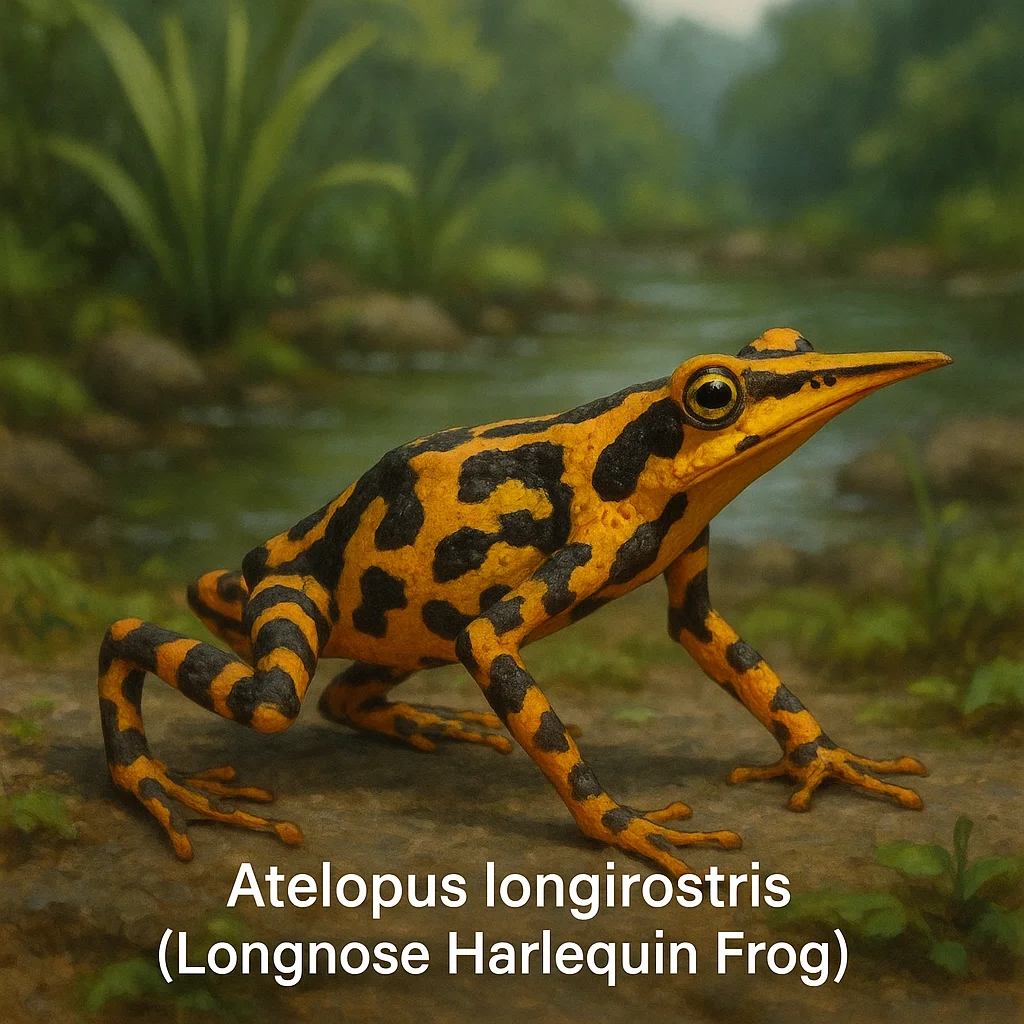
The Longnose Harlequin Frog was closely related to other species within the Atelopus genus, many of which are themselves facing severe threats and risk of extinction. These frogs typically played a crucial role in local ecosystems, particularly in controlling insect populations.
In this article, you will learn where Atelopus longirostris lived, how it thrived in its natural habitat, the timeline leading to its disappearance, and the suspected reasons behind its extinction. We will also explore what makes this species unique, the evidence for its existence, potential conservation options that might have helped, and whether any relatives continue to survive today.
🧭 Where It Lived
The Longnose Harlequin Frog was native to the tropical rainforests of Ecuador, specifically thriving in the Andes mountain range. These areas provided a unique and biodiverse habitat that supported a wide range of amphibian life. The Andes offered the perfect blend of elevation and moisture for such a species, making it a biological hotspot.
This frog primarily inhabited cloud forests, which are distinguished by their persistent low-level cloud cover. The cloud forests of the Andes are known for their humidity, rich flora, and complex ecosystem interactions. They faced threats primarily from human encroachment and environmental changes.
Being an area-restricted species, the Longnose Harlequin Frog faced significant risks due to habitat fragmentation and localized environmental changes. Species confined to such specific environments are inherently more vulnerable to these disturbances, as they have fewer options for relocation or adaptation.
🌿 Habitat and Daily Life
The cloud forests of the Andes were humid, with high levels of rainfall throughout the year and consistently moderate temperatures. This environment was crucial for the survival of the Longnose Harlequin Frog, which depended on moist conditions for skin respiration and reproduction.
The diet of Atelopus longirostris consisted mainly of small insects and other invertebrates. Its foraging behavior was largely ground-based, using its keen vision to spot and capture prey. The frog played a vital ecological role, aiding in the control of insect populations and thus maintaining balance within its habitat.
Reproduction for the Longnose Harlequin Frog was synchronized with the rainy season, when conditions were most favorable for egg development. This frog practiced external fertilization, with females laying eggs in moist environments where tadpoles could develop into adults.
Interaction with other species included avoiding predators and competing with other insectivorous creatures. Its toxicity, signaled by its bright colors, was a defense mechanism that helped deter potential predators.
🧬 What Made It Unique
The Longnose Harlequin Frog was noted for its slender body and elongated snout, traits that distinguished it from other toads and frogs in its range. Its bright coloration was not merely for display but served as aposematic signaling, a defense against predation.
This amphibian had a unique place in its ecosystem as a top insect predator. Its disappearance could have caused significant changes in food web dynamics, affecting both prey and predator species.
Culturally, amphibians like Atelopus longirostris have been important to local indigenous people, often appearing in folklore and as a part of natural heritage. However, exact cultural significance may vary and needs careful contextual interpretation.
⏳ When It Disappeared
The Longnose Harlequin Frog was last observed in the late 1980s. After this period, repeated surveys failed to locate any surviving individuals, leading to its classification as extinct. The formal declaration of extinction often requires rigorous attempts to locate any remaining individuals, which in this case, did not yield positive results.
Uncertainties in remote and inaccessible forest regions can complicate extinction declarations. These factors sometimes foster hope for rediscovery, although such chances are often slim.
When a species is declared "Extinct in the Wild," it indicates that its survival is limited to captive populations, if any exist. In the case of Atelopus longirostris, it is considered fully extinct as no such populations remain.
⚠️ Why It Went Extinct
One primary driver for the extinction of the Longnose Harlequin Frog was habitat loss and fragmentation due to deforestation. Forest areas were often cleared for agriculture, which disrupted the complex ecosystems these frogs depended on.
Another significant factor was the emergence of a fungal disease known as chytridiomycosis, which has decimated amphibian populations globally. The fungus affects the skin, impairing essential functions such as hydration and respiration in amphibians.
Climate shifts, leading to altered rainfall patterns and temperatures, could have further stressed the populations, aggravating existing vulnerabilities due to environmental changes.
These extinction factors are not isolated but typically interact, creating compounded effects that severely reduce survival and reproduction chances for vulnerable species like the Longnose Harlequin Frog.
🧩 How We Know (Evidence and Records)
Evidence of the Longnose Harlequin Frog’s existence is preserved through museum specimens, field notes, and photographs, all forming part of essential records that aid in identifying this species. Such specimens offer tangible evidence of the frog’s morphological characteristics.
Correctly identifying and dating these records help scientists ascertain species presence over time. Detailed field notes provide context, contributing to our understanding of when and where these frogs were last seen.
Challenges in verifying the existence of certain species can arise due to factors like their nocturnal habits, cryptic coloration that blends with the environment, or the sheer remoteness of their habitats, which makes finding and observing them inherently difficult.
🛡️ Could It Have Been Saved
Conservation actions that might have helped the Longnose Harlequin Frog include protecting forest habitats and instituting hunting or collection limits, although these actions require timely implementation to be effective.
Captive breeding programs could have provided a buffer against extinction, allowing conservationists to reintroduce the species if conditions improved. However, such efforts are complex, costly, and have uncertain outcomes for diverse species like amphibians.
Regrettably, many conservation efforts were initiated too late, only after the substantial decline of the populations had occurred, highlighting the challenges in responding promptly to emerging ecological threats.
🔁 Are There Any Survivors or Close Relatives Today
While Atelopus longirostris itself is no more, other species within the Atelopus genus still exist, though many of these are threatened. They share similar ecological roles and physical characteristics that the Longnose Harlequin Frog exhibited.
No formal reintroduction or captive breeding programs exist for Atelopus longirostris, but global efforts continue to focus on related species to prevent further losses.
These conservation measures prioritize habitat preservation and broader ecological management to sustain the remaining populations of closely related species still found in parts of South America.
❓ Common Questions and Misconceptions
Was it hunted to extinction? No, hunting was not a significant factor in its extinction. The key drivers were habitat loss and disease.
Why didn’t it adapt or move? This species was highly specialized and adapted to specific environmental conditions, making relocation or rapid adaptation challenging.
Could it still be alive somewhere? There is always a faint hope until extensive searches confirm otherwise, but it is officially declared extinct.
What does 'declared extinct' actually mean? It means the species has not been observed in the wild despite extensive searches, and no surviving individuals are known.
What is the difference between endangered and extinct? Endangered species are at a high risk of extinction, while extinct species are confirmed to have no living individuals left.
Why are island species so vulnerable? Island species often lack alternatives for relocation and are uniquely adapted to their specific environments, making them susceptible to changes.
📌 Summary
- The Longnose Harlequin Frog was a brightly colored amphibian with a distinct long nose, part of the Atelopus genus.
- It lived in the tropical cloud forests of the Andes in Ecuador.
- The species depended on humid forest environments for its lifecycle.
- It fed on insects, playing a crucial role in controlling these populations.
- Bright coloration served as a defense mechanism against predators.
- The frog was last observed in the late 1980s, leading to its extinction declaration.
- Key extinction drivers included habitat loss, disease, and climate change effects.
- Evidential records include museum specimens and field observations.
- Closest relatives are other Atelopus species still present in South America.
- The extinction highlights the need for timely conservation efforts.
- Atelopus longirostris serves as an important case study in amphibian population decline.