🏞️ Ainsworth’s Salamander
🌍 What It Was
Ainsworth’s Salamander was an amphibian known for its distinctive flattened body and vivid markings. As a member of the salamander family, it had specific traits that allowed it to thrive in its unique environment. Salamanders are known for their ability to regenerate lost limbs, a feature that played a crucial role in their survival and adaptation.
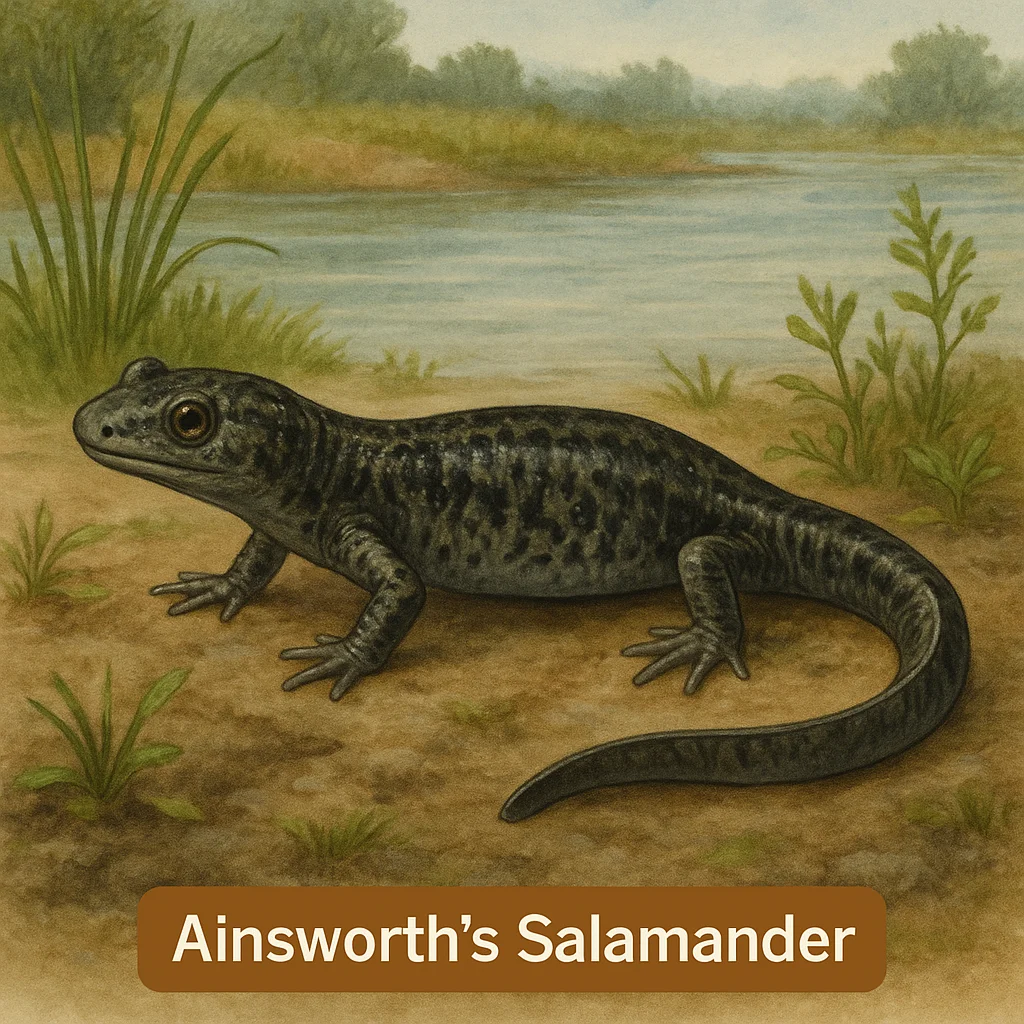
Closely related to modern species such as the Eastern Tiger Salamander, Ainsworth’s Salamander had a specialized role within its ecosystem. It served as both a predator and prey, fitting into a delicate balance within the food chain. Such amphibians often play important roles in controlling insect populations, making them essential for ecological health.
In this article, you will learn about where Ainsworth’s Salamander lived, how it lived its daily life, when it disappeared, and the reasons behind its extinction. We will also explore its unique characteristics and its place in the larger picture of conservation science.
🧭 Where It Lived
Ainsworth’s Salamander was native to a limited range in North America, primarily found in specific regions of Mississippi. The species inhabited areas with abundant streams and wetlands, as it required a moist environment to maintain its skin moisture and body temperature.
The habitat of Ainsworth's Salamander primarily included deciduous forested areas with ample leaf litter and fallen logs. These environments provided the shelter and resources necessary for its survival. Wetland habitats were crucial for breeding, as these provided the appropriate settings for laying eggs and developing juveniles.
The salamander's dependence on specific habitats increased its vulnerability to environmental changes. Any decline in water quality or alteration of land could have significantly impacted its survival. Living in a narrow geographic range made it more susceptible to localized threats, which are often more intense and less buffered compared to species with larger distributions.
🌿 Habitat and Daily Life
Ainsworth’s Salamander lived in a climate characterized by warm, humid summers and mild winters, with rainfall spread throughout the year. This climate supported lush vegetation, which was essential for the salamander’s microhabitat and survival.
The diet of Ainsworth’s Salamander consisted mainly of small invertebrates, such as insects and worms, which it hunted under the cover of night. Its nocturnal foraging behavior helped it evade predators while also playing a role in soil aeration through its movements.
Reproduction occurred in the spring season, when the salamanders gathered near water bodies to mate. After mating, females laid eggs in damp soil or under submerged vegetation, where the moisture would aid in their development. The absence of parental care meant the eggs and juveniles were left to fend for themselves, dependent on environmental conditions for their survival.
Interactions with other species likely included predation by birds and small mammals, as well as competition with other amphibians for resources. Its role as a mid-level predator allowed it to contribute significantly to the balance of its ecosystem.
🧬 What Made It Unique
Ainsworth’s Salamander was known for its vivid coloration, which ranged from black to bright yellow patterns, a possible adaptation for deterring predators or camouflaging in its habitat. Its flattened body allowed it to move easily under leaves and logs, a crucial adaptation for its forest environment.
Specialized skin glands produced toxins that served as a defense mechanism against predators. This adaptation was common among many salamanders, giving them an edge in surviving predation.
There are no well-documented cultural or historical significance of Ainsworth's Salamander, which likely reflects its relatively obscure presence in human observation records. However, its ecological role underscores the importance of preserving amphibian species for the health of ecosystems at large.
⏳ When It Disappeared
The last confirmed sighting of Ainsworth’s Salamander occurred in the early 2000s. Subsequent surveys in its known habitat failed to locate any individuals, leading to its classification as extinct by the International Union for Conservation of Nature (IUCN).
Extinction declarations often rely on the absence of sightings despite extensive searches in suitable habitats. In Ainsworth's case, the lack of verifiable evidence of its existence over a defined period led to the extinction categorization.
Uncertainties can linger due to the remote and often inaccessible nature of its habitat, which complicates the ability to definitively confirm extinction. Misidentifications and lookalike species also pose challenges in assessing the true status of such rare animals.
⚠️ Why It Went Extinct
Ainsworth’s Salamander faced multiple threats that contributed to its extinction. Habitat loss due to human encroachment and forest clearing critically reduced available living spaces. This fragmentation of habitats made isolated populations more vulnerable to extinction.
Pollution of water systems also posed a significant threat, as the species relied on clean water for reproduction and daily activities. Chemical runoff from agriculture and urban areas degraded the quality of their aquatic habitats.
Climate shifts, particularly changes in precipitation patterns, may have also led to habitat degradation. As salamanders are sensitive to moisture changes, alterations in local climate could have critically impacted breeding success and adult survivability.
Moreover, the introduction of invasive species like predatory fish into its habitat likely disrupted the ecological balance, adding pressure to already declining populations. While each factor alone might not have caused extinction, their combination resulted in a loss of resilience for Ainsworth’s Salamander.
🧩 How We Know (Evidence and Records)
Evidence of Ainsworth’s Salamander primarily comes from historical field notes and museum specimens. These records provided scientists with details about its morphology and ecological requirements. A small number of preserved specimens in natural history collections serve as physical proof of its existence.
Field observations documented both in historic notes and recent surveys helped assess its population trends over time. However, the rarity of the species made sightings sporadic, complicating accurate assessments of its status.
Verification of species identity relies on distinguishing morphological features captured in descriptive records. Ensuring accuracy can be challenging for species that are cryptic by nature or have experienced range reductions.
🛡️ Could It Have Been Saved
Protected habitat creation would have likely aided in preserving Ainsworth’s Salamander. Ensuring clean, unfragmented wetland environments could have given the species the resilience needed to survive fluctuations and threats.
Conservation actions such as invasive species control and pollution regulation could have reduced additional survival pressures on the salamander. Limiting changes in its natural ecosystem might have enabled populations to stabilize and recover.
Unfortunately, conservation efforts for Ainsworth’s Salamander came too late to prevent extinction. Lack of awareness and resources at the time meant that necessary actions were delayed, highlighting the need for proactive measures in conservation practice.
🔁 Are There Any Survivors or Close Relatives Today
While Ainsworth’s Salamander is extinct, its closest living relatives include other species of the same genus, like the Spotted Salamander. These relatives share similar ecological roles and morphological features, offering insight into the characteristics of the extinct species.
No direct reintroduction programs are feasible due to the absence of surviving populations. However, conserving related species that share similar ecological roles helps maintain the broader ecological function these amphibians serve.
❓ Common Questions and Misconceptions
Was it hunted to extinction? No, hunting was not the primary cause. Habitat loss and pollution were the main factors.
Why didn’t it adapt or move? Its specialized habitat needs limited its ability to adapt or relocate effectively.
Could it still be alive somewhere? Unlikely, as extensive habitat surveys have not found any survivors.
What does 'declared extinct' actually mean? It means no individuals have been observed over a significant period despite intensive searches.
What is the difference between endangered and extinct? Endangered means at risk of extinction; extinct means no longer any living members.
Why are island species so vulnerable? They often have limited ranges and specialized adaptations, making them susceptible to changes.
📌 Summary
- Ainsworth’s Salamander was a distinctive type of amphibian.
- It lived in North America, specifically in Mississippi.
- Its habitat included wetland forests.
- It fed on small invertebrates.
- Unique adaptations included skin toxins for defense.
- The last known period of existence was the early 2000s.
- Main extinction drivers included habitat loss and pollution.
- Evidenced by museum specimens and field records.
- Closest relatives are other salamander species.
- Key conservation lesson: need for proactive habitat protection.
- Memorable takeaway: extinction often results from multiple combined factors.