🏞️ What Must Change to Prevent More Loss
🌍 What It Was
The Great Auk was a flightless bird that once roamed the North Atlantic waters. It stood out because of its size, resembling a small penguin, and its distinct black and white plumage. These birds were expert swimmers, well adapted to life at sea but awkward on land.
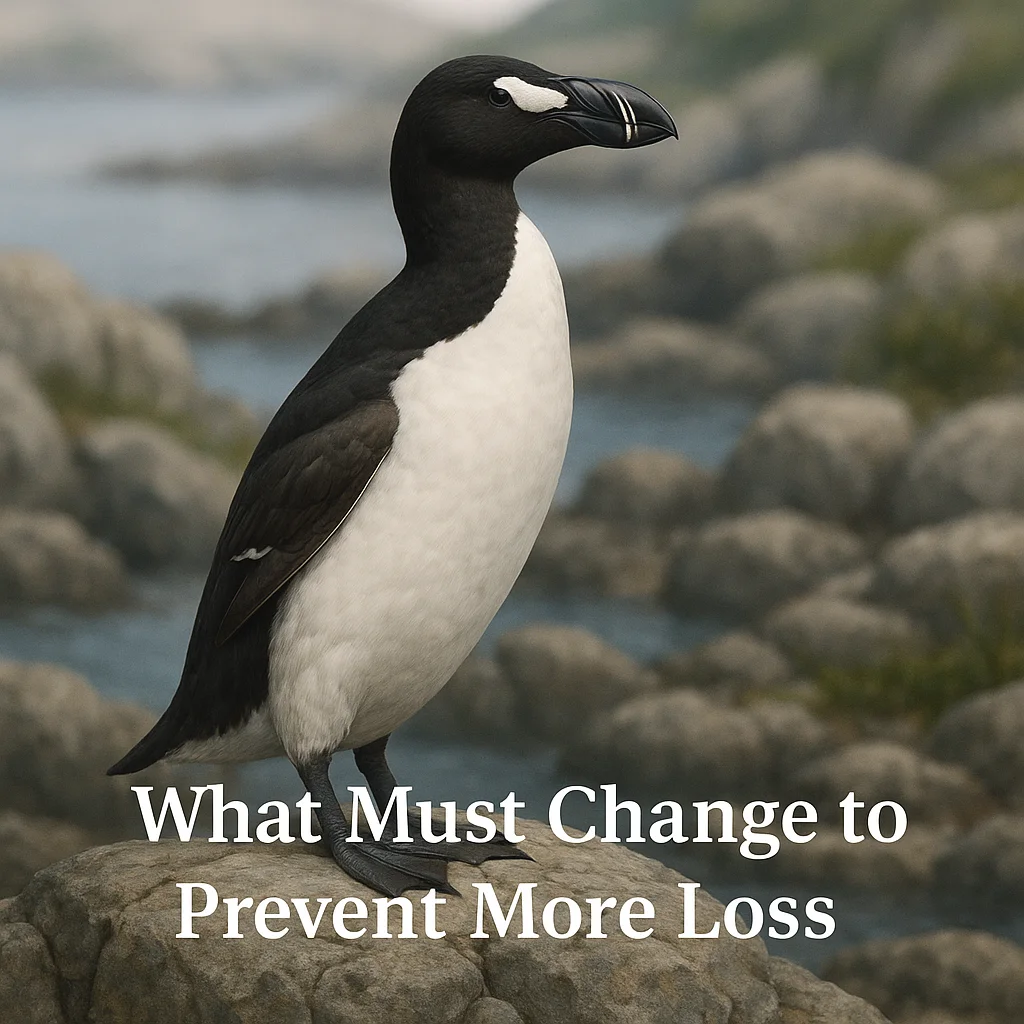
Closest living relatives to the Great Auk are the Razorbill and other alcids, seabirds that thrive in similar environments. The Great Auk functioned as an important predator in its ecosystem, feeding on fish and invertebrates.
This article will explore the geographic range, habitat, and factors leading to the Great Auk's extinction. We will look at where they lived, their daily lives, why they went extinct, and what we can learn to prevent future loss.
🧭 Where It Lived
The Great Auk was once widespread across the North Atlantic, inhabiting coastal areas of Europe, America, and the North Sea. Their range extended from Canada and the northeastern United States to Greenland, Iceland, and the British Isles.
The habitat of the Great Auk was primarily rocky islands and coasts, areas that provided shelter and easy access to the ocean for feeding. These birds were exclusively coastal, seldom venturing far inland, relying on coastal cliffs and rocky islets for nesting.
Being island-limited significantly increased the Great Auk's extinction risk. Islands offered limited escape from predators and environmental changes, while being highly susceptible to human disturbance. Their restricted breeding sites made their populations vulnerable to overexploitation.
🌿 Habitat and Daily Life
The Great Auk's habitat consisted of cold maritime environments with harsh winters and cooler summers. Despite this, their dense feathers provided insulation, allowing them to thrive in icy waters.
Primarily feeding on fish and crustaceans, the Great Auk was a proficient diver, using its wings to 'fly' underwater. They formed large colonies during the breeding season, with both parents sharing the responsibility of incubating the single egg laid each year.
Socially, the Great Auk had a cooperative lifestyle, often seen in large groups, which likely provided safety in numbers from predators like orcas and humans. However, once human activities intensified, their group behavior made them more susceptible to hunting.
🧬 What Made It Unique
The Great Auk possessed notable physical traits, such as its large size, standing up to 85 cm tall, and its powerful beak adapted for catching slippery prey. Its black and white coloring not only camouflaged it against the sea but also helped regulate its body temperature.
Known primarily for its exceptional swimming ability, the Great Auk played a crucial role in its ecosystem by controlling fish populations. These birds left a mark on various cultures, depicted in European folklore and sought after for their meat and feathers.
⏳ When It Disappeared
The decline of the Great Auk began in earnest during the late 16th century, with final confirmed records in the mid-1800s. As the 19th century progressed, reports of sightings dwindled dramatically.
Its designation as extinct came after the last known individuals were killed in 1844 on the Icelandic island of Eldey. Some ambiguity exists due to the remote nature and inaccessibility of its breeding sites, making it hard to confirm exact dates.
In this context, "Extinct" means the species no longer exists in any wild or controlled environments, differentiating from "Extinct in the Wild," where some may survive under human care.
⚠️ Why It Went Extinct
The extinction of the Great Auk was driven by a combination of factors. Habitat loss played a role as coastal developments encroached on their breeding sites. Overhunting, primarily for feathers and as an easy food source, critically depleted their numbers.
Introduced species, such as rats and dogs, posed new predation challenges on breeding islands, further stressing populations. Meanwhile, climate shifts might have affected fish stocks they depended on, presenting another layer of difficulty in survival.
Pollution also impacted these birds, as human activity increased near their habitats. This extinction story highlights how different pressures often act together, rather than independently, to threaten species.
🧩 How We Know (Evidence and Records)
The evidence of the Great Auk's existence and history comes from various sources. Subfossils and preserved bones provide direct physical evidence of their size and features.
Museum specimens and historical hunting records offer snapshots of their distribution and abundance. Field notes and early photographs contribute to understanding their behavior and appearance.
Oral histories and ecological observations helped confirm their decline. Scientists use this evidence to verify species identity, establish timelines, and comprehend the disappearance context.
🛡️ Could It Have Been Saved
Conservation actions, such as protected breeding sites and restrictions on hunting, might have helped preserve the Great Auk. However, these measures came too late as human pressures had already pushed them toward extinction.
Trade-offs included the difficulty of enforcing laws over remote regions and balancing human economic interests with wildlife conservation. Unfortunately, effective actions only began as the population was nearing irreversible decline.
Late conservation attempts included protective laws and recognition of their critical status, but by then, the key population strongholds had already been disrupted beyond repair.
🔁 Are There Any Survivors or Close Relatives Today
Today, the Razorbill is the closest living relative of the Great Auk, sharing similar ecology and behaviors. These birds continue to inhabit parts of the northern hemisphere, filling some aspects of the ecological role their extinct cousin once held.
While no active reintroduction programs for the Great Auk exist, understanding their life history provides valuable insights for managing existing alcid populations, ensuring ecological balance in similar environments.
❓ Common Questions and Misconceptions
Was it hunted to extinction? Yes, extensive hunting for feathers and meat was a significant factor in its extinction.
Why didn’t it adapt or move? The Great Auk was highly specialized for its environment, making adaptation difficult. Limited range and breeding sites also restricted movement.
Could it still be alive somewhere? While unlikely, remote areas without extensive surveys could theoretically harbor unknown individuals.
What does 'declared extinct' actually mean? It signifies that no known individuals exist in any habitat, wild or artificial.
What is the difference between endangered and extinct? Endangered species still exist but face a significant risk of extinction, while extinct species have no surviving individuals.
Why are island species so vulnerable? Island species often evolve in isolation, having less defense against new predators and diseases, with limited range and resources.
📌 Summary
- The Great Auk was a flightless seabird native to the North Atlantic.
- It lived along rocky coastal areas in Europe and North America.
- Habitats included cold maritime environments and remote islands.
- Its diet consisted mainly of fish and invertebrates.
- Size and swimming ability distinguished it as a predator.
- The last known period of existence was the mid-1800s.
- Main extinction drivers included hunting, habitat loss, and introduced species.
- Evidence from fossils, museum specimens, and historical records informs our understanding.
- Closest living relative is the Razorbill.
- A key lesson is the importance of early, robust conservation efforts.
- One memorable takeaway is the Great Auk's stark illustration of multi-causal extinction factors.