🏞️ The 2000s: Recent Extinctions & Near-Misses
🌍 What It Was
The 2000s witnessed the unfortunate disappearance of several unique species and the narrow escape of others. This period in Earth's history serves as a lens through which we can better understand the dynamics of extinction and survival. This article highlights a few prominent examples of recent extinctions and near-misses, focusing on what we can learn from these events.
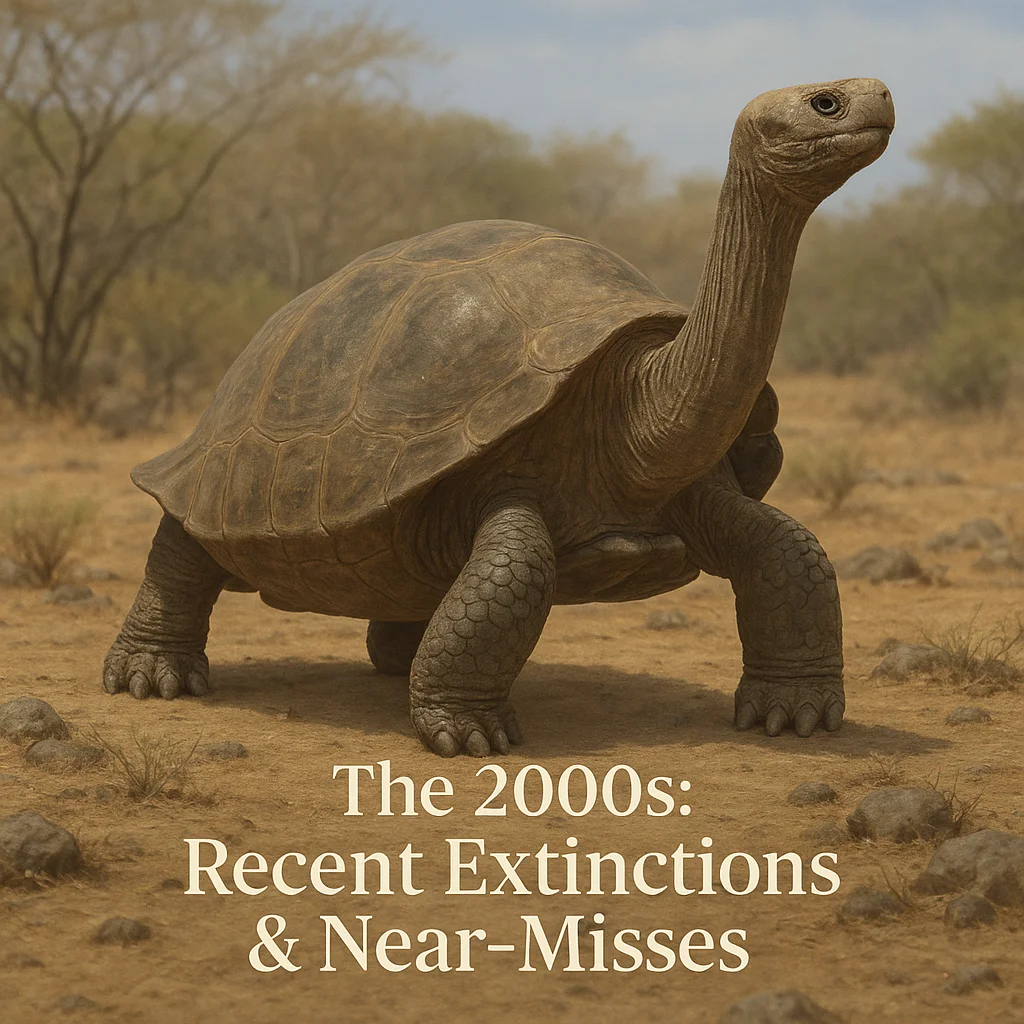
Examples include the Pinta Island tortoise and the Yangtze River dolphin. These creatures were not only unique in their own right but also played essential roles in their respective ecosystems. The closest living relatives of these species continue to offer insights into biodiversity and ecological interconnectivity.
In this exploration, we will cover various aspects of these animals’ lives, including their habitats, daily lifestyles, unique characteristics, causes for extinction, and what could have potentially saved them. By understanding these elements, we hope to guide future conservation efforts and avoid further losses.
🧭 Where It Lived
The Pinta Island tortoise, a giant tortoise species, hailed from the Galápagos Islands, notably Pinta Island. This region is renowned for its endemic species, animals that are found nowhere else in the world. The limited range on a single island made the tortoise especially vulnerable.
The Yangtze River dolphin, possibly extinct, lived in China’s Yangtze River, the longest river in Asia. The river basin, historically a biodiverse hotspot, supported numerous aquatic and terrestrial species intertwined in a delicate ecological balance.
The restriction to specific islands or river basins heightens the risk of extinction for species like these. Geography limits their capacity to escape threats, making it more challenging to migrate or adapt when their existing habitats face existential challenges.
🌿 Habitat and Daily Life
The typical environment of the Pinta Island tortoise included arid zones with sparse vegetation, which experienced distinct wet and dry seasons. These giant tortoises were primarily herbivorous, feeding on grass, leaves, and fruit, exerting a significant influence over plant distribution through their grazing and seed dispersal activities.
The Yangtze River dolphin thrived in freshwater ecosystems, showing adaptability to varied climatic conditions within the river's regions. These mammals used echolocation, a sensory technique, to hunt fish, their primary diet. Understanding their social and solitary behaviors enriches our comprehension of their species-specific needs for survival.
Both species had distinct reproductive strategies. Tortoises laid eggs on land, requiring suitable nesting sites, while dolphins gave birth to live young, relying on nurturing maternal care for survival. These reproductive strategies, adapted to their environments, underscore their evolutionary success and vulnerabilities.
🧬 What Made It Unique
The Pinta Island tortoise boasted a robust shell and a long neck, adaptations allowing access to high vegetation. Additionally, their slow metabolism contributed to their long life span, making them marvels of evolution.
Distinctive features of the Yangtze River dolphin included their light gray color and elongated beaks. Their echolocation capabilities were crucial for navigation and hunting in the often-murky waters of the Yangtze River.
These species also carried cultural significance. The tortoises were emblematic of the Galápagos archipelago's unique biodiversity, while the dolphins were cultural symbols in China, integral to local folklore and history.
⏳ When It Disappeared
The Pinta Island tortoise was last recorded in 2012 when Lonesome George, the final known individual, passed away. His death marked the species' extinction, as no other tortoises were found despite extensive searches.
The Yangtze River dolphin’s last confirmed sighting was in the early 2000s, but the lack of sightings in subsequent surveys has rendered the species functionally extinct. Functionally extinct means no viable breeding population exists, although a few isolated individuals may remain.
Declaring a species extinct requires comprehensive and continuous surveys, typically across decades, highlighting the challenges in distinguishing true extinction from mere absence.
⚠️ Why It Went Extinct
Habitat loss and fragmentation significantly impacted both species. Agriculture and urban expansion reduced the availability of suitable habitats for the tortoise, while the construction of dams and water pollution altered the Yangtze River environment.
Overexploitation also played a role. Introduced species, such as rats and goats on Pinta Island, competed with tortoises for resources. Similarly, the Yangtze River faced overfishing and increased vessel traffic, which directly and indirectly impacted the dolphin population.
Invasive species introduced predators and competitors to new environments, causing native species to decline. Furthermore, climate shifts and pollution worsened these pressures, creating a perilous situation for animals whose survival depended on stable ecosystems.
🧩 How We Know (Evidence and Records)
Evidence from fossils, museum specimens, and detailed field notes provide invaluable insights into past populations. For instance, Charles Darwin's observations in the 1800s remain pivotal to our understanding of species like the Galápagos tortoises.
Photographic records and oral histories from local communities supplement scientific documentation, helping to humanize and contextualize scientific understanding. Genetic analysis has also been instrumental, allowing scientists to confirm species identity and relationships even after extinction.
Detection challenges arise with elusive species, as nocturnal or deep-sea creatures are inherently harder to locate. The absence of evidence is not evidence of absence but also highlights the importance of rigorous and sustained scientific efforts.
🛡️ Could It Have Been Saved
Conservation actions, such as protecting habitats, limiting hunting, controlling invasive species, and captive breeding, might have offered lifelines to these species. Unfortunately, effective measures were often delayed.
The case of Lonesome George exemplifies conservation challenges, as a last-minute search for potential mating partners underscored the importance of earlier interventions. Captive breeding programs, if initiated sooner, might have supported population recovery.
Trade-offs in conservation priorities and resource allocation also impact effectiveness. Therefore, proactive, rather than reactive, conservation efforts are essential to prevent further loss.
🔁 Are There Any Survivors or Close Relatives Today
While the Pinta Island tortoise is extinct, other subspecies of Galápagos tortoises continue to thrive, providing a genetic reservoir for potential reintroduction efforts. Conservationists are exploring these possibilities while safeguarding existing populations.
For the Yangtze River dolphin, its closest relative, the finless porpoise, currently inhabits the Yangtze River. Conservation efforts now focus on protecting this remaining cetacean species from similar fates.
Ecological replacements fulfill similar roles within ecosystems, ensuring continuity of function. In some cases, captive programs succeed in stabilizing populations, highlighting the resilience of nature and the potential for recovery through concerted action.
❓ Common Questions and Misconceptions
Was it hunted to extinction? Overhunting exacerbated risks, but habitat loss and invasive species were key drivers.
Why didn’t it adapt or move? Constrained by geography and rapid environmental changes, evolutionary adaptation was unlikely.
Could it still be alive somewhere? Functional extinction doesn't preclude isolated individuals, but viable breeding populations are unlikely.
What does 'declared extinct' actually mean? A species is declared extinct after exhaustive surveys show no surviving individuals.
What is the difference between endangered and extinct? Endangered species are critically at risk, whereas extinct species have no surviving members.
Why are island species so vulnerable? Limited ranges and distinct ecological niches make island species particularly susceptible to changes.
📌 Summary
- The Pinta Island tortoise and Yangtze River dolphin are recent examples of extinction.
- These species lived in isolated regions, such as islands and rivers, increasing their vulnerability.
- Crucial habitats were arid zones and freshwater systems.
- Their diets consisted mainly of plants and fish, respectively.
- Unique features included long necks for tortoises and echolocation in dolphins.
- Last known occurrences were in the early 2000s for both species.
- Main drivers included habitat loss, invasive species, and overexploitation.
- Evidence comes from fossils, field notes, and genetic analysis.
- Closest living relatives offer insights and possible conservation avenues.
- The key lesson is proactive conservation measures are crucial.
- The extinction stories emphasize the importance of protecting biodiversity.