🏞️ Railroads, Cities, and Habitat Fragmentation
🌍 What It Was
The Carolina Parakeet was a vibrant species of parrot that was once native to the United States. Known for its colorful plumage of green, yellow, and orange, it was a unique and recognizable bird within its ecosystem. Its closest living relative is thought to be the sun parakeet, found in South America, though they are not quite the same.
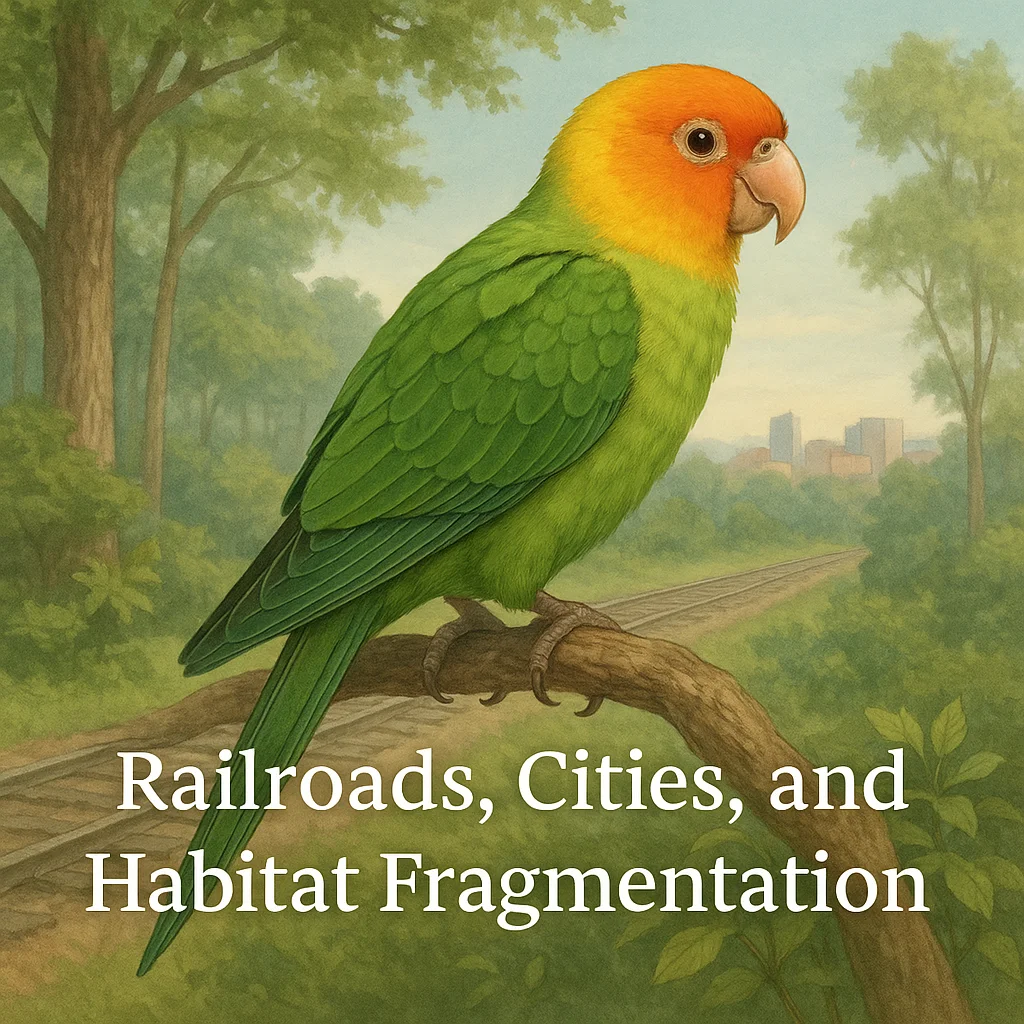
This parakeet played a crucial role in its environment by aiding in seed dispersal, which helped maintain healthy plant communities in its habitat. In this article, you will learn about where it lived, how it lived, and the factors that contributed to its disappearance from our world.
Through understanding the story of the Carolina Parakeet, we gain insight into the importance of conserving biodiversity and the impact of human activity on wildlife.
🧭 Where It Lived
Historically, the Carolina Parakeet was found in a wide range across the eastern United States, from the plains of Nebraska to the forests of Florida. Its range extended throughout the Mississippi-Missouri River system, favoring regions with abundant forests.
The parakeet thrived in mature forests and swampy areas where it found an abundance of fruits, seeds, and nuts, which made up the bulk of its diet. These habitats provided not only food but also nesting sites essential for their reproduction.
The unique localization to the dense forest areas made the species highly susceptible to habitat changes. As deforestation and development encroached upon these territories, the Carolina Parakeet found itself increasingly pushed into smaller, fragmented areas of habitat, heightening its risk of extinction.
🌿 Habitat and Daily Life
The Carolina Parakeet lived in subtropical climates ranging in temperature from mild to hot, with reasonable rainfall spread throughout the year. These consistent environmental conditions allowed a stable supply of food sources.
Their diet consisted predominantly of seeds from grasses and trees, notably favoring cockleburs, which are small spiny seeds. While feeding, these birds often formed small flocks, which helped them ward off predators and efficiently exploit food sources.
Breeding usually took place in the spring, with parakeets forming monogamous pairs. They nested in cavities of large trees, where females laid clutches of usually two to five eggs. Both parents shared the responsibility of incubating the eggs and providing care to the hatchlings.
Alongside their foraging and social behaviors, the Carolina Parakeet was an essential member of its ecosystem. It helped in spreading seeds far from parent plants, thus contributing to forest regeneration and biodiversity maintenance.
🧬 What Made It Unique
The Carolina Parakeet was distinctive not only for its striking plumage but also for its social nature. It was one of the few parrot species native to North America, making it ecologically significant.
Its coloration served various purposes, including mate attraction and camouflage among the colorful leaves and flowers of its habitat. The structure and size of its beak were well adapted for cracking tough seed shells, enabling it to access food sources unavailable to other species.
In terms of historical significance, the Carolina Parakeet was often captured and kept as a pet though this was not sustainable and contributed to its overall decline. Despite its popularity, little was done during its time to enforce protective measures for wild populations.
⏳ When It Disappeared
The decline of the Carolina Parakeet began in the late 1800s, with the last confirmed sighting occurring in the wild in the early 1900s. By 1939, the species was declared extinct after exhaustive searches yielded no evidence of any survivors.
Uncertainties remain regarding its exact date of extinction because unconfirmed sightings persisted for some years after these dates. Factors such as deforestation and human expansion were compounded by its limited range and habitat specificity.
When a species is declared extinct, it means there are no known surviving individuals. It typically involves a combination of exhaustive surveys and historical evidence confirming the absence of sightings over a significant period.
⚠️ Why It Went Extinct
The extinction of the Carolina Parakeet was a result of several interrelated factors. The primary driver was habitat loss due to the extensive clearing of forests for agriculture, settlement, and urban development. As forests disappeared, so too did the parakeet's food sources and nesting sites.
Overhunting played a role, as these birds were often killed for their feathers, which were used in the millinery (hat-making) industry. Additionally, many were shot by farmers who considered them pests.
Introduced species such as cats also preyed on these birds. Diseases introduced by European poultry may have further decimated their populations, although this theory remains less substantiated compared to others.
Overall, the extinction of the Carolina Parakeet is an example of how multiple pressures, including habitat fragmentation and human exploitation, can combine to drive a species to extinction.
🧩 How We Know (Evidence and Records)
Our knowledge about the Carolina Parakeet comes from various sources. Museum specimens have provided invaluable information about their physical characteristics, while historical field notes documented their behaviors and habitats.
Fossil records, though scarce, support the understanding of their former distribution. Genetic studies have not been possible, as no viable DNA samples remain, but ongoing archaeological work sometimes reveals more insights into their lives and extinction.
Oral histories and folk traditions also give hints about the parakeet's presence and interactions with humans, although these are less reliable as scientific evidence.
🛡️ Could It Have Been Saved
Several conservation actions could have aided the Carolina Parakeet. Protecting large areas of its native forest habitat would have been crucial, as would regulations on hunting and trade.
Captive breeding programs, if implemented early enough, might have bolstered populations, giving them a buffer against environmental changes. Unfortunately, conservation awareness and action came too late, hindering any effective measures.
Trade-offs, such as land-use decisions favoring agriculture over wildlife, complicated conservation efforts. By the time conservation laws were considered, much of the population had already dwindled to unsustainable levels.
🔁 Are There Any Survivors or Close Relatives Today
The Carolina Parakeet has no direct descendants, as it was the only member of its genus. Close living relatives are found in South America, like the sun parakeet, which shares the familial traits of coloration and social behavior.
Ecological replacements for its role in seed dispersal within the U.S. do not quite exist, leading to changes in plant community compositions in its former range. Adaptation efforts or ecological engineering may attempt to replace this role through other means.
No current reintroduction or captive programs exist since the bird was considered extinct before such initiatives were common. Modern efforts focus instead on understanding its extinction to prevent similar fates for other species.
❓ Common Questions and Misconceptions
Was it hunted to extinction? Overhunting contributed, but habitat loss was more significant.
Why didn’t it adapt or move? Its specific habitat needs and limited range hindered adaptability.
Could it still be alive somewhere? Unlikely, given exhaustive searches and lack of credible sightings.
What does 'declared extinct' actually mean? It means no known individuals remain despite thorough searches.
What is the difference between endangered and extinct? Endangered species are at high risk of extinction but still exist.
Why are island species so vulnerable? They often have limited ranges and specific adaptations, making them less resilient to change.
Could captive breeding have saved it? Possibly, but efforts began too late when populations were already critically low.
What role did disease play? Suggested as a factor, but evidence is less certain compared to habitat loss and hunting.
📌 Summary
- The Carolina Parakeet was a colorful parrot native to the U.S.
- Lived in southeast and east-central United States.
- Dependent on forest and swampy habitats.
- Diet consisted mainly of seeds, particularly cockleburs.
- Adapted for seed dispersal and social flocking behaviors.
- Extinction declared in the early 1900s, last sighted in the wild in the early 20th century.
- Main extinction drivers included habitat loss and overhunting.
- Evidence includes museum specimens and historical records.
- Closest relatives are found in South America, such as sun parakeets.
- Highlights the consequences of habitat fragmentation and human impact.
- Remember, conserving habitat is crucial for species survival.