🏞️ Key Extinction Case Studies of the 1800s
🌍 What It Was
The 1800s witnessed the disappearance of several remarkable species. Among them were the Great Auk, a large flightless bird once found in the North Atlantic, and the broad-snouted Solitaire, a flightless bird native to Rodrigues Island in the Indian Ocean. These animals were awe-inspiring in their ways and played critical roles in their ecosystems.
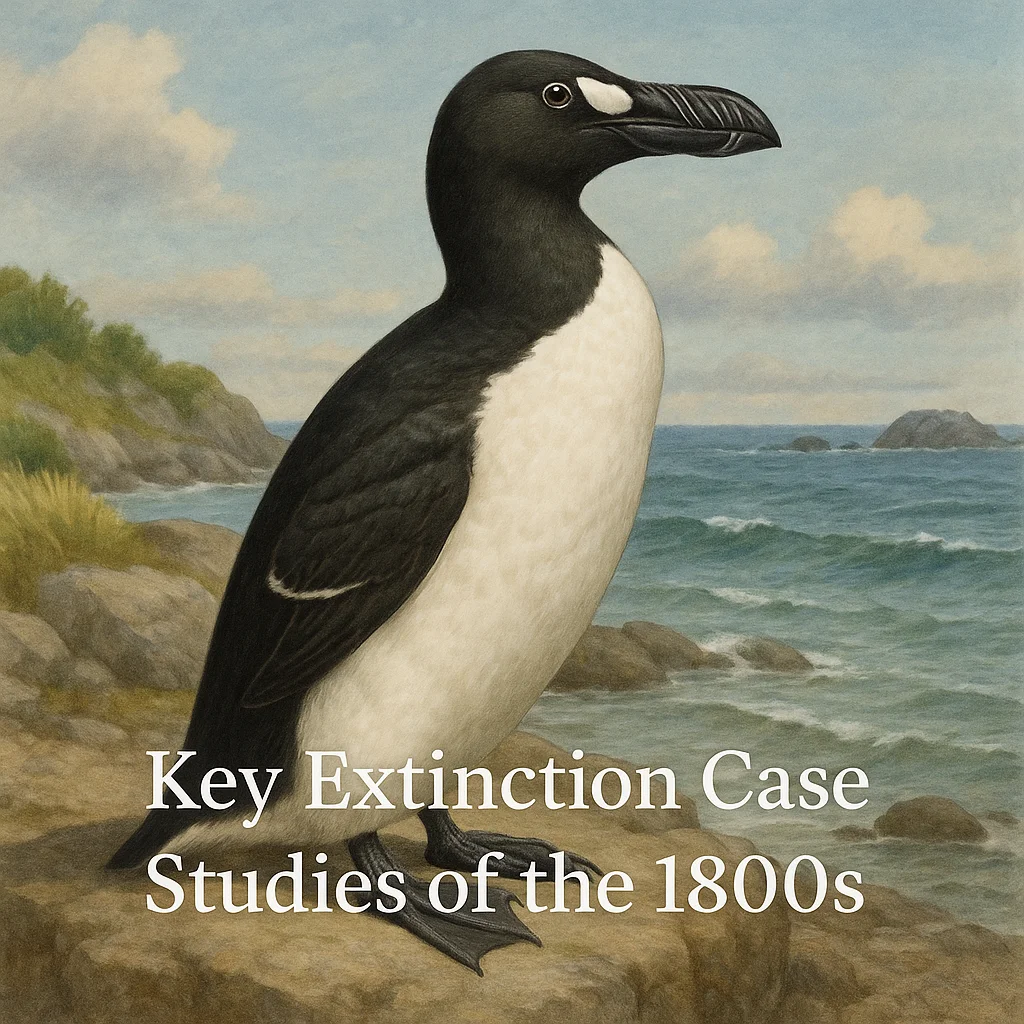
The Great Auk was related to modern-day puffins and penguins. It was distinctive for its large size and inability to fly, living a life at sea for the most part. On Rodrigues Island, the Solitaire, closely related to pigeons, was known for its unique cooing calls and its important role in seed dispersion.
This article explores where these species lived, their daily lives, and the factors leading to their extinction. It will also shed light on the evidence we have about these species today and discuss whether their extinctions could have been prevented.
🧭 Where It Lived
The Great Auk thrived in the cold waters of the North Atlantic Ocean. It was particularly abundant along the rocky, isolated shores of Iceland, Greenland, and eastern Canada. The species' habitat preference for remote islands limited their breeding grounds, making them vulnerable to human encroachment.
Rodrigues Island, part of the Mascarene Islands in the Indian Ocean, was the only home of the Solitaire. The island's dense forests and unique geographic isolation supported a diverse range of endemic species, animals found nowhere else in the world. This isolation both protected and endangered many species, as limited geographic range increases extinction risk.
Both the Great Auk and the Rodrigues Solitaire occupied habitats that were rich in resources yet highly localized. Their reliance on specific breeding sites and food sources left them susceptible to changes in their environment.
🌿 Habitat and Daily Life
The North Atlantic habitat of the Great Auk was characterized by freezing temperatures, severe winters, and rough seas. Nonetheless, this environment provided an abundance of fish, which formed the bulk of their diet. Great Auks were adept swimmers, using their wings to dive and catch prey. They mostly lived in large colonies and needed specific sites for breeding, often laying one egg per season.
In contrast, the climate of Rodrigues Island was tropical, with warm temperatures, ample rainfall, and lush forests. The Rodrigues Solitaire foraged on fruits, seeds, and small invertebrates on the forest floor. They were solitary or lived in pairs, with a simple courtship involving vocal calls and displays. Breeding involved nesting on the ground, where they laid and tended to one egg.
Both species had few natural predators due to their isolated habitats. Human arrival altered their ecological dynamics significantly, leading to over-predation and competition for resources.
🧬 What Made It Unique
The Great Auk was notable for its size, standing nearly a meter tall, with a black back, white belly, and a large hooked beak. These adaptations allowed it to thrive as a strong swimmer and proficient hunter.
The Rodrigues Solitaire was similar in stature to a large chicken, with a robust body, small head, and strong legs. Its adaptations for ground foraging made it an important agent in spreading the seeds of the island's native plants.
Both species held cultural significance to the people who encountered them. The Great Auk was often hunted for its eggs and meat, while the Solitaire was immortalized in early explorers’ records, noting its peculiar behavior and appearance.
⏳ When It Disappeared
For the Great Auk, the last confirmed record was in the mid-1800s, when the last known pair was killed on an Icelandic island. The timeline for the Rodrigues Solitaire’s disappearance is less precise but is believed to have been extinct by the late 1700s due to habitat destruction and hunting by humans.
A lack of subsequent sightings and extensive searches confirmed their extinction. Once a species has not been observed for a significant period, and all potential habitats are searched, it is declared extinct.
Determining the exact time of extinction can be difficult due to incomplete records and misidentifications, but evidence supports the timeline agreed upon by most researchers.
⚠️ Why It Went Extinct
Both species suffered from habitat loss and overexploitation. The rapid colonization by humans led to habitat fragmentation, where islands were cleared for agriculture and settlement, destroying breeding areas.
Overhunting was a critical factor for the Great Auk, which was extensively hunted for its feathers, meat, and oil. Similarly, the Solitaire fell victim to hunting. Introduced species like rats and cats further decimated their populations by preying on eggs and chicks.
Climate shifts and extreme weather events also contributed but were not primary drivers. Their extinctions illustrate how multiple factors often combine to challenge species’ survival.
🧩 How We Know (Evidence and Records)
The extinctions of these species are documented through historical records, fossil remains, and museum specimens. Early exploration logs and sailors' journals provide detailed accounts of sightings and encounters.
Physical evidence from fossils and subfossils, primarily bones, help scientists confirm the identity and morphology of these extinct species.
Museum specimens, such as preserved bodies, skins, or eggs, offer valuable insights into their physical traits and ecological roles, verifying the historical and described phenomena.
🛡️ Could It Have Been Saved
Conservation actions could have potentially preserved these species. Establishing protected areas and imposing hunting bans might have allowed populations to recover.
Efforts came too late for both species. Awareness of extinction as a consequence of human actions was minimal during their time. Once populations had dwindled, it became unfeasible to implement effective recovery plans.
Modern conservation strategies, like captive breeding and invasive species control, offer hope for current endangered species but were not available or utilized effectively in the 1800s.
🔁 Are There Any Survivors or Close Relatives Today
Relative species, like puffins in the case of the Great Auk, and surviving members of the pigeon family, hold some biological kinship to these extinct animals. These relatives continue to play similar ecological roles in different settings.
Though there are no direct descendants or populations of these two species remaining, their living relatives provide crucial insights into their biology and help inform conservation efforts for similar species today.
Ecological replacements, in a broad sense, can maintain some ecosystem functions, but the unique contributions of the Great Auk and the Solitaire were lost with their extinction.
❓ Common Questions and Misconceptions
Was it hunted to extinction? Yes, hunting was a significant factor in their extinction, especially for the Great Auk.
Why didn’t it adapt or move? Their specialized habitats and island isolation hindered adaptability and relocation.
Could it still be alive somewhere? It is unlikely, as extensive searches have been carried out without success.
What does "declared extinct" actually mean? It means there is no reasonable doubt that the last individual has died.
What is the difference between endangered and extinct? Endangered species are at significant risk of extinction, whereas extinct species no longer exist.
Why are island species so vulnerable? Island species often have limited ranges, specialized requirements, and few defenses against introduced threats.
📌 Summary
- The Great Auk and Rodrigues Solitaire were iconic species of the 1800s.
- The Great Auk lived in the North Atlantic, the Solitaire on Rodrigues Island.
- Their habitats ranged from rocky shores to tropical forests.
- Diet included fish for the Auk, and seeds and fruit for the Solitaire.
- Unique adaptations included flightlessness aiding in swimming or ground foraging.
- Last known alive in the mid to late 1800s, and late 1700s, respectively.
- Primary extinction drivers included overhunting and habitat loss.
- Evidence includes fossils, historical accounts, and museum specimens.
- Closest living relatives include puffins and pigeons.
- Their stories highlight the importance of early conservation actions.
- Notably, their loss signals the need for ongoing habitat protection.