🏞️ Hunting + Habitat Change in the 1500s
🌍 What It Was
The 1500s were a period marked by the dramatic interaction between humans and wildlife, where many species faced significant changes to their habitats and increased hunting pressures. Animals that once thrived in diverse ecosystems were forced to navigate a rapidly changing world.
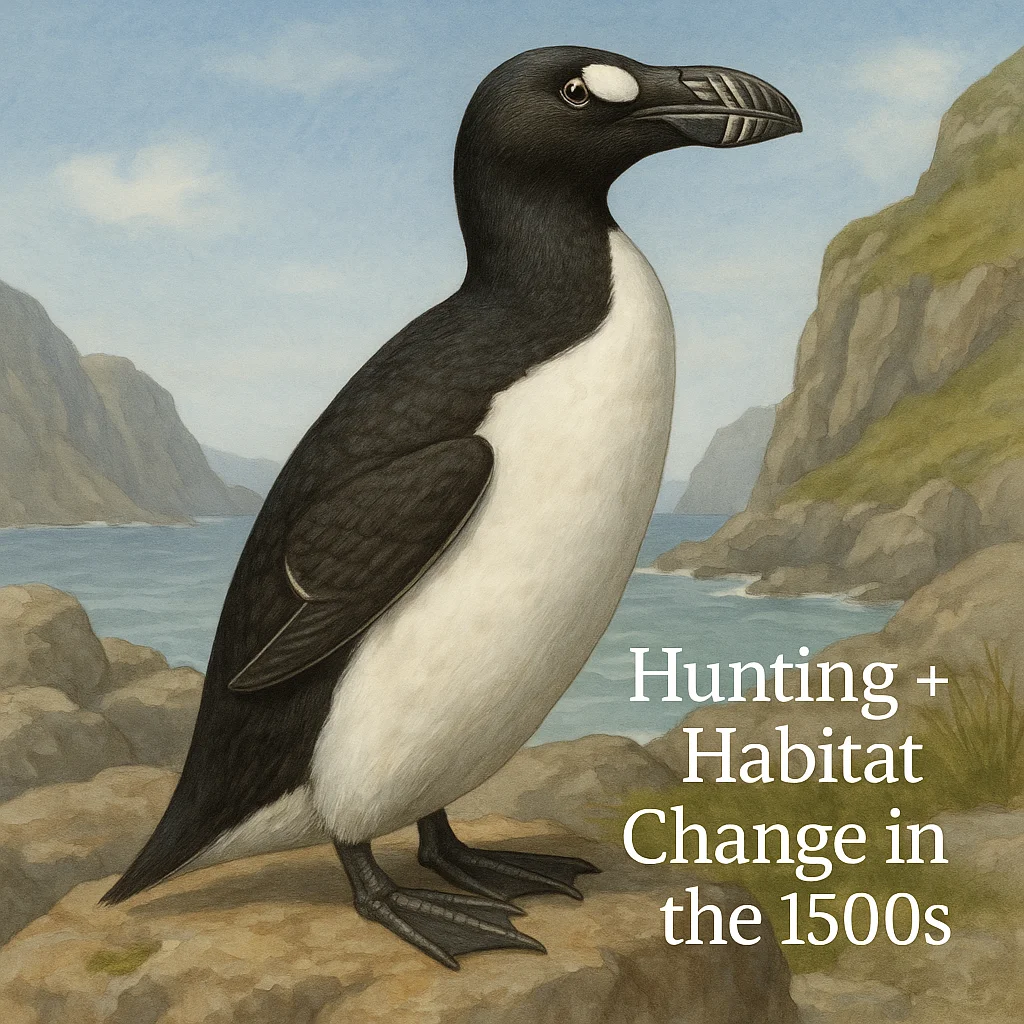
One example of such creatures was the flightless bird, known as the Great Auk. Similar in appearance to today's penguins, the Great Auk was a part of the puffin family and played a vital role in its marine ecosystem. Its closest living relatives include the Razorbill and other seabirds that continue to populate the cold northern Atlantic.
In this article, you will learn about the Great Auk's historic range, its natural lifestyle, and the factors that ultimately led to its extinction. We will explore how habitat changes and human influences in the 1500s played pivotal roles in the disappearance of such species.
🧭 Where It Lived
The Great Auk once inhabited the rocky islands and cliffs of the North Atlantic, particularly around Newfoundland, Iceland, and parts of Northern Europe. Its range extended from the icy waters of the Arctic Circle to the moderately warmer shores of the British Isles.
These seabirds relied heavily on coastal regions, which provided nesting sites and food resources. The cold ocean currents supported a wealth of fish and crustaceans, the Great Auk's primary diet. The coastal habitat was ideally suited for their breeding colonies, which thrived on isolated islands to avoid predators.
However, their limited range to island habitats came with significant risks. Isolation provided some protection, but it also made populations vulnerable to any changes in local conditions. As human exploration and colonization expanded in the 1500s, so did the risk factors for species like the Great Auk.
🌿 Habitat and Daily Life
The climate in the regions inhabited by the Great Auk was typically cold and temperate, with harsh winters and cool summers. The abundance of marine life in these chilly waters supported the Great Auk throughout its life cycle, from feeding chicks to molting adults.
The Great Auk was a formidable swimmer, using its wings to dive and hunt fish underwater. They were known for their cooperative breeding habits, nesting in dense colonies and sharing parental duties to ensure the survival of their young.
Beyond reproduction, the Great Auk's interactions with other species were minimal due to their isolated island habitats. However, they played a critical ecological role as both predator and prey, balancing their ecosystem's marine food web.
🧬 What Made It Unique
The Great Auk stood about three feet tall and possessed a distinctive black and white plumage. Its wings were small, adapted for swimming rather than flying. This physical trait set them apart, allowing them to pursue prey underwater effectively.
In cultural terms, the Great Auk was a subject of fascination for early explorers and indigenous peoples. Its eggs and skins were collected as valuable resources, contributing to its importance in trade and local traditions.
The Great Auk's role as a top predator in its ecosystem and its unique adaptations made it a significant species. Unfortunately, these characteristics also made it a target for overexploitation by humans.
⏳ When It Disappeared
The decline of the Great Auk began in the early 16th century and accelerated as human activities intensified. The last confirmed sighting of these birds occurred in the mid-19th century. Declared extinct shortly thereafter, the process of recognizing their disappearance was complicated by scarce historical records and misidentifications.
Uncertainty remains about the precise timeline of extinction, mainly due to their remote habitats and infrequent observations. Some early reports may have confused the Great Auk with similar bird species, adding to the challenges of confirming its extinction status.
While it was not a case of being "extinct in the wild," as with some other species, the abrupt end to the Great Auk's presence in the known world highlighted the vulnerability of isolated island species to human impact.
⚠️ Why It Went Extinct
The extinction of the Great Auk resulted from a combination of factors. Habitat loss and fragmentation due to human expansion displaced numerous colonies. Additionally, overhunting for feathers, eggs, and skins severely depleted populations.
The introduction of invasive species, primarily through European exploration, disrupted local ecosystems and competed with native wildlife for limited resources. These pressures combined with climate shifts to alter the fragile balance of survival.
Each of these drivers negatively impacted the Great Auk's ability to reproduce and thrive, with multiple causes overlapping to create a dire situation. This demonstrates the interconnected nature of extinction drivers and their compound effects on vulnerable species.
🧩 How We Know (Evidence and Records)
Various forms of evidence have provided insights into the Great Auk's decline. Fossils and museum specimens offer tangible proof of its existence, while explorers' field notes detail historical interactions with the species.
Oral histories from indigenous communities further enrich the understanding of the Great Auk's cultural significance and historical range. Genetic analyses have also shed light on the evolution of its surviving relatives.
Despite these records, confirming the identity and dates of sightings is often challenging due to overlapping characteristics with other seabirds and the Great Auk's nocturnal habits, which limited visual observations.
🛡️ Could It Have Been Saved
Numerous conservation actions might have helped preserve the Great Auk, such as establishing protected areas around breeding colonies or implementing hunting regulations. However, during the 1500s, conservation concepts were not yet widely understood or prioritized.
Trade and exploitation interests often superseded preservation efforts, leading to delayed responses. Even when action was considered, it proved too late for the Great Auk as population declines approached irreversible stages.
This highlights the importance of timely intervention in conservation practices and the need for proactive measures to ensure the survival of endangered species today.
🔁 Are There Any Survivors or Close Relatives Today
The closest living relatives of the Great Auk include birds like the Razorbill and other members of the Alcidae family. These species share behavioral traits and ecological roles but occupy differing niches within the marine environment.
Although no direct reintroduction programs exist for the Great Auk, human behaviors have improved to support current population health. Conservation measures focus on maintaining the integrity of shared habitats to aid living relatives.
Studying these living relatives enables insights into what the Great Auk once contributed to its ecosystem, supporting broader biodiversity within these shared regions.
❓ Common Questions and Misconceptions
Was it hunted to extinction? Yes, overhunting was a major factor in the Great Auk's extinction.
Why didn’t it adapt or move? Limited mobility and specific habitat needs prevented significant adaptation or relocation.
Could it still be alive somewhere? Unlikely, as confirmed records indicate it is extinct.
What does 'declared extinct' actually mean? It means no individuals have been confirmed alive after thorough searches.
What is the difference between endangered and extinct? "Endangered" refers to species at high risk of extinction, while "extinct" is when no living individuals remain.
Why are island species so vulnerable? Island species often have limited ranges and specialized habitats, making them sensitive to changes.
📌 Summary
- The Great Auk was a flightless seabird similar to penguins.
- It lived in the North Atlantic's rocky coastal regions.
- Their habitats included remote islands and cold ocean waters.
- The Great Auk fed on fish and crustaceans using its swimming ability.
- It had unique adaptations like small wings for swimming.
- The extinction occurred by the mid-19th century.
- Main extinction drivers included overhunting and habitat changes.
- Evidence comes from fossils, records, and oral histories.
- Closest living relatives are seabirds like the Razorbill.
- Conservation today can benefit from lessons learned from its extinction.
- The memorable takeaway is the importance of protecting habitat to prevent extinctions.